

Director of the National Museum of Korea publishes an art history book for foreigners
Published: 23 Sep. 2025, 16:29
Updated: 24 Sep. 2025, 19:39
-

- LEE JIAN
- [email protected]
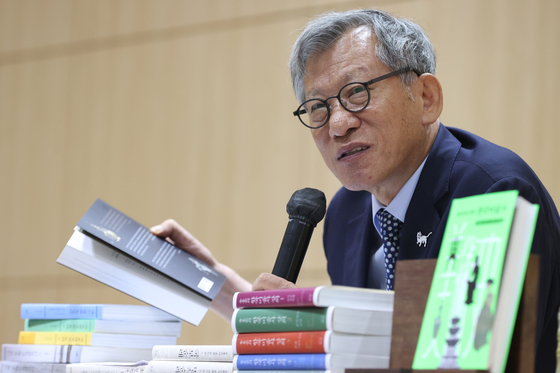
Director of the National Museum of Korea You Hong-june speaks to local reporters about his newly published books ″Korean Art History for Foreigners″ (translated) and ″Korean Art History for Everyone″ (translated) at Changbi Publishers office in Mapo District, western Seoul, on Sept. 23.
Director of the National Museum of Korea You Hong-june released two books on Monday on Korean art history, including one written specifically for foreign readers.
"Korean Art History for Foreigners" and "Korean Art History for Everyone," published by Nulhwa, represent You’s latest bid to make the country’s artistic legacy accessible to a broader audience.
“I wanted to write a story of Korean art, not just an academic historical account,” You told reporters on Tuesday during a press conference in Mapo District, western Seoul. “My goal was for readers to enjoy it from the comfort of their sofas, not hunched over desks with pens in hand.”
Both books are currently available only in Korean. Translation plans are underway, although no concrete publishing deals have been finalized yet.
Born in Seoul in 1949, You has a bachelor’s degree in aesthetics from Seoul National University, a master’s degree in art history from Hongik University and a doctorate in Eastern philosophy from Sungkyunkwan University. He debuted as an art critic through the Dong-A Ilbo’s New Year Literary Contest in 1981, and subsequently served as a professor at Yeungnam University and Myongji University, and administrator of the Cultural Heritage Service. Earlier this year, You was appointed director of the National Museum of Korea, the most visited museum in Asia.
You’s new titles come at a timely moment as global interest in Korean traditional culture and history surges. Last month, animated film "KPop Demon Hunters" became the most-watched movie ever on Netflix, sparking unprecedented attention to not only Korea's modern culture but also its cultural heritage.
The National Museum of Korea has felt this impact. From January to August, it welcomed 4,073,006 visitors – nearly double the figure from the same period last year. Sales of the museum’s cultural merchandise also hit a record 11.5 billion won ($8.3 million), which the museum largely attributes to the film's popularity.
![″Korean Art History for Everyone,″ left, and ″Korean Art History for Foreigners" [LEE JIAN]](https://koreaseafood.online/data/photo/2025/09/24/eda616ac-33c7-4f04-846e-e3684cce98eb.jpg)
″Korean Art History for Everyone,″ left, and ″Korean Art History for Foreigners" [LEE JIAN]
Despite the hype, Korea has long lacked encyclopedic examinations of its art history, especially compared to its neighbors China and Japan, in part because the discipline developed relatively late. You sees his new works as filling that gap. "They were books that the times were asking for, and I felt it a duty to try my best to write a comprehensive overview of Korean art history at this particular social moment."
He chose to write a separate volume for foreign readers, believing that a book for Koreans and one for foreigners should differ in structure and approach while still relaying the same content.
The key distinction lies in organization. "Korean Art History for Everyone" follows a chronological narrative, and "Korean Art History for Foreigners" is arranged by genre, with chapters on prehistoric art, tomb art, crafts, Buddhist art, ceramics and painting.
The foreigners' edition also frequently compares Korean art with that of China and Japan. “Overseas readers are likely more familiar with the art histories of China and Japan, so I emphasized both the universality and the distinctiveness of East Asian cultures,” You said.
Though the title includes the word “foreigners,” You said the book is not solely for them. “Many Koreans actually find Korean art even more unfamiliar than Western art. This book can serve as both an introduction and a work of cultural literacy for them as well.”
The first chapter presents prehistoric artifacts, like the Goguryeo (37 B.C. to A.D. 668) tomb murals, golden relics of the Silla Dynasty (57 B.C. to 935 A.D.), treasures from the Baekje Kingdom's (18 B.C. to 660 A.D.) royal tomb and exquisite masterpieces of lacquer and mother-of-pearl inlay.
The Buddhist art section contains Buddhist sculptures, granite pagodas, stone lanterns and stupas, monastic architecture adapted to Korea’s natural landscape, delicate Buddhist paintings of the Goryeo Dynasty (918-1392) and the narrative Buddhist paintings of the Joseon Dynasty (1392-1910) that have recently drawn new attention.
The ceramics section introduces Goryeo celadon, inlaid celadon with its intricate patterns and buncheong (a traditional Korean pottery style featuring white slip-coated stoneware).
Joseon Dynasty paintings are described in-depth as well, divided into themes such as landscape painting, genre painting and bird-and-flower painting.
Separate chapters are devoted to crafts, folk art and embroidery, which have rarely been addressed in detail in previous art histories.
“With the global success of Korean drama, film, and music, people around the world are paying increasing attention to the traditional culture at the roots of Korea. 'Art History for Foreigners' responds to that demand. It shows that Korea holds a rightful share as a cultural powerhouse,” said You.
BY LEE JIAN [[email protected]]


with the Korea JoongAng Daily
To write comments, please log in to one of the accounts.
Standards Board Policy (0/250자)