

Lee, Trump to discuss alliance modernization during summit: National Security Adviser Wi
Published: 22 Aug. 2025, 19:39
-
- SARAH KIM
- [email protected]
![National Security Adviser Wi Sung-lac speaks at a press conference held at the Yongsan presidential office in central Seoul on Aug. 22 on the eve of President Lee Jae Myung’s six-day trip to Japan and the United States. [NEWS1]](https://koreaseafood.online/data/photo/2025/08/22/3383b5a0-e0d4-4705-aa9e-573162ef705b.jpg)
National Security Adviser Wi Sung-lac speaks at a press conference held at the Yongsan presidential office in central Seoul on Aug. 22 on the eve of President Lee Jae Myung’s six-day trip to Japan and the United States. [NEWS1]
National Security Adviser Wi Sung-lac highlighted Friday that the modernization of the Korea-U.S. alliance will be on the agenda in President Lee Jae Myung and U.S. President Donald Trump upcoming summit in Washington, a critical moment to set the direction of future security and economic cooperation between the two countries.
"We need to modernize our alliance to serve our national interests in a situation where instability is growing in the region due to North Korea's nuclear and missile threats and the war in Ukraine," Wi said in a press conference at the Yongsan presidential office on the eve of Lee's departure for a two-country tour that will take him to Japan before he heads to the United States.
"While increasing cooperation between South Korea and the United States, we will reach an agreement to ensure that the overall outcome does not undermine South Korea's security or hinder our combined force posture," Wi said, underscoring that the alliance modernization is "one of the goals" for the first summit between Lee and Trump on Monday at the White House.
Such modernization encompasses a range of issues, including the strategic flexibility of the U.S. Forces Korea (USFK), as pushed by Washington, and increased defense spending.
"Our defense budget could indeed increase," Wi told reporters, saying the matter is currently under discussion with the United States but that "it's too early to specify" the exact amount. The Trump administration previously requested NATO allies to increase defense spending to 5 percent of their GDP by 2035, and Seoul is also looking to such a precedent.
Wi said that the issue of the transfer of wartime operational control, or Opcon, to Korea, is unlikely to be addressed at the summit because it is not an "urgent" matter at the moment, though it will continue to be pursued.
He further highlighted that while Seoul and Washington made some progress regarding trade and economic stability through their trade deal in late July, the summit will be an occasion to solidify the agreement at the top level, as well as to open up new areas of cooperation.
"In a situation where there are many challenges to the alliance, South Korea and the United States need to pioneer new areas of cooperation," Wi said, including in cooperation in areas such as nuclear energy, shipbuilding, artificial intelligence (AI), semiconductors, defense and research and development.
Through their trade deal, Seoul and Washington agreed to set tariffs on Korean exports to the United States at 15 percent, lower than the expected 25 percent. Korea, in turn, promised to invest $350 billion in the United States, which includes a $150 billion shipbuilding cooperation initiative dubbed the "Make American Shipbuilding Great Again" (MASGA) project.
Wi likewise said that the revision of a civil nuclear energy agreement with the United States to ease restrictions on enriching or reprocessing spent nuclear fuel could also be on the agenda.
While negotiations on bilateral trade and security matters can happen through separate channels, Wi said that the Korean government ultimately views agreements as a comprehensive single package.
Regarding North Korea, Wi reiterated that South Korea doesn't "condone North Korea's nuclear weapons," but also noted that an easing of sanctions could be discussed in the process of a phased denuclearization of Pyongyang.
President Lee revealed earlier this week a three-stage road map for a phased denuclearization of the Korean Peninsula, comprising a freeze, reduction and dismantlement of North Korea's nuclear and missile weapons program.
"Sanctions relief can naturally be discussed in the process of reducing North Korea's nuclear arsenal," Wi said.
"The United States has not changed its ultimate goal of denuclearization, and there is a consensus on our approaches," Wi said. "After a freeze, then complete denuclearization can be achieved."
He noted that Seoul is not currently in a position to facilitate dialogue between Trump and North Korean leader Kim Jong-un, reminiscent of the 2018 denuclearization negotiations, when asked if the South could play some role in advancing North-U.S. talks.
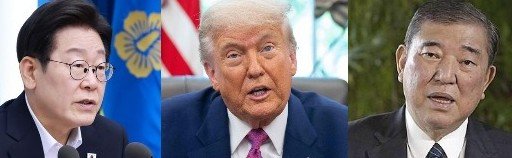
From left: Korean President Lee Jae Myung, U.S. President Donald Trump and Japanese Prime Minister Shigeru Ishiba
Wi, in turn, downplayed reports that Foreign Minister Cho Hyun abruptly departed for Washington on Thursday because of hiccups in agreements ahead of the summit.
Cho headed straight to the United States on a connecting flight instead of accompanying Lee to his summit in Japan, fueling speculation that there were issues in the negotiation process between the two countries, such as U.S. demands for Korea to open up its agricultural and livestock markets.
Wi assured that the trade deal announced at the end of July didn't include opening Korea's agricultural and livestock markets, though Washington has consistently made such demands.
On Lee heading to Tokyo before Washington, Wi said that "the new trade order initiated by the United States has created a need for more strategic communication between South Korea and Japan." He said the two sides will discuss progress in practical cooperation in each field to resolve common economic and social challenges facing both countries.
Likewise, he highlighted that trilateral cooperation between South Korea, Japan and the United States is "a central axis of our diplomacy," calling for the development of Korea-Japan cooperation to create favorable conditions for flexible and forward-looking discussions on historical issues.
![National Security Adviser Wi Sung-lac, right, takes questions from Korean journalists and foreign correspondents at a press conference held at the Yongsan presidential office in central Seoul on Aug. 22 on Pesident Lee Jae Myung’s upcoming summits in Japan and the United States. [YONHAP]](https://koreaseafood.online/data/photo/2025/08/22/ea3dbc7a-e171-416a-97dd-2ba21d5eceb7.jpg)
National Security Adviser Wi Sung-lac, right, takes questions from Korean journalists and foreign correspondents at a press conference held at the Yongsan presidential office in central Seoul on Aug. 22 on Pesident Lee Jae Myung’s upcoming summits in Japan and the United States. [YONHAP]
Lee departs for a six-day trip Saturday morning for a bilateral summit, joint press briefing and dinner with Japanese Prime Minister Shigeru Ishiba in Tokyo. He will also meet with Korean residents living in Japan.
On Sunday, Lee heads to the United States, where he will meet with the Korean diaspora in Washington.
On Monday, Lee will attend a welcome ceremony and hold his first bilateral summit with Trump at the White House, followed by a luncheon meeting. He will also attend a Korea-U.S. business roundtable and deliver a policy speech at the Center for Strategic and International Studies think tank. He will later attend a dinner meeting with opinion leaders from both countries to hear their views on advancing the alliance.
On Tuesday, Lee will visit Arlington National Cemetery in Virginia and then travel to Philadelphia, Pennsylvania, where he is expected to visit Hanwha Philly Shipyard, owned by Korean shipbuilder Hanwha Ocean.
Lee is expected to return to Seoul early Thursday.
The president will also send a special envoy to China to coincide with his visits to Japan and the United States.
The presidential office announced on Friday that former National Assembly Speaker Park Byeong-seug will be dispatched as a special envoy to Beijing to discuss ways to improve bilateral relations.
Park will lead a delegation comprised ruling Democratic Party (DP) Reps. Kim Tae-nyeon and Park Jeung, as well as Roh Jae-hun, son of former President Roh Tae-woo, presidential spokesperson Kang Yu-jung said in a briefing.
They will begin a four-day visit Sunday to deliver a personal letter from the president and meet with Chinese officials to convey the Korean government's commitment to promoting "the mature development of the strategic cooperative partnership with China." They will also seek to expand cooperation in such areas as the economy, culture and people-to-people exchanges.
The delegation is expected to deliver the president's message "regarding the future direction of Korea-China relations and ways to promote mutual goodwill," Kang said.
The delegation is scheduled to have a luncheon with Chinese Foreign Minister Wang Yi on Monday and a meeting with China's top legislator Zhao Leji, chairman of the National People's Congress, on Tuesday. They are not expected to meet with Chinese President Xi Jinping due to a scheduling conflict, according to Kang.
BY SARAH KIM [[email protected]]


with the Korea JoongAng Daily
To write comments, please log in to one of the accounts.
Standards Board Policy (0/250자)