

Let the spirit not be distorted by artificial intelligence
Published: 20 Aug. 2025, 00:07
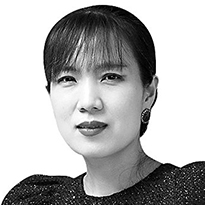
Lee Eun-hye
The author is the CEO of the publishing house Geulhangari.
In the searing heat of midsummer, I ran for 40 minutes each morning. It was a way of shaking off the sense of uselessness and the weight of the day’s impending lethargy. Yet, like the heavy humidity before rain, the rise of artificial intelligence (AI) presses down with the reminder that human worth is shrinking, even as anxiety grows.
For months, my daily work has involved reviewing Chinese, English, and French books through translation software. Our publishing house relies heavily on foreign titles, and in the past, such reviews were assigned to translators — a process that took weeks before opinions and sample translations were returned. The waiting stirred not impatience, but expectation. Tempo, after all, is what gives life its dramatic rhythm. Pulling and releasing time allows us to carry the present into the past with little regret, to welcome the future as if it were yesterday, through the tacit knowledge we accumulate along the way. After World War II, Europeans, seated amid the ruins, called 1945 “Year Zero,” summoning the will to rebuild — a will rooted in the bodily memory of laying bricks and mixing cement. Such a sense of time feels elusive today, when AI daily reminds us of betrayal by accumulation itself.
![[JOONGANG ILBO]](https://koreaseafood.online/data/photo/2025/08/20/db4fd320-6c05-4a10-a651-8f717cb7a141.jpg)
[JOONGANG ILBO]
What AI has introduced into publishing, more than anything, is contempt for foundations. First, translation once demanded years of apprenticeship; editors invested time in guiding novices, hoping their craft would mature. Now the will to invest in such growth falters. Second, training a new editor required at least three years of careful mentoring in proofreading and style — now that process feels inefficient. Third, writing rests on structure and voice. But if machines intrude into that process, how far can one go in respecting the author? Once, writing was seen as the sum of a life. That view is harder to sustain.
What gave humans confidence, above all, was time. Accumulation and chronology were powerful weapons, allowing ordinary people to feel a sense of overwhelming victory. But completing a foreign book review in a single day with machine translation, and repeating that routine, has dulled my regard for the word “discipline.” An editor who makes publishing decisions on the basis of what a machine has produced can see herself only as a manager.
![Bibliophiles wait to enter this year's Seoul International Book Fair at Coex in Gangnam District, southern Seoul, on Wednesday. [SEOUL INTERNATIONAL BOOK FAIR]](https://koreaseafood.online/data/photo/2025/08/20/dd7ecb21-2be4-4433-8098-e3fa60932819.jpg)
Bibliophiles wait to enter this year's Seoul International Book Fair at Coex in Gangnam District, southern Seoul, on Wednesday. [SEOUL INTERNATIONAL BOOK FAIR]
And managers are, in their bones, calculators. For them, the future is a world of cost reductions — and in such a world, I, too, could become a target. To resist fatalistic predictions, one must look backward as well as forward. Only then can present instability be placed in context. That, perhaps, is why Eric Schmidt and others, when writing of AI in the new digital age, repeatedly turned back to the beginnings of civilization to contextualize anxiety and coax adaptation. Yet, there is a great gulf between achieving something and merely adapting to it. In Robert Walser’s Tobold, those who do nothing but wait for the future to come to them are guilty of grave negligence. Many today face the future in precisely that way.
But the very idea of “facing the future” feels outdated. The future is no longer something we approach; it races toward us. Many professionals still insist they do creative work, but in reality — as in my case, overseeing the full process of bookmaking — the role often feels more like that of a servant, required to give meticulous attention at every step. AI is fast and silent. The editor is slow and noisy. Once, I believed manuscripts contained a spirit that shielded me from the prevailing system. Now, with machines woven into every process, my work no longer feels like a source of protection.
Even so, I continue to read Benjamin, Martin Walser and Gustave Flaubert. Much of the literature of the past remains, in fact, literature of the future. Walser’s prose, for instance, carries shyness — the shyness of believing “I” and “my writing” have no substance. He poured himself entirely into writing and then died, having lived an exemplary life. His novels contain almost no content, yet their luminous form survives. One of humanity’s tasks, then, must be to ensure that “the spirit is not distorted into mere intelligence.” Martin Heidegger, in the 1930s, worried that the rise of the United States and Russia was transforming the human spirit into nothing more than the intellect required for observation, calculation and analysis. He insisted on the distinction between spirit and intelligence. Writers, too, have long emphasized that writing is ultimately the work of self-cultivation.
Authors, translators and editors alike may now be prepared to entrust parts of their craft to AI. But where each individual draws the line — what parts of the spirit cannot be ceded, what work can still be claimed as uniquely one’s own — will differ from person to person.
This article was originally written in Korean and translated by a bilingual reporter with the help of generative AI tools. It was then edited by a native English-speaking editor. All AI-assisted translations are reviewed and refined by our newsroom.


with the Korea JoongAng Daily
To write comments, please log in to one of the accounts.
Standards Board Policy (0/250자)