

Tax reform plan triggers dilemma between market momentum and fiscal expansion
Published: 05 Aug. 2025, 18:19
Updated: 05 Aug. 2025, 20:06
-
- JIN MIN-JI
- [email protected]
![First Vice Minister of Economy and Finance Lee Hyoung-il, center, delivers a detailed briefing on the 2025 tax reform plan on July 29. [YONHAP]](https://koreaseafood.online/data/photo/2025/08/05/913c1e01-f728-4d48-94d6-e3ea1b7dce31.jpg)
First Vice Minister of Economy and Finance Lee Hyoung-il, center, delivers a detailed briefing on the 2025 tax reform plan on July 29. [YONHAP]
[NEWS ANALYSIS]
What began as a honeymoon rally, driven by President Lee Jae Myung’s inauguration and his bold vow to lift the Kospi to past the 5,000 mark, ended sharply last week after a proposed tax change shifted market forecasts from major investment houses.
The turn of events underscores Lee’s central dilemma: rejuvenating the long-struggling Kospi while generating necessary tax revenue to boost the sluggish economy.
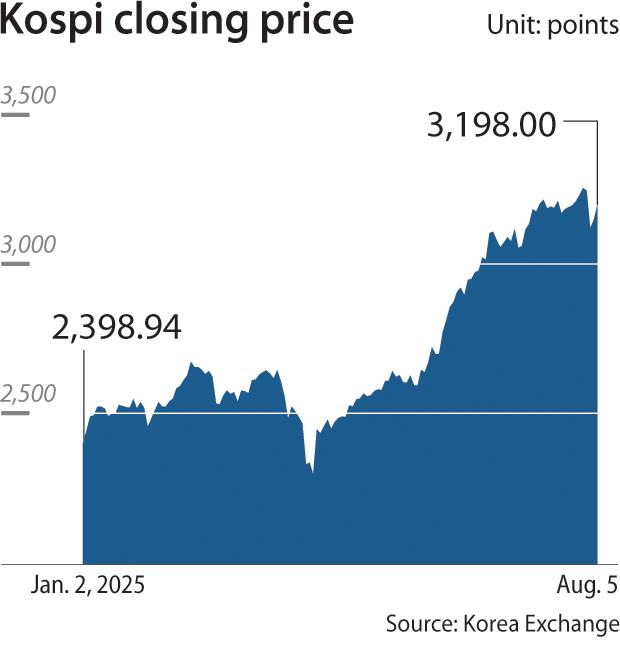
Investor banks are sounding alarms over Korea’s market following last week’s proposed tax reform that includes raising taxes on investors and companies, marking a sharp reversal from the earlier optimism that propelled the Kospi more than 30 percent this year.
Return to fluctuations
ㅇㅇ
Citigroup and Hong Kong-based brokerage CLSA have warned that the proposed tax increase could dampen investor sentiment.
Citi’s cross-asset team downgraded Asia emerging market stocks to neutral from overweight due to Korea’s tax revision, Bloomberg reported.
“While in general we think that tax changes do not impact markets for very long, we do think these measures are 180 degrees opposed to the sentiment of the ‘Korea Up’ program, which was meant to boost valuation,” according to a note by Citigroup strategists including Dirk Willer.
CLSA released a report on Friday titled “Yikes, tax hikes,” warning that there were “only sticks, no carrots” in the latest proposal, according to the Korea Economic Daily.
Korea’s Kospi is fluctuating on news of a proposed capital gains tax revision on stock holdings that widens the pool of investors subject to the levy, which has drawn sharp criticism at home and abroad from investors arguing that it undercuts the Lee Jae Myung administration’s push to dramatically lift the benchmark index.
The Kospi closed up 1.6 percent on Tuesday, a sharp turnaround from a 3.9 percent plunge last Friday after the Ministry of Economy and Finance announced a tax reform scheme that rolls back tax cuts. Friday's drop was the largest since Lee took office on June 4 . The scheme is aimed at boosting economic growth as the new administration seeks an expansionary fiscal policy amid dropping tax revenue.
Half-baked reform
Part of the reform called for lowering the capital gains tax threshold on stock holdings from 5 billion won ($3.6 million) to 1 billion won, which has drawn more than 135,000 signatures on a petition on the National Assembly’s website urging the government to withdraw the plan in fear of a massive year-end selling spree. Once a petition reaches 50,000 signatures, it is forwarded for review by the relevant committee.
As the debate heated up, Rep. Jung Chung-rae, the newly appointed leader of the Democratic Party, on Monday instructed staff to draft two alternatives regarding the major shareholder capital gains tax threshold.
There were roughly 23,600 “large” stockholders that held more than 1 billion won worth of a stock as of the end of 2023, according to a report from Yonhap News TV.
“The latest tax reform scheme is like cutting off the leaves of a sprout that’s just begun to grow" amid a weak dollar, said Lee Kyung-soo, senior researcher at Hana Securities, referring to Korea’s equity market.
The Kospi has been one of the strongest performers this year, with the index jumping 37 percent at its peak in late July from the beginning of the year.
“The government should first implement policies that help grow the stock market, and then consider raising taxes on stock gains,” the researcher added.
“The tax reform is fundamentally at odds with the Lee Jae Myung administration’s ‘Kospi 5000’ goal, fueling investor anxiety,” said Professor Won Jai-hwan, who teaches business at Sogang University.
“While not many retail investors will be subject to the capital gains tax on stock holdings, their greater concern lies in a potential market downturn triggered by the year-end selling spree to avoid the capital gains tax.”
![President Lee Jae Myung meets employees of the Korea Exchange at its office in Yeouido, western Seoul, on June 11. The picture is from Lee's Instagram account. [SCREEN CAPTURE]](https://koreaseafood.online/data/photo/2025/08/05/1dcfcdd0-f6e2-4fac-ade1-f3c2cd03b620.jpg)
President Lee Jae Myung meets employees of the Korea Exchange at its office in Yeouido, western Seoul, on June 11. The picture is from Lee's Instagram account. [SCREEN CAPTURE]
In desperate need of revenue amid drought
The government expects to raise 200 billion won in tax revenue from lowering the capital gains tax threshold, while it expects to collect 2.3 trillion won from upping the securities transaction tax from 0.15 percent to 0.2 percent, according to the Finance Ministry.
The gain is essential as the government’s tax revenue dropped for a second consecutive year last year, falling 7.5 trillion won to 336.5 trillion won, after plunging 51.9 trillion won in 2023.
Some say a bigger obstacle interrupting the index growth lies in the dividend income tax.
Separately taxing dividend income from other financial income — intended to motivate companies to pay higher dividends to resolve the so-called Korea discount — also failed to meet market expectations as eligibility is “stringent,” according to Kim Jong-young, an analyst at NH Investment & Securities, in a report on Monday.
“The market had expected full separate taxation on dividend income exceeding 300 million won from listed companies with a dividend payout ratio of 35 percent or higher,” Kim said.
But under the revised scheme, only companies that have not reduced their cash dividends compared to the previous year and meet one of the following conditions are eligible: a dividend payout ratio of 40 percent or higher or a dividend payout ratio of at least 25 percent, with dividends having increased by more than 5 percent compared to the company’s average over the past three years.
The Finance Ministry expects there will be roughly 350 publicly traded companies eligible for the full separate taxation on dividend income, which is around 13 percent of all listed companies as of late last year.
The government plans to submit the proposals to the National Assembly, which is controlled by the parliament-controlling Democratic Party (DP), by Sept. 3.
The presidential office on Tuesday denied that it asked the DP to reconsider the capital gains tax criteria after a News1 report claimed such a request was made.
“It is not easy to reconsider a policy based solely on day-to-day market fluctuations,” said the office spokesperson Kang Yu-jung.
BY JIN MIN-JI [[email protected]]


with the Korea JoongAng Daily
To write comments, please log in to one of the accounts.
Standards Board Policy (0/250자)