

These accessible musicals are for blind people, deaf people — and also everyone
-
- LEE JIAN
- [email protected]
![A scene from the play ″Gyeon Gothic Girl″ featuring captions for deaf audience members [KIM SOL/THEATER BOXROOM]](https://koreaseafood.online/data/photo/2025/07/30/6a0d347a-4ee0-42fa-a273-d04a1abccc77.jpg)
A scene from the play ″Gyeon Gothic Girl″ featuring captions for deaf audience members [KIM SOL/THEATER BOXROOM]
As the curtain rose on Saturday’s matinee of the National Theater Company of Korea’s new Buddhism-themed metadrama play “Sammaekyung,” audio describer Seo Soo-yeon, positioned beneath the stage of the Myeongdong Theater, began painting the first scene through her microphone.
“Actors are embodying nature. Some raise their arms and sway like trees in the wind, others lie on their sides, miming a flowing river. They make the sounds of the nature they portray,” she softly said to the handful of audience members, clutching an audio device and wearing a discreet earpiece. Their eyes lit up with interest as her crisp details began filling them in on the action on stage.
![Audio describers narrate a show for deaf audience members [NATIONAL THEATER COMPANY OF KOREA]](https://koreaseafood.online/data/photo/2025/07/30/021b23aa-a8d2-4736-bc47-18ed4254f993.jpg)
Audio describers narrate a show for deaf audience members [NATIONAL THEATER COMPANY OF KOREA]
Two screens on the sides of the stage displayed stylized captions that visualized sounds such as wind and birdsong, in playful, expressive fonts. Sign language interpreters also translated the performance live in a corner below the screen.
The captions and descriptions of costume styles and facial expressions made for a vivid and immersive performance — even for those seated in the back, regardless of whether they were disabled or not.
![A promotional image for the National Theater Comapany of Korea's new play "Sammaekyung" [NTCK]](https://koreaseafood.online/data/photo/2025/07/30/3e03e849-2af4-4d28-8fc5-97b04f8a6787.jpg)
A promotional image for the National Theater Comapany of Korea's new play "Sammaekyung" [NTCK]
Not all performances of “Sammaekyung,” which opened July 17 and are set to run through Aug. 3, have these features, but Saturday’s show was a designated “access show,” aimed at making live shows more inclusive for deaf and blind audience members.
The National Theater Company of Korea (NTCK), spearheading the country’s accessible live theater movement, also provided a haptic tour of the stage, through a miniature model set up in the lobby, for blind patrons and advanced script readings for deaf attendees during Saturday’s matinee.
![A sign language interpreter and an LED screen featuring the sounds of the noises being made on stage with diffferently stylized fonts are present during an accessible performance of the "Sammaekyung" at the Myeongdong Theater in Jung District, central Seoul, on Saturday. [LEE JIAN]](https://koreaseafood.online/data/photo/2025/07/30/f9aecf05-02e3-41d7-8975-d48952a79f53.jpg)
A sign language interpreter and an LED screen featuring the sounds of the noises being made on stage with diffferently stylized fonts are present during an accessible performance of the "Sammaekyung" at the Myeongdong Theater in Jung District, central Seoul, on Saturday. [LEE JIAN]
Live productions in Korea have only recently begun to include accessibility-specific performances in their runs. The Covid-19 pandemic served as a significant catalyst for theaters seeking new ways to engage audiences who were unable to attend in person. Institutional changes, such as the 2020 Disability Discrimination Act and the establishment of Korea's first specialized access performance venue, the Modu Art Theater, in 2023, have also bolstered accessibility efforts in the performing arts.
The change is particularly notable for a country whose live theater culture is traditionally strict about not disturbing others, so much so that local theatrical audiences are satirically described as “corpses.”
![Blind patrons are allowed to touch a model of the set of "Sammaekyung" in the lobby of the Myeongdong Theater in Jung District, central Seoul, on Saturday. [LEE JIAN]](https://koreaseafood.online/data/photo/2025/07/30/c68db0f5-7ed7-460a-9e23-d4d0388cd290.jpg)
Blind patrons are allowed to touch a model of the set of "Sammaekyung" in the lobby of the Myeongdong Theater in Jung District, central Seoul, on Saturday. [LEE JIAN]
The modern theater scene, however, is trying harder to cater to demographics who have been underserved in the past, including disabled audience members, older adults and non-Korean speakers.
“Accessibility isn’t limited to people with disabilities,” Lee said. “That broader perspective can be a meaningful and worthwhile pursuit, and more people in the local live theater field are coming to reckon with that.”
![Accessibility features for the National Theater Company of Korea's "Twelfth Night" which was staged with features tailored to neurodivergent attendees. The above chart lists such services, including free entry and exists during the show, earlier entry to the theaterr, adjusted light ing so that the theater never goes completely dark and the allowance of comfort objects. [SCREEN CAPTURE]](https://koreaseafood.online/data/photo/2025/07/30/20656a5d-0a99-41e0-8e82-4676b9295643.jpg)
Accessibility features for the National Theater Company of Korea's "Twelfth Night" which was staged with features tailored to neurodivergent attendees. The above chart lists such services, including free entry and exists during the show, earlier entry to the theaterr, adjusted light ing so that the theater never goes completely dark and the allowance of comfort objects. [SCREEN CAPTURE]
Accessibility brings creativity
![A scene from the play ″Gyeon Gothic Girl″ featuring stylized captions for the deaf or the hard of hearing [KIM SOL/THEATER BOXROOM]](https://koreaseafood.online/data/photo/2025/07/30/b075296d-2135-4033-a015-fe3677069f1f.jpg)
A scene from the play ″Gyeon Gothic Girl″ featuring stylized captions for the deaf or the hard of hearing [KIM SOL/THEATER BOXROOM]
“Gyeon Gothic Girl” — Gyeon Gothic refers to a specific typeface in Korean fonts, identified by its bold and square style — was last staged in Seoul in April. It centers on a teenager whose twin sister pushes her classmate onto subway tracks and then dies by suicide, exploring the emotional aftermath of the violent crime.
The entire 16-day run of the play featured open captions for deaf and hard of hearing people, audio narration for blind attendees and adjusted lighting and sound design for neurodivergent individuals. Premiering in 2023, “Gyeon Gothic Girl” became the first show in Korea to experiment with open captions as an expressive visual element. Much of the dialogue is poetic and rhythmic, which naturally lent itself to musical interpretation.
“We had this idea,” Lee said. “What if we translated that musicality into visual form, through the captions themselves?”
The team began adjusting typographic elements to match shifts in mood and rhythm, turning captions into a dynamic tool for storytelling.
“It was designed to offer the deaf a more emotionally expressive experience,” Lee said, “but it resonated with all audiences. We’re already used to stylized captions on Korean TV that influence how we read a moment.”
What began as an accessibility feature soon became central to the show’s aesthetic. “It wasn’t just functional: it became a storytelling device in its own right,” Lee said.
In some NTCK performances, sign language interpreters take to the stage alongside actors to perform “shadow sign language interpreting.”
Its ongoing rendition of “Twelfth Night,” a Shakespearean comedy reimagined in the Joseon Dynasty (1392-1910), includes performances where sign language interpreters are not merely translators off to the side, but appear onstage as part of the cast, sometimes as a servant to a royal character, other times as a member of the chorus performing synchronized choreography. Occasionally, the actors and interpreters switch roles, with actors briefly taking over the signing.
For "Gyeon Gothic Gir"'s director, Shin Jae-hoon, staging accessible art was a “constant process of stimulation and renewal” and a “meaningful source of creativity.”
“When the world I thought I knew — what I considered to be 'normal’ — starts to crack, that’s when new values and perspectives emerge for me,” he said. “I used to see barrier-free programs as a kind of service or volunteering. But once I actually experienced it, I realized I wasn’t giving something; rather, I found myself confronting assumptions I had normalized.”
Now, Shin said, “I see accessibility not as a separate add-on concern, but as an essential element.”
![The National Theater Company of Korea performs Shakespearean play ″Twelfth Night″ with sign language interpreters at the Myeongdong Theater, which ran through July 6. [NATIONAL THEATER COMPANY OF KOREA]](https://koreaseafood.online/data/photo/2025/07/30/544f8493-2513-4f90-8bf6-72a2bdc5f802.jpg)
The National Theater Company of Korea performs Shakespearean play ″Twelfth Night″ with sign language interpreters at the Myeongdong Theater, which ran through July 6. [NATIONAL THEATER COMPANY OF KOREA]
Are they actually helpful?
![A deaf audience member borrows smart glasses that display closed captions at the Myeongdong Theater in Jung District, central Seoul. [NATIONAL THEATER COMPANY OF KOREA]](https://koreaseafood.online/data/photo/2025/07/30/5c283df9-dd77-48f3-80ff-003f4b12bc42.jpg)
A deaf audience member borrows smart glasses that display closed captions at the Myeongdong Theater in Jung District, central Seoul. [NATIONAL THEATER COMPANY OF KOREA]
Theatergoers Seo Hae-woong, 40, and Jeong Jae-hwan, 34, both blind, attended Saturday's performance “Sammaekyung” that featured live audio description and were largely satisfied with the experience. They also received assistance with walking from the nearby subway station to the Myeongdong Theater from NTCK’s access managers.
At first, Seo Hae-woong wasn’t sure if he could enjoy a live theater show as a blind person. But he was pleasantly surprised .
“I used to love movies and plays as a kid,” said Seo Hae-woong, who lost his sight later in his life. “I had just assumed I’d never be able to enjoy them again. Then I happened to learn about accessible live theater shows and decided to give it a try.
“The effort the staff put in made the experience feel welcoming and meaningful,” Seo Hae-woong added. “Just knowing these services exist puts me at ease.”
Jeong acknowledged that it was occasionally difficult to follow the plot with just the audio description. “Because the story jumped between past and present,” Jeong said, “it was a little hard to understand even with the audio description.
“But it still helped a lot,” Jeong said. “When everyday life gets monotonous or difficult, being able to enjoy a play like this — just for a little while — feels incredibly healing.”
![A digital copy of "Sammaekyung" is availiable for theatergoers to view before the show in the lobby of Myeongdong Theater on Saturday. [LEE JIAN]](https://koreaseafood.online/data/photo/2025/07/30/68538a8b-78e3-4bc3-b56b-3382c58fae27.jpg)
A digital copy of "Sammaekyung" is availiable for theatergoers to view before the show in the lobby of Myeongdong Theater on Saturday. [LEE JIAN]
The show’s staff were initially worried about managing accessible shows. NTCK producer Kim Jeong-yeon predicted that the company might face backlash from nondisabled audience members when it began implementing accessible services in 2021.
“Some audience members, unaware it was an accessible performance, complained that it was hard to focus, distracted by onstage sign language or the leaking sounds from nearby audio description earpieces. It was an unfamiliar environment for many, including myself.”
But her worries were soon eased. “As we continued these efforts, some nondisabled audience members started saying they specifically prefer the accessibility sessions — they find them more fun or engaging.”
![An audio transmitter that can be borrowed for free during accessible performances of "Sammaekyung" at the Myeongdong Theater in Jung District, central Seoul. [LEE JIAN]](https://koreaseafood.online/data/photo/2025/07/30/12b90551-6b21-4931-aa7e-8ab6bd88b447.jpg)
An audio transmitter that can be borrowed for free during accessible performances of "Sammaekyung" at the Myeongdong Theater in Jung District, central Seoul. [LEE JIAN]
A long road ahead
![A scene of the play ″Scapin″ featuring sign language interpreters, performed by the National Theater Company of Korea [NATIONAL THEATER COMPANY OF KOREA]](https://koreaseafood.online/data/photo/2025/07/30/2d0635aa-b537-4102-9da4-09bc55b8ea04.jpg)
A scene of the play ″Scapin″ featuring sign language interpreters, performed by the National Theater Company of Korea [NATIONAL THEATER COMPANY OF KOREA]
“Regrettably, I don’t have many choices,” said Seo Hae-woong. “What’s provided here becomes the first thing to consider, rather than what I personally want to see.”
Most larger-scale, privately produced and often more popular shows do not offer accessible performances. Usually, the only accessibility services are those provided by the venues themselves, such as wheelchair-accessible seating and bathrooms. By contrast, nearly all Broadway and West End shows offer accessibility services similar to those provided by the NTCK, including sign language interpretation, assistive listening devices, audio descriptions and closed captioning in addition to a more established culture of accessibility.
Theater Access NYC, created by the Theatre Development Fund and The Broadway League, lists all 35 shows on Broadway as offering two to five accessibility services, including wheelchair-accessible seats, descriptions and captions, many of which can be accessed for free on a smartphone.
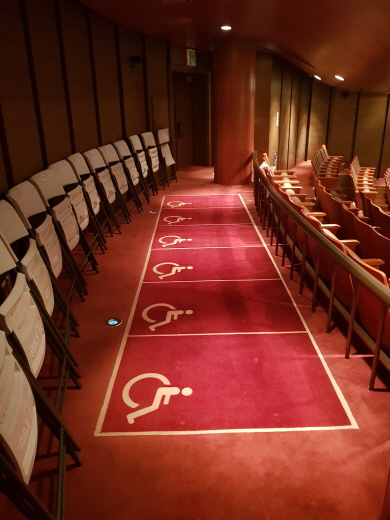
Wheelchair-accessible seats at the Myeongdong Theater in Jung District, central Seoul [MYEONGDONG THEATER[
The main hurdle, experts say, is finances. There's only so much even NTCK productions can do: They usually only offer three to four accessible performances per production run. Organizing them for “Gyeon Gothic Girl,” Lee said, “was like producing two separate performances.”
The play’s first production received public support, allowing the team to hire an accessibility consultant to help them create open captions, audio descriptions and a Braille program. But such cases remain rare, especially in the private sector, which produces the vast majority of Korean performances and relies heavily on profitability, meaning it must attract large audiences to stay viable.
When “Gyeon Gothic Girl” returned for subsequent productions, it had to do so without public support. Still, the team decided to retain its accessibility features under private funding. The show ran at a deficit when it was last staged this spring.
“As we moved into private production, the idea of accessibility had already become inseparable from the identity of the show,” Shin said. “What started as a service aimed at people with disabilities evolved into something that shaped the entire sensory experience of the work, for all audiences, and we decided the show must keep these services no matter what.”
Lee did admit the process was “a bit frustrating.”
“With our tight budget, we weren’t able to realize all the accessibility services we had originally set out to do.”
Even when accessible shows are staged, they often do not see a significant turnout from the disabled communities.
According to the 2024 Seoul Citizen Cultural Access Report, published by the Seoul Foundation for Arts and Culture, 64.5 percent of disabled Seoul residents said they had not attended an in-person cultural or artistic event in the past year. The figure was significantly lower — just 23.9 percent — among nondisabled citizens.
NTCK’s access and house manager, Kim Soo-hyun, says the problem is a lack of infrastructure.
“Just getting to the theater can be costly and time-consuming for some disabled patrons, and support for those efforts is limited,” she said. “So while we continue to make efforts and invest budget into this, we haven’t yet reached the point where audiences are responding in large numbers.”
Another issue is awareness.
“Many blind individuals don’t even know that accessibility performances exist,” said Seo Soo-yeon, who also heads Korea Content Accessibility Research Centre. “If people aren’t aware of what’s available, they can’t show up. And then it looks like there’s no demand.”
A hopeful future
![The National Theater Company of Korea performs Shakespeare's ″Twelfth Night″ with sign language interpreters at the Myeongdong Theater, which ran through July 6. [NATIONAL THEATER COMPANY OF KOREA]](https://koreaseafood.online/data/photo/2025/07/30/3d147982-484f-4897-b975-078e72e080a8.jpg)
The National Theater Company of Korea performs Shakespeare's ″Twelfth Night″ with sign language interpreters at the Myeongdong Theater, which ran through July 6. [NATIONAL THEATER COMPANY OF KOREA]
But accessibility experts aren’t staying discouraged.
Seo Soo-yeon sees awareness and perceptions as “definitely shifting, little by little.”
NTCK and the National Theater of Korea, for instance, scrapped their longtime use of the term “barrier-free” to describe shows with extra accessibility-oriented features and replaced it with “accessibility performances” starting this year. Arts Council Korea has followed suit. “Barrier-free,” though commonly used in Korea, is barely used in most English-speaking countries, where “accessibility” is the standard term.
“Many professionals working in the field are very aware of these issues and show a lot of sensitivity,” Seo Soo-yeon said.
NTCK house and access manager Kim Soo-hyun admitted to feeling dispirited a couple of years ago. “But I’ve since learned that a show doesn’t have to accommodate everyone to be considered accessible,” Kim said. “Even if you can realistically offer just one accessible feature, doing that alone is still meaningful.
“That’s how this kind of culture can take deep root.”
Lee saw even more potential on the horizon: “Accessibility is the future of live performance,” Lee said. “It’s a way to reach audiences who’ve never really been part of the target demographic. And that opens up a whole new market.”
BY LEE JIAN [[email protected]]


with the Korea JoongAng Daily
To write comments, please log in to one of the accounts.
Standards Board Policy (0/250자)