'Rogue states' find way back to diplomatic stage as pragmatism outweighs principles
Countries long condemned by the international community for their human rights violations are finding more room on the world stage as governments prioritize practical gains over shared values.
North Korean Vice Foreign Minister Kim Son-gyong tells the United Nations General Assembly that the North's status as a nuclear weapons state is irreversible at the UN headquarters in New York on Sept. 28REUTERS/YONHAP
North Korea, Myanmar, Afghanistan and Syria, which have long been condemned for their human rights violations, are finding more room on the world stage as governments put practical gains ahead of shared values.
U.S. President Donald Trump’s “America First” policy and the wars in Ukraine and Iran have opened cracks in the international order, granting “rogue states” a wider diplomatic stage.
North Korea’s status as a nuclear weapons state “can never be reversed in any circumstances or by any means,” North Korean Vice Foreign Minister Kim Son-gyong told the United Nations General Assembly — the center of multilateral diplomacy — in New York on Monday.
His remarks came six days after South Korean President Lee Jae Myung laid out a phased approach to the same assembly on Sept. 22.
“We can halt the advancement of the North’s nuclear and missile capabilities, reduce them over the medium term and move toward a nuclear-free Korean Peninsula in the long term,” Lee said.
Pyongyang’s answer outright rejected that plan.
North Korea’s nuclear deterrent is “the absolute might and irresistible force designed […] to safeguard the sovereignty, security and peace against aggression and threat from outside,” the North Korean vice foreign minister said.
The North “will continue to strictly control and manage every external threat by dint of [its] supremacy in overwhelming strength,” he continued.
North Korean Vice Foreign Minister Kim Son-gyong speaks at the United Nations General Assembly at the UN headquarters in New York on Sept. 28.AP/YONHAP
Pyongyang can have such a position because the world has changed. Russia, desperate for troops and weapons, and China, needing a strategic buffer, are both courting the North.
Trump, looking for a diplomatic breakthrough as the Iran war drags on, has also publicly said that he is willing to meet North Korean leader Kim Jong-un and has even scaled back joint military exercises between Seoul and Washington.
“North Korea appears to be at odds with the UN, but it is, in effect, acknowledging the UN’s stance and using it,” Jeon Kyung-joo, a research fellow at the Asan Institute for Policy Studies, said regarding the North Korean vice foreign minister’s speech.
“As Trump rejects the Western international order and the UN as its symbol, an opportunity to build a new alternative order has opened up. The room for rogue states to make their voices heard at the UN and elsewhere will only expand.”
Myanmar President Min Aung Hlaing, left, shakes hands with Chinese President Xi Jinping at the Great Hall of the People in Beijing on June 16 during a state visit to China.XINHUA/YONHAP
Myanmar President Min Aung Hlaing, who seized power through a coup in February 2021, is also trying to make his government look like a normal state. The military’s brutal crackdown on protesters resulted in Myanmar being shut out of Asean summits and sanctioned by the United States and the European Union.
But this attitude began to shift after Hlaing took office in April.
Malaysian Prime Minister Anwar Ibrahim plans to invite Hlaing for an official visit, Reuters reported on Sept. 16. Malaysia was once one of Myanmar’s harshest critics but appeared to change course after finding it more urgent to send Rohingya refugees in Malaysia home. The Rohingya are an ethnic minority from Myanmar.
Thailand rolled out the red carpet for Hlaing on a state visit in August, as the country needs Myanmar’s cooperation to fight drug trafficking, scam operations and other cross-border crime.
China, which sees Myanmar as a gateway to the Indian Ocean, held a summit with Hlaing in June. Before that, India, which needs Myanmar’s help to keep China in check, hosted him in May.
Similarly, Washington seems to be attempting to improve ties, “laying the groundwork to cooperate with the military regime” in a bid for rare earth minerals, the U.S. magazine Foreign Policy reported.
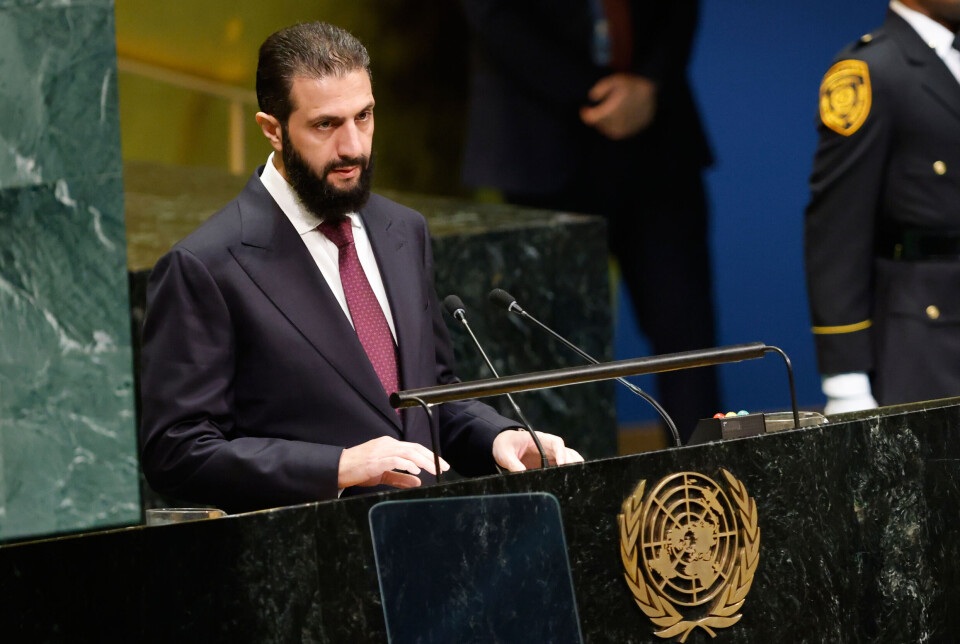
Syrian President Ahmed al-Sharaa, a former militant once wanted by the United States, addresses the 81st session of the United Nations General Assembly at the UN headquarters in New York on Sept. 23.AP/YONHAP
The Taliban, the Islamist militant group that retook Afghanistan in August 2021, has also widened its diplomatic reach and publicly announced 3,651 diplomatic engagements with 103 countries and entities in its first five years back in power, the Washington Institute for Near East Policy found.
Taliban officials have met with China, India, Qatar and others this year. In May, for example, the Taliban signed a military-technical cooperation agreement with Russia. The countries courting Kabul are after Afghanistan’s mining rights and access to logistics and energy transit routes. Against that backdrop, Taliban foreign ministry spokesperson Abdul Qahar Balkhi told CBS News that the Taliban wants diplomatic ties with “every single country of the world, including the United States.”
Syrian President Ahmed al-Sharaa, who took power in 2025 after the fall of Bashar al-Assad’s dictatorship, once had a $10 million bounty on his head as a terrorist and has faced condemnation over sectarian massacres. He has, nonetheless, widened his diplomatic footprint.
From left: U.S. President Donald Trump, Qatari Emir Tamim bin Hamad Al Thani and Syrian President Ahmad al-Sharaa attend a multilateral meeting of the Gulf Cooperation Council during the 81st session of the United Nations General Assembly at the UN headquarters in New York on Sept. 22.GETTY/YONHAP
In July, Syria agreed with the United States and the International Atomic Energy Agency to remove nuclear material left over from the Assad era. In August, Washington took Syria off its list of state sponsors of terrorism; it had been on the list since 1979. Both moves reflect Washington’s aim to put indirect pressure on Iran in the Middle East.
European countries, which faced a refugee crisis in 2015 as the Syrian civil war drove people abroad, are also acting friendly toward the new government in Damascus as they try to stem further arrivals.
Governments now weigh practical interests such as resource security more heavily than values-based diplomacy, and the return of the rogue states reflects that shift. The Taliban’s new contacts “stem from a combination of regional security concerns, pressure in the West to reduce illegal immigration and a general recognition that the Taliban are unlikely to be forced from power in the foreseeable future,” The Guardian reported in August.
North Korean Vice Foreign Minister Kim Son-gyong tells the United Nations General Assembly that the North's status as a nuclear weapons state is irreversible at the UN headquarters in New York on Sept. 28.GETTY/YONHAP
Above all, the world has become more multipolar. Western sanctions over human rights abuses now carry less force because China and Russia back sanctioned governments. That support has allowed sanctioned states to offset Western pressure, Radio Free Europe/Radio Liberty noted.
Still, the international community is not fully embracing these rogue states. Western sanctions on North Korea and Myanmar remain in place, and Russia is still the only country to have formally recognized the Taliban government.
The Munich Security Conference is among those uneasy about the interest-driven diplomacy.
“We might see a world shaped by transactional deals rather than principled cooperation, private rather than public interests, and regions shaped by regional hegemons rather than universal norms,” Wolfgang Ischinger, the conference’s chairman, wrote in this year’s Munich Security Report. Such a world, the report cautioned, would paradoxically favor only the strong.
This article was originally written in Korean and translated by a bilingual reporter with the help of generative AI tools. It was then edited by a native English-speaking editor. All AI-assisted translations are reviewed and refined by our newsroom.