Kim Jong-un flexes China ties in possible message to Trump
Kim’s surprise Dandong trip highlighted North Korea’s solidarity with China ahead of the Asia-Pacific Economic Cooperation summit and potential U.S. talks.
North Korean leader Kim Jong-un, right, shakes hands with Wang Huning, chairman of the National Committee of the Chinese People’s Political Consultative Conference, in China on Oct. 24, in this photo released by the North's state media, the Korean Central News Agency, on Oct. 25.YONHAP
North Korean leader Kim Jong-un made a surprise one-day trip to the Chinese border city of Dandong on Saturday, a show of solidarity with Beijing that experts say aimed to strengthen his hand with Washington ahead of next month’s Asia-Pacific Economic Cooperation (APEC) summit in China.
The trip could also be seen as an indirect message to U.S. President Donald Trump, who has repeatedly signaled interest in talks with Kim, that North Korea will not rely solely on the United States for sanctions relief.
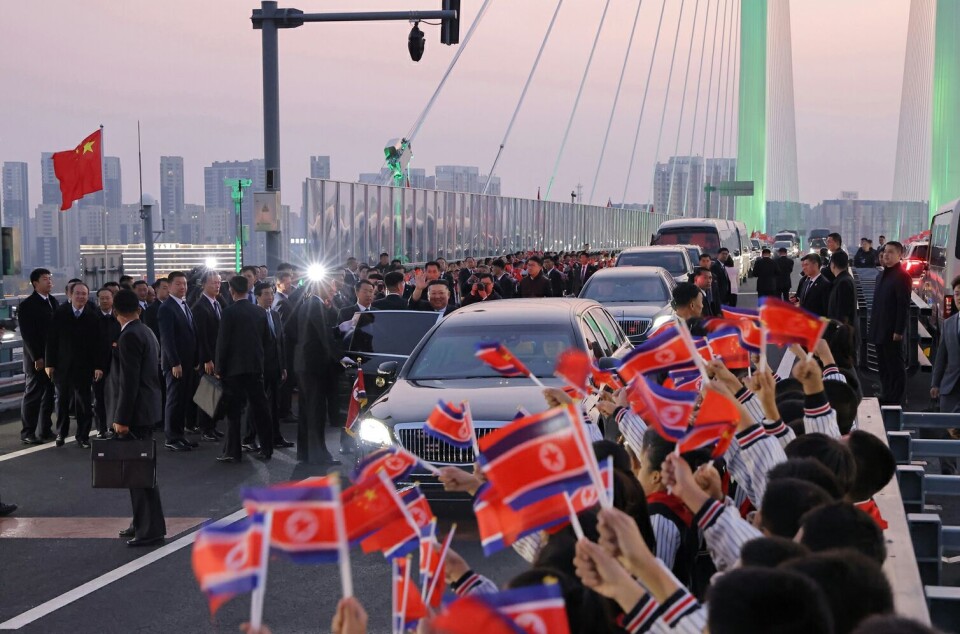
Kim traveled by land and crossed the New Yalu River Bridge by car, just nine days after it opened on Oct. 15. He was welcomed by a Chinese delegation that included Foreign Minister Wang Yi and Wang Huning, chairman of the National Committee of the Chinese People’s Political Consultative Conference and China’s fourth-highest-ranking official.
Kim was accompanied by senior North Korean party and government officials, including Jo Yong-won, a member of the Presidium of the Political Bureau of the ruling Workers’ Party’s Central Committee; Foreign Minister Choe Son-hui; and Kim Yo-jong, his sister and a party department director.
The Rodong Sinmun, the official newspaper of North Korea’s ruling party, devoted its first three pages on Sunday to the visit.
The trip came ahead of the 76th anniversary of the Chinese People’s Volunteers’ entry into the 1950-53 Korean War on Sunday. Both North Korea and China mark Oct. 25 each year as the anniversary of the so-called War to Resist U.S. Aggression and Aid Korea, Beijing’s name for its intervention in the Korean War. The date marks the Chinese forces’ first battle after entering the conflict. Though China called its forces the Chinese People’s Volunteers, they were volunteers in name only.
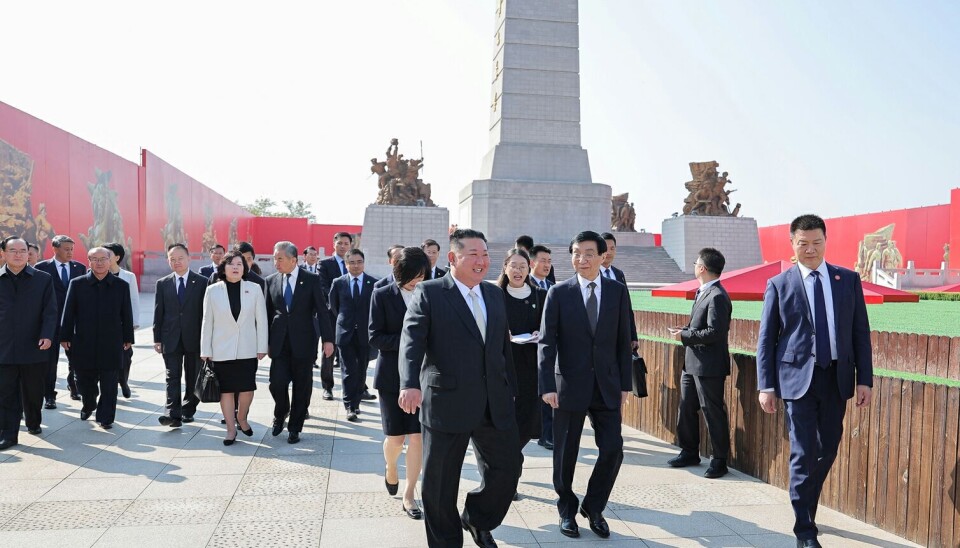
North Korean leader Kim Jong-un, center left, walks with Wang Huning, chairman of the National Committee of the Chinese People’s Political Consultative Conference, center right, in Dandong, China, on Oct. 24, in this photo released by the North's Rodong Sinmun on Oct. 25.NEWS1
Kim Jong-un's first stop was the Memorial Hall of the War to Resist U.S. Aggression and Aid Korea, China’s official museum dedicated to the conflict, in Dandong.
During a meeting with the Chinese delegation, Kim said North Korea will remember that China helped its revolution at “the cost of their blood and steadily and [will] firmly carry forward the history of the DPRK-China friendship.” The DPRK is the abbreviation of North Korea’s official name, the Democratic People’s Republic of Korea.
Notably, Kim invoked the two countries’ blood alliance five times during the trip, describing their friendship as invincible, forged in blood and bound by blood. Such strong language rarely appeared during Chinese President Xi Jinping’s June visit to Pyongyang. The timing of the trip and Kim’s repeated references to blood-forged ties are being read as a message that North Korea and China remain tightly bound.
Though North Korea traditionally places particular importance on anniversaries that fall in five- or 10-year increments, this year marks the 76th anniversary, not the 75th or 80th. Yet Kim still traveled to Dandong in person.
North Korean leader Kim Jong-un’s motorcades cross the New Yalu River Bridge in Dandong, China, on Oct. 24, in this photo released by the North's state media, the Korean Central News Agency, on Oct. 25.NEWS1
The trip also contrasted with last month's opening ceremony for a North Korea-Russia road bridge across the Tumen River, at which North Korean Premier Pak Thae-song appeared only by video.
On the surface, the visit appeared aimed at showcasing anti-U.S. solidarity rather than laying the groundwork for U.S.-North Korea talks. But it may also have been intended to maximize Pyongyang’s leverage by signaling that North Korea is not desperate for dialogue with Washington, which has repeatedly said ahead of the APEC summit in Shenzhen that it remains open to talks with Kim.
Kim may have sought to show that North Korea has another route to easing its economic difficulties besides direct negotiations with Washington, which holds the key to lifting international sanctions. Expanded economic cooperation with China could weaken those sanctions' effectiveness and strengthen Pyongyang’s bargaining position in any future talks with the United States.
Saturday’s trip was Kim’s first visit to China in a year and a month and his sixth since taking power in 2011. He previously traveled to Beijing in September last year, when he attended a massive military parade marking the 80th anniversary of the end of World War II, standing side by side with Xi and Russian President Vladimir Putin.
It was also Kim's first return from China without meeting Xi.
North Korean leader Kim Jong-un, left, attends a meeting with Wang Huning, chairman of the National Committee of the Chinese People’s Political Consultative Conference, in China, on Oct. 24, in this photo released by the North's Rodong Sinmun on Oct. 25.NEWS1
South Korea’s National Intelligence Service initially speculated that Chinese Premier Li Qiang — the Chinese Communist Party’s second-highest-ranking official — might attend events surrounding Kim’s visit. However, Wang Hunin, China’s fourth-ranking official, ultimately received Kim instead.
Discussions over Kim’s trip had been underway for at least two weeks, sources familiar with the matter said.
“Given its strategic competition with the United States, China would find it burdensome to unilaterally ease sanctions on North Korea,” Prof. Park Won-gon at Ewha Womans University’s Department of North Korean Studies said. “It means this was an event that would have been too burdensome for Li Qiang himself to step into.”
North Korean leader Kim Jong-un, center, and Chinese officials view historical exhibits at the Memorial Hall of the War to Resist U.S. Aggression and Aid Korea in Dandong, China, on Oct. 24, in this photo released by the North's Rodong Sinmun on Oct. 25.NEWS1
If China expands economic cooperation to the level North Korea wants, Beijing would risk not only greater friction with Washington but also exposing Chinese companies and institutions to U.S. secondary sanctions.
Experts also see economic interests as an important factor behind Kim’s surprise visit.
The New Yalu River Bridge was completed in 2014 but remained unopened for years. Discussions about opening the bridge gained momentum after Xi’s June visit to Pyongyang.
Kim’s decision to cross the bridge himself can be seen as an effort to highlight a tangible result of the “new era” in North Korea-China relations proclaimed by the two leaders.
North Korea desperately needs greater economic cooperation with China as it struggles with severe economic difficulties and seeks results from Kim’s signature initiatives, such as a beach resort complex in Wonsan Kalma coastal tourist zone.
North Korean leader Kim Jong-un, front center, inspects vehicles during a visit to a bus plant in Dandong, China, on Oct. 24, in this photo released by the North's Rodong Sinmun on Oct. 25.NEWS1
Kim’s visit to a bus factory in Dandong after touring the war memorial has also been interpreted as a sign of interest in expanding transportation infrastructure in preparation for an increase in international group tourism.
“The event shows North Korea’s intention to make maximum use of China, and at the same time demonstrates just how urgently Pyongyang needs sanctions relief and economic cooperation with Beijing,” Hong Min, a senior research fellow at the Korea Institute for National Unification, said.
Kim has a precedent of coordinating strategy with Xi ahead of talks with Trump, having met the Chinese leader in the months before their first summit in June 2018.
If strategic coordination between North Korea and China deepens after the latest visit, and Kim and Xi meet around the APEC summit in November, the development could introduce a new variable into any future U.S.-North Korea dialogue.
This article was originally written in Korean and translated by a bilingual reporter with the help of generative AI tools. It was then edited by a native English-speaking editor. All AI-assisted translations are reviewed and refined by our newsroom.