North Korea plants nearly 1 million land mines along DMZ in just over two years: Lawmakers
South Korean military data shows Pyongyang has planted 960,000 land mines since 2024 as it attempts to fortify the inter-Korean border.
North Korea has planted nearly 1 million land mines in the demilitarized zone (DMZ) over the past two years, according to lawmakers on the National Assembly's National Defense Committee.
The data came from the South Korean military, which reported that North Korea has planted 960,000 land mines in the DMZ area since 2024, according to the offices of the committee lawmakers on Friday.
A total of approximately 2 million land mines are reportedly buried in the DMZ, including those planted by South Korean forces, according to experts. Unification Minister Chung Dong-young cited the same figure of "2 million" land mines when he addressed the issue during a parliamentary audit on Oct. 7.
Based on the military report, nearly half of the estimated 2 million land mines buried in the DMZ may have been planted by the North since 2024.
The sweeping mine-laying campaign appears to be part of Pyongyang's efforts to turn the military demarcation line (MDL) inside the DMZ into a fortified border. The work began in April 2024 after the North declared that the two Koreas were "two states hostile to each other."
The fortification campaign extends well beyond land mines. North Korea is also clearing stretches of land, erecting walls and barbed-wire fences, building military roads and cutting off the Gyeongui and Donghae rail lines that once connected the two Koreas.
North Korean troops have also repeatedly crossed the MDL during the fortification work.
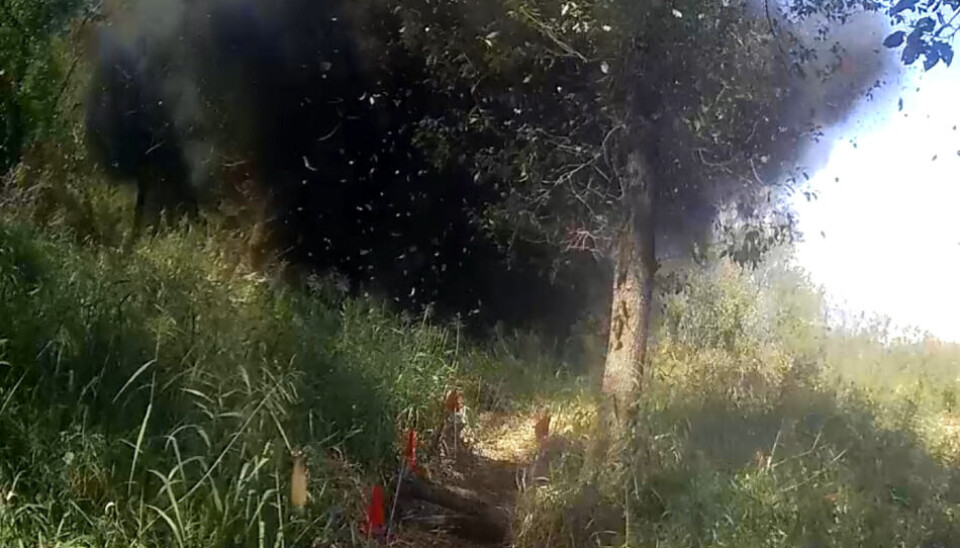
A North Korean land mine exploded south of the MDL on Sept. 21 and seriously injured three South Korean soldiers.
The South Korean military has continued to issue warnings over loudspeakers and fire warning shots at North Korean troops who cross the MDL. In response, Pyongyang has denounced the measures as threats to the safety of its troops and raised the prospect of renewed loudspeaker broadcasts toward Seoul.
BY JUNG SI-NAE [[email protected]]
This article was originally written in Korean and translated by a bilingual reporter with the help of generative AI tools. It was then edited by a native English-speaking editor. All AI-assisted translations are reviewed and refined by our newsroom.