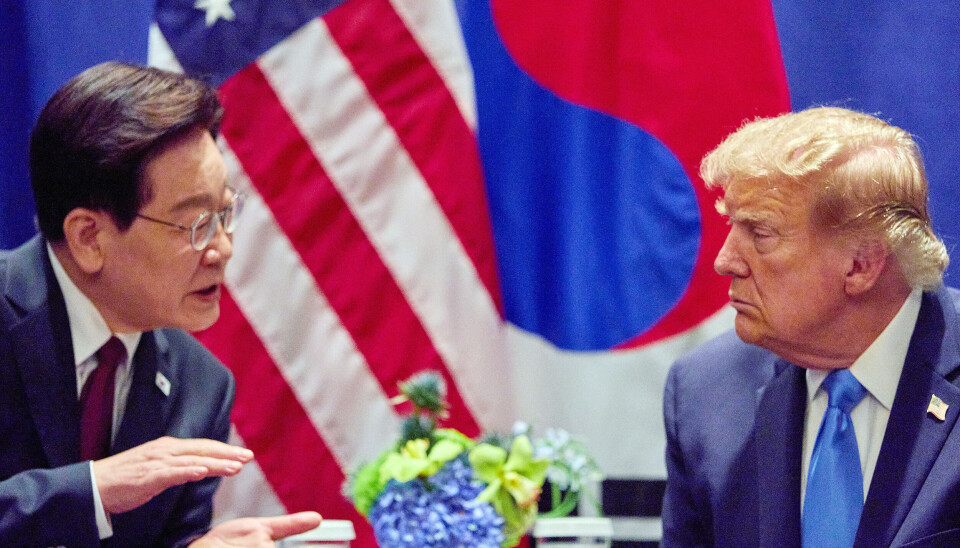
Lee, Trump discuss submarines, investment and North Korea at UN sideline summit
The leaders discussed South Korea’s U.S. investment pledge, nuclear-powered submarines, shipbuilding cooperation and reopening dialogue with Pyongyang.
South Korean President Lee Jae Myung, left, and U.S. President Donald Trump hold an unannounced bilateral summit at a hotel in New York on Sept. 22 on the sidelines of the United Nations General Assembly.JOINT PRESS CORPS
NEW YORK — President Lee Jae Myung and U.S. President Donald Trump discussed key pending trade and security issues, including nuclear-powered submarines and shipbuilding cooperation, during an unannounced bilateral summit on the sidelines of the United Nations General Assembly in New York on Tuesday.
The meeting followed Seoul's announcement of a key investment project in the United States, part of Seoul's $200 billion pledge under a bilateral trade deal signed last year.
"During the meeting, both leaders welcomed the significant progress made in recent discussions regarding investment projects between the two nations,” National Security Adviser Wi Sung-lac said in a press briefing in New York late Tuesday.
Trump also reaffirmed his willingness to engage in dialogue with North Korean leader Kim Jong-un, an issue Lee also raised in his address to the UN General Assembly.
The 30-minute talks, arranged at the last minute, took place during a dinner reception hosted by Trump for leaders attending the UN General Assembly at a New York hotel.
Efforts to secure a bilateral meeting with Trump were underway before Lee’s U.S. trip began, but the summit was only finalized Tuesday morning.
This marks the third meeting between the two leaders since Lee took office, following summits in Washington in August last year and on the sidelines of the Asia-Pacific Economic Cooperation summit in Gyeongju, North Gyeongsang, last October.
Trump had a packed schedule starting at 7 a.m., meeting with the leaders of Britain, Ukraine and Japan. The South Korea-U.S. summit was the final bilateral meeting on his agenda before he returned to Washington.
Based on the joint fact sheet agreed upon during the South Korea-U.S. summit last November, the two leaders reaffirmed their shared commitment to deepening bilateral cooperation in areas such as nuclear-powered submarines, the right to enrich uranium and reprocess spent nuclear fuel and shipbuilding, Wi said, and agreed to follow-up consultations. They also discussed the transfer of wartime operational control (Opcon) from the United States to South Korea.
The bilateral talks come after South Korea confirmed a $22.3 billion gas-fired power plant project in Texas as the first project under its $200 billion strategic investment package in the United States. Negotiations are still underway for two other projects: the construction of eight nuclear reactors in the United States and a liquefied natural gas development project in Alaska.
South Korean President Lee Jae Myung, left, and U.S. President Donald Trump hold a summit at a hotel in New York on Sept. 22, on the sidelines of the United Nations General Assembly.JOINT PRESS CORPS
Trump reaffirmed his willingness to engage in dialogue with North Korea, and the two leaders agreed to communicate closely, “acting as peacemakers and pacemakers, to open the door to dialogue and establish sustainable peace on the Korean Peninsula,” Wi said.
Lee also noted the importance of the upcoming summit between Trump and Chinese President Xi Jinping, scheduled for Wednesday in Washington, and expressed his hope for a successful outcome.
However, the issue of deploying troops to the Strait of Hormuz was not raised during the meeting, according to a senior presidential official.
“It wasn't intentionally omitted,” the official said, but “neither side made any specific remarks on the subject.”
Regarding the Opcon transfer issue, the official said Lee explained South Korea's position extensively, conveying directly in person for the first time Seoul’s desire to “finalize the process as soon as possible while meeting the necessary conditions."
According to this official, the meeting proceeded in a cordial atmosphere from start to finish. U.S. Commerce Secretary Howard Lutnick, the U.S. chief negotiator for the trade talks with Seoul, took part in the meeting.
After entering the venue, Trump first asked how first lady Kim Hea Kyung was doing. Trump suggested to Lee that they should play a round of golf sometime, a proposal made during the G7 summit in France in June.
Lee mentioned the G20 summit in Miami scheduled for December, saying, "I hope we can play golf there."
Earlier Tuesday, Lee shared in his second address to the UN General Assembly his three-point blueprint for the road to peaceful coexistence on the Korean Peninsula: building mutual respect, rendering conflict unnecessary and responsibly contributing to world peace.
“As a direct party to peace on the Korean Peninsula, and as a pacemaker, my government will exert every effort to open and sustain the path toward dialogue,” Lee said.
“President Trump’s resolve has recently created a hard-won opportunity for change,” Lee said, adding that he hoped dialogue between North Korea and the United States “can resume without delay.”
He added that Seoul “will lay the groundwork for this to develop into a dialogue among the parties aimed at ending the war on the Korean Peninsula and transitioning to a peace regime.”
The 1950-53 Korean War ended with an armistice agreement signed by the U.S.-led UN Command and the North Korean and Chinese militaries, leaving the two Koreas technically at war to this day.
South Korean President Lee Jae Myung addresses the 81st session of the United Nations General Assembly at the UN headquarters in New York on Sept. 22.JOINT PRESS CORPS
Lee reiterated his phased approach to North Korea's denuclearization, calling for a freeze in further advances in North Korea’s nuclear and missile capabilities, followed by reductions and a long-term move toward "a Korean Peninsula free from nuclear weapons."
Lee further underscored that South Korea would make constructive contributions toward finding solutions to shared challenges facing humanity, such as the AI revolution, climate change and energy security.
He also urged the formation of a coalition to ensure global energy supply chains amid repeated blockades of sea routes in the Strait of Hormuz and the Red Sea.
On Tuesday, Lee held bilateral talks with Australian Prime Minister Anthony Albanese and discussed cooperation on energy supply chains amid the unstable situation in the Middle East.
Lee also met with outgoing UN Secretary-General António Guterres to seek UN support on Korean Peninsula issues.
On Wednesday, Lee will attend a Korea investment summit and wrap up a three-day trip to New York and head to Mexico for a state visit.
“Through recent intensive negotiations, our discussions on bilateral strategic investment projects have made significant progress,” Lee wrote in an X post Wednesday after his talks with Trump. “I had an in-depth conversation with President Trump on this issue, as well as on ways to further our bilateral relations across diverse areas, such as nuclear-powered submarine fuel, civil enrichment and reprocessing, shipbuilding cooperation, and the transition of wartime operational control.”
Lee said he “found it deeply meaningful to once again hear President Trump express his willingness to engage in dialogue with North Korea,” adding Seoul and Washington “will maintain even closer communication to help resume the stalled dialogue and bring lasting peace to the Korean Peninsula.”
He noted that Trump reminded him of a plan to play golf at the G7 summit in Evian, France, and added, “I hope we can continue our discussions at the G20 Summit in Miami at the end of this year.