Leaders of Korea, Argentina agree to energy supply chain cooperation in summit
In their first meeting in Buenos Aires, Korean President Lee Jae Myung and Argentine President Javier Milei agreed to a double taxation avoidance agreement.
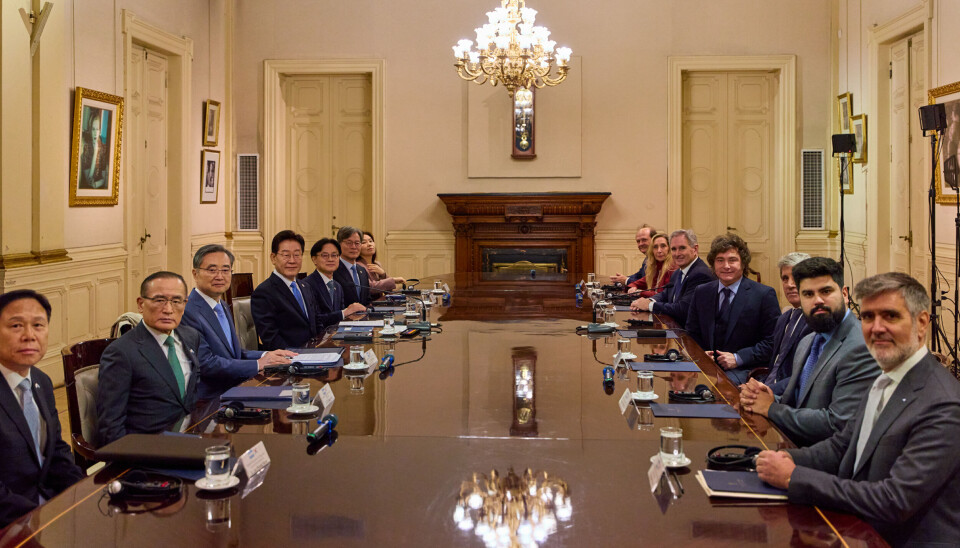
Korean President Lee Jae Myung, left, and Argentine President Javier Milei pose for a commemorative photo ahead of their first bilateral summit at Casa Rosada, the presidential palace, in Buenos Aires on July 31.JOINT PRESS CORPS
Korean President Lee Jae Myung and Argentine President Javier Milei agreed to pursue cooperation in energy supply chains, including critical minerals and crude oil, during a bilateral summit in Buenos Aires on Friday.
Lee and Milei held their first summit talks for over 80 minutes at the presidential palace in Buenos Aires in the first visit by a Korean president to Argentina in 22 years.
During the summit, the two countries signed a memorandum of understanding on critical mineral cooperation and agreed to pursue investments and joint projects by companies in Korea and Argentina across the entire lithium value chain, including exploration and mining.
The two leaders also reached a double taxation avoidance agreement aimed at increasing trade and investment, said National Security Adviser Wi Sung-lac in a press briefing.
“This will reduce the double taxation burden on our companies operating in Argentina and increase the predictability of investment conditions,” Wi said.
A double taxation avoidance agreement ensures that income earned abroad is taxed in only one of the two countries, and the issue had been cited as a key hurdle for Korean companies entering the Argentine market.
Korean steelmaker Posco, which is engaged in lithium-related cooperation projects, had faced challenges in receiving tax benefits, but the issue was resolved through the agreement reached at the summit, Wi added. The Korean government previously attempted to reach such an agreement during former National Assembly Speaker Kim Jin-pyo's visit to Argentina in 2024 but failed to do so.
Argentina has one of the world's largest lithium reserves, a key material for rechargeable batteries, and Posco currently operates a lithium hydroxide production plant since acquiring mining rights at the Hombre Muerto North salt lake.
Wi said that the summit “reaffirmed the Argentine government's commitment to providing continued support for lithium projects currently being pursued by Korean companies,” adding that Korea plans to expand investment opportunities for companies into new critical mineral sectors, such as copper.
The summit was also an occasion to expand crude oil supply chains to South America.
“This is expected to serve as an opportunity to broaden our crude oil supply sources, which are currently concentrated in the Middle East, to South America, thereby reducing geopolitical uncertainty and enhancing our responsiveness to energy supply and demand,” Wi said.
“Going forward, the two countries agreed to expand the scope of energy cooperation beyond crude oil to include natural gas and nuclear power, and to jointly identify specific cooperation projects.”
Korean President Lee Jae Myung, center left, and Argentine President Javier Milei, center right, hold a summit at Casa Rosada, the presidential palace, in Buenos Aires on July 31.JOINT PRESS CORPS
The two countries also agreed to the swift resumption of negotiations on a trade agreement between Korea and Mercosur, the largest South American trade bloc. Such a deal would expand Korean companies' access to the South American market, a strategic hub rich in critical mineral resources such as lithium and nickel.
In his opening remarks at the summit, Lee noted that the bilateral trade volume was just over $1.4 billion last year, which is smaller than that between Korea and Brazil, which was just over $10 billion.
"Instead of leaving it as it is, let's dramatically increase it since it falls short of the potential of both nations,” Lee said.
Milei agreed and added that his government is easing regulations. He also noted that Argentina has strengths in energy sectors such as natural gas and crude oil, as well as in food production and critical minerals, including copper and lithium.
The summit between the two leaders drew interest considering their diametrically opposed backgrounds and tendencies. Lee is a progressive with a past as a child factory worker, and Milei, known to admire U.S. President Donald Trump, is a right-wing economist who has used a chain saw as a symbol of cutting state spending.
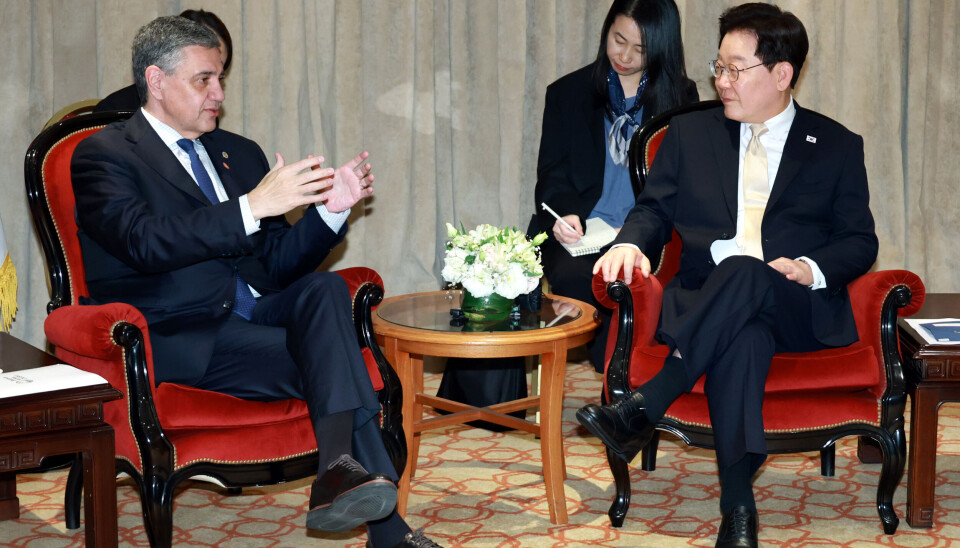
Korean President Lee Jae Myung, right, speaks with Jorge Macri, the head of government of Buenos Aires, in Argentina on July 31.JOINT PRESS CORPS
Lee and Milei were said to have engaged in an informal conversation during their first meeting.
Milei expressed interest in K-beauty and K-culture and said he is “a lover of Korean cosmetics.” He also said that Argentina is a cultural powerhouse in South America, as well as a country with a strong interest in K-culture.
The two nations agreed to push for the swift conclusion of a mutual recognition agreement for driver's licenses and to identify new cooperation projects in the fields of defense, aerospace, Antarctica and health. They also agreed to hold consultations to expand cultural exchanges, educational cooperation and people-to-people exchanges.
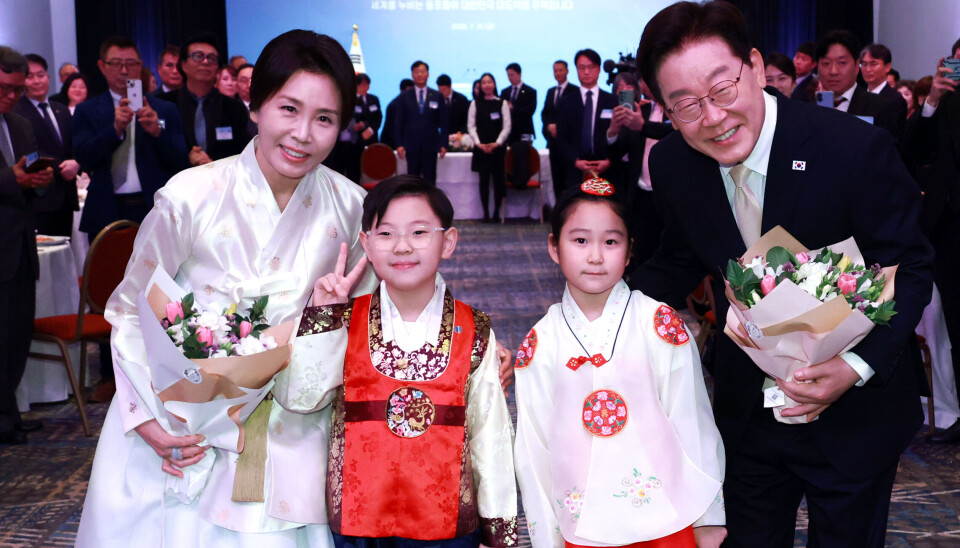
Korean President Lee Jae Myung, right, and first lady Kim Hea Kyung pose for a photo with children at a reception banquet for the Korean community at a hotel in Buenos Aires on July 31.JOINT PRESS CORPS
Lee later held talks with Jorge Macri, the head of government of Buenos Aires, and attended a reception banquet with the Korean community in Argentina.
Argentina was the final leg of Lee and first lady Kim Hea Kyung’s South America tour, which included bilateral summits with Brazilian President Luiz Inácio Lula da Silva and Chilean President José Antonio Kast.
In Chile, Lee and Kast agreed on Thursday to expand cooperation in strategic sectors including critical mineral supply chains, infrastructure, public security and defense. The two sides signed five MOUs covering mineral resources, public security, polar research, maritime safety and security and investment cooperation. Korea and Chile also agreed to establish an institutional framework for expanding cooperation in the defense and shipbuilding industries.
Lee returns to Seoul on Monday, concluding an 11-day visit to San Francisco, the three South American nations and Germany.