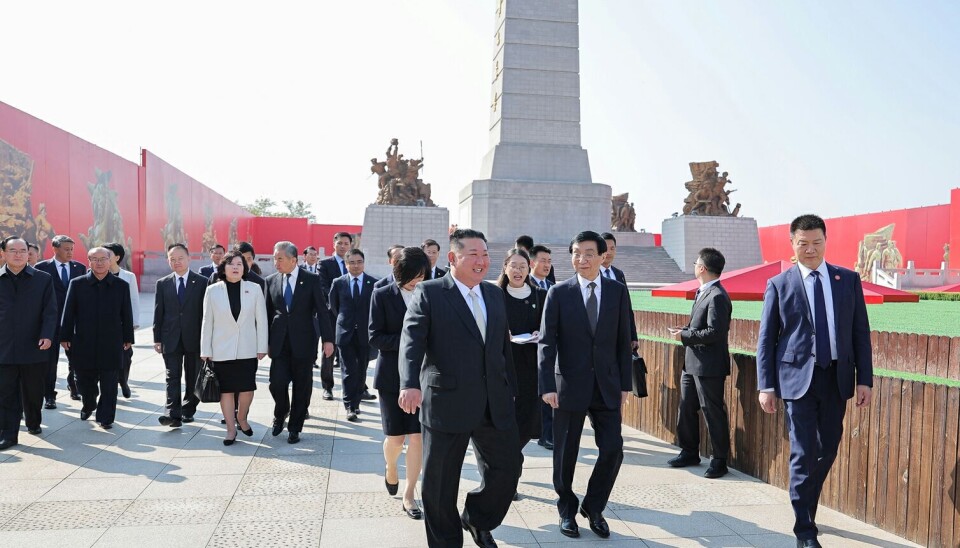
North Korean leader Kim Jong-un, right, pays tribute at the memorial tower commemorating the War to Resist US Aggression and Aid Korea, the official term used by China to describe its involvement in the 1950-53 Korean War in Dandong, China, on Oct. 24, in this photo released by the North's state media the Rodong Sinmun on Oct. 25.NEWS1
North Korean leader Kim Jong-un reaffirmed his country’s strong ties with China during a brief visit to the Chinese border city of Dandong on Saturday, North Korean state media reported Sunday.
“We will always remember the history when the excellent sons and daughters of the Chinese people helped our revolution at the cost of their blood and steadily and firmly carry forward the history of the DPRK-China friendship,” he said during a meeting with the Chinese delegation. DPRK is the initialism for North Korea's official name, the Democratic People's Republic of Korea.
Kim visited Dandong, a Chinese border city across the Yalu River from Sinuiju, on Saturday, ahead of the 76th anniversary of the Chinese People’s Volunteers’ entry into the 1950-53 Korean War, and toured the Memorial Hall of the War to Resist US Aggression and Aid Korea, China’s official museum about the war, according to the Korean Central News Agency (KCNA).
China marks Oct. 25 each year as the anniversary of the War to Resist US Aggression and Aid Korea, Beijing’s name for its intervention in the Korean War. The date commemorates the Chinese forces’ first battle after entering the conflict. The Chinese People’s Volunteers was the name China gave its forces in the war, which were nominally volunteers.
Kim was accompanied by senior North Korean party and government officials, including Jo Yong-won, a member of the Presidium of the Political Bureau of the ruling Workers’ Party’s Central Committee; Foreign Minister Choe Son-hui; and Kim Yo-jong, his sister and a party department director.
The Chinese delegation included Wang Huning, chairman of the National Committee of the Chinese People’s Political Consultative Conference and China’s fourth-highest-ranking official; Foreign Minister Wang Yi; and Liu Haixing, head of the International Department of the Communist Party of China Central Committee.
Kim Jong-un laid a wreath at a war memorial bearing a message pledging to forever remember the martyrs of the Chinese people.
After paying tribute, the North Korean leader vowed that the North Koreans “would remember forever the glorious years when they fought together with the Chinese people” and pass down their gratitude to China for helping the North Korean revolution from generation to generation.
North Korean leader Kim Jong-un, center, walks with Wang Huning, chairman of the National Committee of the Chinese People’s Political Consultative Conference, center right, in Dandong, China, on Oct. 24, in this photo released by the North's state media, the Rodong Sinmun on Oct. 25.NEWS1
Kim Jong-un then toured the memorial hall’s exhibits with Wang Huning.
The North Korean leader described the memorial hall as a testament, written in blood, to the enduring friendship between North Korea and China.
Kim Jong-un presented the memorial hall with a commemorative plaque bearing a photograph of North Korea’s founder Kim Il Sung.
After the tour, Kim Jong-un held talks with Wang Huning, during which he stressed that it was North Korea’s duty to honor the shared history and solidarity forged with China at the site from which the Chinese People’s Volunteers departed for war.
Wang Huning conveyed greetings from Chinese President Xi Jinping to the North Korean leader and said Kim Jong-un’s visit to the memorial hall was significant to preserving the two countries’ “traditional friendship and militant fraternity.”
North Korean leader Kim Jong-un, center left, attends a meeting with Wang Huning, chairman of the National Committee of the Chinese People’s Political Consultative Conference, center right, in China, on Oct. 24, in this photo released by the North's state media, the Rodong Sinmun on Oct. 25.NEWS1
Wang Huning also hosted a banquet for Kim Jong-un on Xi’s special instructions, according to KCNA.
Kim Jong-un later toured a bus factory in Dandong and encouraged workers before leaving China via the New Yalu River Bridge, which opened Oct. 15.
Wang Huning and other Chinese officials accompanied the North Korean delegation to the midpoint of the bridge to see Kim off.
The bridge will “undoubtedly and correctly fulfill its historic mission of linking the two countries and firmly joining the minds of the peoples of the two countries,” Kim Jong-un said at the midpoint.
North Korean leader Kim Jong-un, left, poses for a photo with Wang Huning, chairman of the National Committee of the Chinese People’s Political Consultative Conference, in front of the New Yalu River Bridge in Dandong, China, on Oct. 24, in this photo released by the North's state media, the Rodong Sinmun on Oct. 25.NEWS1
The four-lane bridge stretches 3,026 meters (1.88 miles) and connects Dandong — the biggest hub for trade between the two countries — with Sinuiju in North Pyongan Province.
The latest trip was Kim Jong-un’s sixth visit to China since March 2018 and his first in more than a year, after he traveled to Beijing with his daughter Ju-ae in September last year to attend events marking the 80th anniversary of China’s victory in its war against Japan.
This article was originally written in Korean and translated by a bilingual reporter with the help of generative AI tools. It was then edited by a native English-speaking editor. All AI-assisted translations are reviewed and refined by our newsroom.