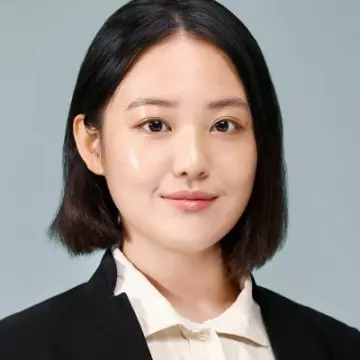
Researchers studying late Joseon Dynasty (1392-1910) paintings of beautiful women identified several common, uniting characteristics in their faces: crescent-shaped eyebrows; a round, curved nose; and single, long and thin eyelids.
All befitting a “soft, wise, economical and brilliant” disposition prized in women at the time, the Kyungpook National University researchers wrote.
Few of those features are prominent among the lead actors in Netflix’s new period drama “The Scandal,” set in the same late Joseon era. Yet it was Nana’s lips that viewers chose to focus on.
A painting of a woman by Shin Yun-bok (1758–1813), a painter in the late Joseon Dynasty (1392-1910)KOREA HERITAGE SERVICE
Four days after the series premiered on Sept. 18, the K-pop singer-turned-actor and model apologized for “making viewers uncomfortable” after commenters said her full lips were distracting and ill-suited to Hui-yeon, the young widow she plays. Director Jung Ji-woo later took “full responsibility” for everything shown on screen but defended the casting, saying that Nana had immersed herself in the role and brought the emotional intensity he wanted for the character.
Nana as Hui-yeon in “The Scandal”NETFLIX
Many online commenters speculated that Nana had received lip fillers, and local media often framed the controversy that way, though she only referred to a “personal choice” and did not confirm any procedure. Some users circulated older photos and videos in an attempt to “prove” that she had gotten fillers and, later, that she had dissolved them after the backlash.
The criticism boiled down to one claim: that Nana’s face looked too modern for a period drama, called sageuk in Korea.
But what, exactly, makes a face look right for the genre?
From left: Kim Ji-an, Shin So-hyun, Shin Youn-ha and Han Sun-hwa in supporting roles in “The Scandal”NETFLIX
The notion that some faces simply belong in a sageuk — and others do not — has circulated in Korean popular culture for decades.
In 2009, the entertainment outlet Newsen asked a plastic surgeon what made certain women suited to historical dramas. He pointed to a “well-shaped forehead” and facial contours that worked with pulled-back hairstyles and heavy wigs, citing actors including Lee Young-ae and Han Ji-min. But the article also noted that a sageuk hero needed both “classical charm” and an image suited to contemporary tastes.
In a 2021 YouTube video, a surgeon from the Pleasure Korea clinic associated the ideal historical-drama look with understated eyes, rounded foreheads and oval faces, while suggesting that prominent double eyelids could sit less naturally with hanbok (traditional Korean dress).
Men who struck him as natural fits included Lee Junho and Park Bo-gum; for women, he noted Park Eun-bin in “The King’s Affection” (2021) as an example. Han Ye-seul, by contrast, seems too “urban” and polished. After initially questioning whether Lee Hye-ri’s “darker complexion” and K-pop idol image suited the genre, he changes his mind once he sees her in costume.
After going back and forth over several actors, he and his employees arrive at a simpler conclusion: “If you’re pretty, it works.”
Choi Soo-jong in the KBS drama "Dae Jo-yeong" (2006-07)KBS
Ji Chang-wook as Cho Won in "The Scandal"NETFLIX
Public criticism over what doesn't constitute a “sageuk face” has been equally irregular.
Son Ye-jin as Lady Cho in “The Scandal”NETFLIX
Choi Soo-jong, now closely associated with the genre through hits including “Emperor Wang Gun” (2000-02) and “Dae Jo-yeong” (2006-07), said in a 2008 interview that he had initially faced criticism that his large eyes and pronounced double eyelids were ill-suited to historical dramas. He also faced rumors that he had undergone eyelid surgery, which he repeatedly denied — later poking fun at them in an “Saturday Night Live Korea” (2011-) music-video skit declaring his eyes “all natural.”
Ji Chang-wook, who plays Cho Won in “The Scandal,” also has prominent double eyelids. Unlike Choi’s, he has largely escaped comment over them. So has Son Ye-jin, who plays Lady Cho.
Changing beauty standards — and the cosmetic trends that follow them — may help explain why some features register as more modern than others.
The idea of “natural beauty” — a face neither so distinctly Korean as to seem old-fashioned nor so Westernized as to appear unnatural — emerged only in the 2000s, according to Leem So-yeon, a professor at Dong-A University who has extensively studied Korea’s cosmetic surgery industry through fieldwork.
While procedures targeting the eyes — including double-eyelid surgery, now among Korea’s most common cosmetic procedures — and the nose were already widespread in the 1990s, by the 2000s, treatments were increasingly focused on the lower face, such as the mouth, jawline, facial shape and the face’s overall proportions.
“The cosmetic surgery industry did not drive this change entirely on its own,” Leem said. “It emerged together with the media industry and the growing global popularity of Korean popular culture.”
Lee Young-ae in “Dae Jang Geum” (2003)MBC
What people commonly call a “sageuk face” may reflect contemporary beauty standards as much as historical ones, she added.
Lee Young-ae offers one example. Once described in the 1990s as a more Westernized beauty, she was recast in the public imagination with the success of “Jewel in the Palace” (2003-04) to the point that medical tourism marketing advertised procedures promising a “Lee Young-ae nose” as part of an “ideal Korean beauty” look, Leem said. A 2017 survey of 290 Seoul residents ranked her as the celebrity who best embodied a “traditional Korean face.”
As for Nana, the professor said that the issue “may have been less that [her] face or lips were unsuitable for a sageuk and more that modern cosmetic procedures seemed out of place in a historical setting.”
“After all, you can’t say there were no women with full lips in the Joseon era,” she said.