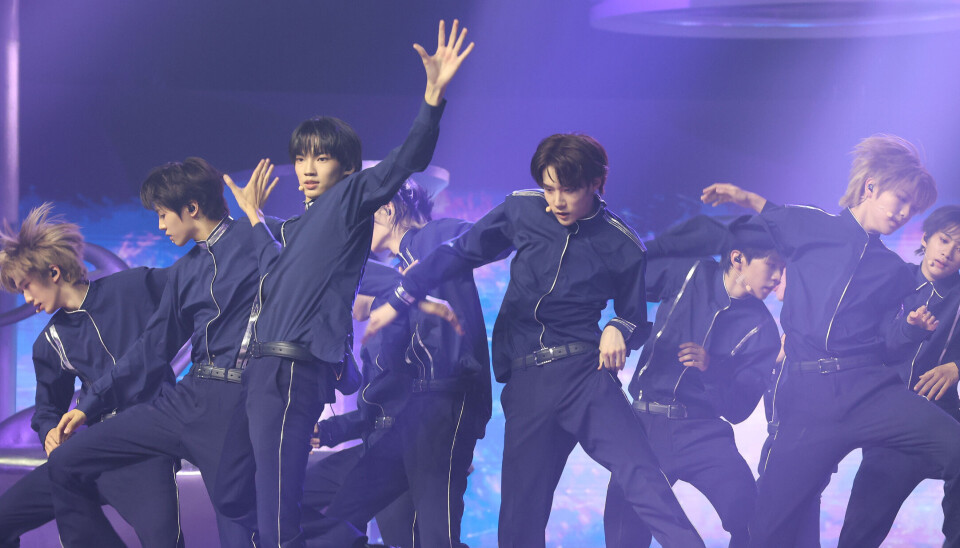
A2O Lite performs its debut single "Neon" during the “Welcome to Soulite From A2O Soul A2O Lite” debut showcase at Kintex in Goyang, Gyeonggi, on Oct. 12.YNA
[Reporter's Notebook]
Whether you like Lee Soo-man or not, the man knows how to make an entrance.
The 74-year-old industry veteran, who had an outsize influence on what we call the K-pop system today, has certainly secured an audience for his latest venture, A2O Entertainment, with Monday’s showcase, “Welcome to Soulite From A2O Soul A2O Lite.”
The event at Kintex in Gyeonggi was billed as a debut showcase for two rookie groups: boy band A2O Soul and girl group A2O Lite. Much of the public attention, expectedly, fell on the strikingly young members — about whom we still know remarkably little — and the precision of their undeniably polished performance.
Yet the true centerpiece of the day, to which Lee dedicated about 10 minutes in his 20-minute speech, was something with a considerably less catchy name: four-dimensional Gaussian splatting, or "4DGS."
Lee Soo-man, A2O Entertainment founder and key producer, speaks during the “Welcome to Soulite From A2O Soul A2O Lite” debut showcase at Kintex in Goyang, Gyeonggi, on Oct. 12.NEWS1
“I think 4DGS may be the most advanced form, and the final form, in the evolution of the recording devices we call cameras,” Lee said during his presentation.
The 4DGS technology basically produces immersive virtual reality (VR) content that captures a space in 360 degrees, reconstructing moving people and scenes in 3-D and allowing them to be viewed from different positions and angles.
Then how is it different from VR concerts, which are becoming less of a novelty now?
In the VR concert I had previously watched, taking a step toward an idol would not have brought the performer any closer to me. In the 4DGS demonstration, I could move into the performance and stand among the idols if I wanted to.
At the venue, journalists could try the technology in a designated area, putting on a VR headset to watch A2O Soul and A2O Lite perform their debut singles.
A2O Soul performs its debut single "Superstar" during during the “Welcome to Soulite From A2O Soul A2O Lite” debut showcase at Kintex in Goyang, Gyeonggi, on Oct. 12.YONHAP
Watching a short excerpt of A2O Lite’s “Neon,” I would not say the experience felt groundbreaking at first glance. Small glitch-like visual effects flickered around the members, giving them the aesthetic of digital humans in a futuristic setting.
Then I took a couple of careful blind steps into the formation.
As the A2O Lite members changed positions, I almost passed through the digital image of one member and nearly lost my footing. And then I bumped into one of the small white tables where the headsets had been placed as I stumbled beyond my designated area.
And when I turned around, I could see the back of the member who had been standing at the center of the formation.
What struck me, beyond fascination with the experience, was how close I felt to the digitally rendered body in front of me. The visual effects and imperfect resolution made it clear that I was looking at a digital image, but the proximity felt more tangible, precisely because I could choose to close the distance.
Lee Soo-man, A2O Entertainment founder and key producer, speaks during the “Welcome to Soulite From A2O Soul A2O Lite” debut showcase at Kintex in Goyang, Gyeonggi, on Oct. 12.NEWS1
That freedom of choice was the point of the experience, which also made me wonder, "What else might a viewer do? Crouch lower? Move in close? Reach toward the idol, even if the outstretched hand would meet nothing but empty air?"
The actual artists would feel none of it, of course. Still, I wondered what it could mean to give viewers that freedom around a digital representation of a real person — especially a young one.
There have always been, and will be, a corner of the internet full of zoom-ins and slow-motion clips of performers’ bodies. I don’t know if this brief demonstration of volumetric video could and would extend into that kind of viewing as well, but choosing where to stand felt different from watching a camera angle someone else has selected for the viewers.
I understand and share Lee’s excitement about the technology to some extent. Being able to revisit a moment in the past as if I am reliving that precise time and place is a striking experience.
But the demonstration at the venue, coupled with the trial of an AI-powered chatbot experience, Blooming Talk, made me think about the people who will be preserved in that moment.
A2O Lite poses for a photo during the “Welcome to Soulite From A2O Soul A2O Lite” debut showcase at Kintex in Goyang, Gyeonggi, on Oct. 12.A2O ENTERTAINMENT
On Blooming Talk, the fan communication platform of A2O, I could speak with AI versions of actual members, including A2O Soul’s Tai and A2O Lite’s Oa. Tai is 15. Oa is 13. My question was how much say these young performers had over the ways their faces, voices and performances have become available for recreation and reconstruction? What could they restrict? I am not saying they won’t be protected — my question is how much they are being protected, and how many guidelines and guardrails exist to confidently involve kids in this experiment. Being able to walk around a digital person does not, in and of itself, make the experience exploitative, but that does not change the fact that we are blissfully unaware of what kind of safeguards are already in place or even needed.
I wanted to hear about those safeguards with the same clarity as I had heard about the possibilities.
I was impressed, yes, especially about the amount of freedom the technology gave me as a viewer and how much closer I could get. Now I wonder what the idols could choose to keep at a distance.