From One Direction to BTS, why aren't boy bands winning Grammys?
Experts cite a bias against younger, female fans and categorization rules as reasons that even record-breaking boy bands struggle to be recognized by the Grammys.
BTS members pose with Harry Styles at the British singer’s first concert in Korea in a photo uploaded to BTS member V’s Instagram on March 21, 2023. Clockwise from left are RM, V, Styles, Suga and Jungkook.SCREEN CAPTURE
Why hasn’t BTS won a Grammy yet?
The question has resurfaced almost every awards season among ARMY, the collective name for the septet’s fans, since BTS earned its first Grammy nomination in 2020.
Twelve years earlier, the Recording Academy received the same frustration from another pop-music fandom, when a One Direction fan asked why the British group had never been nominated for a Grammy.
Before One Direction, the Backstreet Boys and *NSYNC repeatedly came close to achieving the feat, earning multiple nominations, but they never took home a trophy. Neither did New Kids on the Block, who marked a major milestone in the history of boy bands back in the 1980s.
Together, these cases, stretching across multiple boy bands from different eras, raise a familiar question: Is there an invisible line around the Grammys that boy bands — from the Backstreet Boys and *NSYNC to One Direction and now BTS — can’t cross?
In December 2014, shortly after the Recording Academy announced the nominations for the 56th Grammy Awards, a One Direction fan named Hannah sent a question to Grammy.com: “Why haven’t One Direction been nominated for a Grammy yet in their career?”
By that point, One Direction, formed through “The X Factor UK” (2004-18) and launched in 2011, was the first group in history to have its first four albums reach No. 1 on the Billboard 200.
One Direction during its performance on NBC's "Today" (1952–) show in New York City on Nov. 13, 2012 [AP/YONHAP][AP/YONHAP]
The Grammys team replied on its website by explaining the nomination process before adding, “Though [One Direction has] yet to receive a nomination, we just want to point out that the Grammys are indeed boy band-friendly.”
As examples, the academy pointed to two of the biggest boy bands of all time: the Backstreet Boys and *NSYNC.
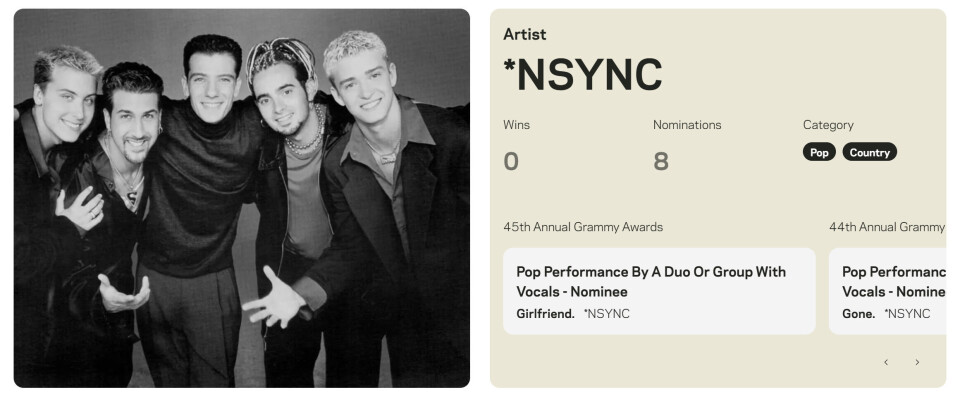
The Backstreet Boys had earned seven Grammy nominations by then, later receiving an eighth in 2019 for Best Pop Duo/Group Performance for “Don’t Go Breaking My Heart” (2019). *NSYNC earned eight nominations from 2000 to 2003.
But neither group had ever won.
*NSYNC's page on the Grammys' websiteSCREEN CAPTURE
One Direction, meanwhile, never even received a nomination.
The Grammys have recognized group acts before, with one of the clearest examples being Irish rock band U2, which has earned 46 nominations and 22 wins. It is the only group to win Album of the Year twice.
But pop groups whose success is powered heavily by their younger, female-led fandom have often faced a steeper battle when it comes to credibility, critics and researchers have long argued.
“In fan-dominated spaces, teen girls are the ultimate authorities,” critic Brodie Lancaster wrote in Pitchfork in August 2015. “But their power has an expiration date because pop artists earn respect only when they stop appealing to a teen demographic.”
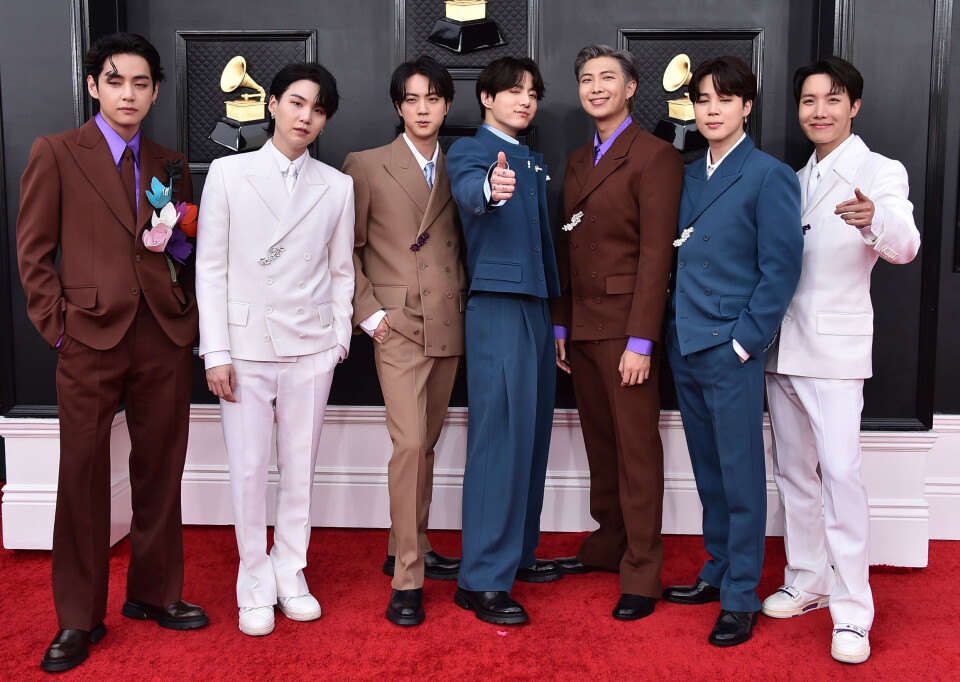
BTS performs during the 64th Annual Grammy Awards show in Las Vegas on April 3, 2022.REUTERS/YONHAP
Citing Justin Timberlake and Beyoncé as examples, Lancaster added that “legitimacy and longevity [await] pop artists when they trade their Teen Choice Awards for Grammys.”
A 2023 paper by Renita Coleman, a professor in the School of Journalism and Media at the University of Texas, made a similar point about the media’s perception of boy bands.
“[They] have long been disparaged in music journalism, in part because of their association with teenage and prepubescent girls who are their primary fans,” she wrote.
She also found that boy bands were frequently discounted due to stereotypes around their age, authenticity, sexuality and fans compared to similar acts.
Beyoncé poses with her award for Best Traditional R&B Performance for "Love On Top" (2011) backstage at the 55th annual Grammy Awards in Los Angeles on Feb. 10, 2013.REUTERS/YONHAP
For One Direction, other factors may also have played a role. Despite its impressive album sales and the scale of its fandom, the group never had a single top the Billboard Hot 100, though it had 29 charting songs. Its strongest base was also widely understood to be in Britain and among young pop fans, rather than across the broader U.S. industry voters who decide Grammy nominees.
Kim Jung-won, an ethnomusicologist who specializes in fandom culture and teaches classes on K-pop culture at Yonsei University, said that One Direction’s lack of a Grammy nomination may have partly reflected the limits of its presence in the U.S. industry, but that it also exemplified a broader pattern.
“The pattern could suggest that boy and girl groups that gain popularity among specific age groups and are created through what we now call the ‘idol-training’ system — being recruited and promoted in certain ways — might have been barred from Grammy recognition,” Kim said.
BTS appears at the 64th Annual Grammy Awards in Las Vegas on April 3, 2022.AP/YONHAP
Kim added that music preferred by young, female fans has long been looked down upon in mainstream pop criticism.
Pop culture critic Kim Hern-sik also pointed to the structure of the Grammy category in which BTS has most often been recognized — the Best Pop Duo/Group Performance.
“The basic criteria in assessing musical performances is fundamentally different between pop music and K-pop, as the [Best Pop Duo/Group Performance] category that BTS has been mainly recognized in so far, tends to weigh collaborations between individual pop stars more,” Kim Hern-sik said. “But [K-pop] idol music is fundamentally different from such categorization.”
The Recording Academy, meanwhile, has made efforts in recent years to address longstanding criticism over diversity and representation, particularly around race and gender.
Of the more than 3,800 people accepted into the Recording Academy’s new member class last year, 50 percent are age 39 or younger, 58 percent are people of color and 35 percent identify as women, according to its website.