Samsung Heavy lands $1.2 billion ship deal as Korean shipbuilders chase next LNG boom
The Korean shipbuilder’s major order highlights a rebounding liquefied natural gas carrier market as rivals expand into offshore facilities, AI operations and floating data centers.
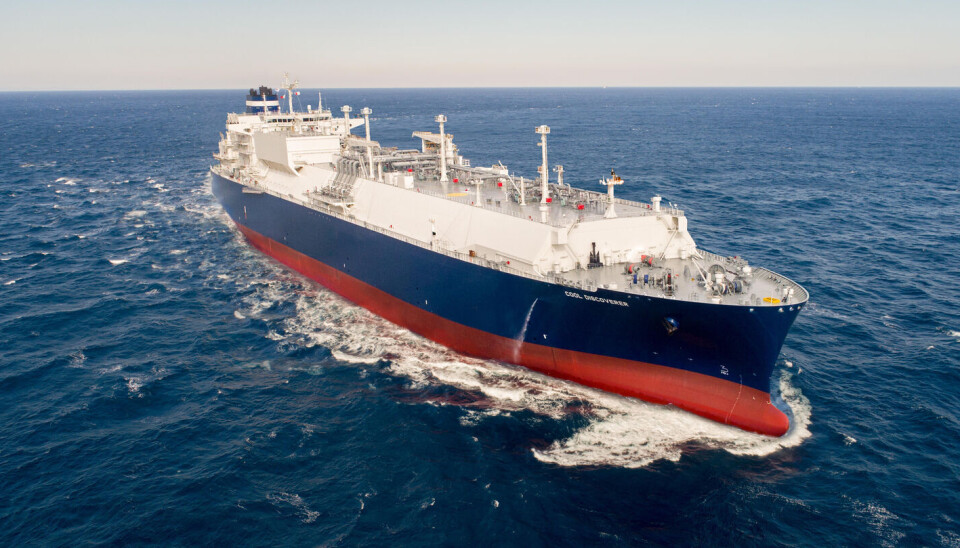
A 266,200-cubic-meter ultra-large liquefied natural gas carrier recently built by Samsung Heavy IndustriesSAMSUNG HEAVY INDUSTRIES
Samsung Heavy Industries has landed a ship order worth more than 1.6 trillion won ($1.2 billion) as demand for its mainstay liquefied natural gas (LNG) carriers rebounds. Korea’s three major shipbuilders are also branching into new businesses tied to LNG vessels.
Samsung Heavy signed a 1.65 trillion won contract with an Oceania-based shipowner for four 200,000-cubic-meter LNG carriers and two crude oil tankers, according to the company on Monday.
The four LNG carriers alone are worth $1 billion in total.
Samsung Heavy Industries has secured $7.3 billion in commercial ship orders this year, including 18 LNG carriers. The figure has already surpassed the $7.1 billion the company booked for all of last year.
The LNG carrier market is also bouncing back fast. Shipowners ordered 59 vessels in the first half of this year. The orders nearly match last year’s full-year total, according to Clarksons Research.
Riding that rebound, Samsung Heavy Industries unveiled its blueprint for future growth at Gastech 2026, the world’s largest energy exhibition, which opened Monday in Bangkok.
The shipmaking giant is putting floating LNG (FLNG) facilities front and center. FLNG facilities are essentially “LNG factories at sea.” The new facilities liquefy and store natural gas directly at offshore fields instead of sending it ashore for processing.
The shipbuilder plans to apply Sense, its proprietary natural gas cooling system, to its FLNG facilities. The company is seeking classification approval for the technology and is also pursuing its first licensing deal.
A liquefied natural gas carrier constructed by HD Hyundai Heavy Industries sails the seas in an undated photo.HD KOREA SHIPBUILDING & OFFSHORE ENGINEERING
HD Hyundai Heavy Industries is focusing on next-generation LNG carriers and digital transformation.
HD Hyundai is showcasing a futuristic LNG carrier that moves the crew accommodation block toward the bow. The new design frees up deck space and makes it easier to install wind-assisted propulsion systems.
HD Hyundai is also working to commercialize an AI solution designed to efficiently operate the complex array of engines, generators and other power equipment aboard LNG carriers. The technology calculates optimal operating conditions to minimize fuel consumption, part of an effort to expand its business beyond shipbuilding into more efficient vessel operation.
Hanwha Ocean is taking a different tack. The shipbuilder is making the global debut of a 60-megawatt floating data center (FDC), its first such concept for the international market.
As AI drives up demand for power-hungry data centers, the shipbuilder’s FDCs could provide a more energy-efficient option. The FDCs use seawater for cooling to cut energy use, which also eases constraints on land and power.
This article was originally written in Korean and translated by a bilingual reporter with the help of generative AI tools. It was then edited by a native English-speaking editor. All AI-assisted translations are reviewed and refined by our newsroom.