CES organizer cites Korea’s startup culture ahead of 2027 show
Kinsey Fabrizio expressed an eagerness to build on CES 2026, which saw over 13,000 Koreans and nearly 800 Korean companies participate.
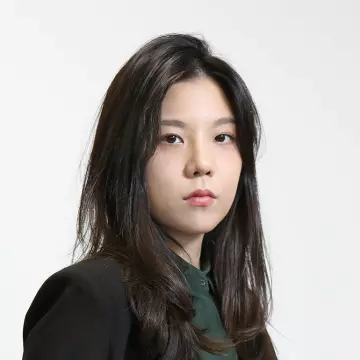
Kinsey Fabrizio, right, president and CEO of the Consumer Technology Association (CTA), and Melissa Harrison, CTA vice president and head of marketing and communications, pose for a photo at a press event previewing CES 2027 at Coex in southern Seoul on Oct. 14.
CONSUMER TECHNOLOGY ASSOCIATION
AI and its reach across industries will be the main themes of CES 2027, while the show’s organizer pointed to Korea’s startup culture as a standout among nations.
“Korea really focuses on the startup innovation culture here, and there’s a tremendous amount of commitment and investment to startups,” said Kinsey Fabrizio, president and CEO of the Consumer Technology Association, at a press event at Coex in southern Seoul on Wednesday. The event introduced the key technology trends for next year’s show.
“What’s great is that those startups, we had almost 400 at CES 2026 […] get to come to Las Vegas,” she said. “It’s a great kick start to what hopefully turns into additional business growth and development.”
Korea’s presence at CES 2026 included more than 13,000 attendees and nearly 800 Korean companies, 400 of them startups.
Chinese companies dominated last year’s show in humanoid and physical AI, making China the second-largest national presence after the United States. The physical AI exhibition is expected to expand further next year. When asked about the scale and nationalities of the participating companies, Fabrizio declined to give a direct answer but said the number of humanoid exhibitors is higher than at CES 2026.
CTA’s trend framework has three tiers: foundation, transformation and exploration. Foundation covers AI chips, vertical AI and agentic AI. Transformation covers robotics or physical AI, smart glasses, mobility, health and the connected home. Exploration covers quantum, space and brain-computer interfaces.
CES 2027 will also showcase more mature AI use cases that companies can quantify, with examples in productivity, advanced manufacturing and health care.
“We’re going to see what’s actually happening, and companies will be showcasing how their solutions are transforming, whether it’s productivity, advanced manufacturing or a specific use case of health care like drug discovery or treatment development, or even just more sophisticated monitoring and communication,” Fabrizio said. “You will see those examples happening on the show floor, and they will be more mature, and those companies will be able to quantify how this would actually work in the [actual] environment.”
BY LEE JAE-LIM [[email protected]]