Retail money chases chip ETFs despite large losses. Can the crackdown calm the market chaos?
Massive investments, particularly from retail investors, flowed into leveraged Samsung Electronics and SK hynix ETFs despite steep losses, prompting regulators to tighten trading requirements.
A SK hynix single-stock leveraged exchange-traded fund rebounds on a smartphone stock trading app on July 15.NEWS1
Investors poured nearly 7 trillion won ($4.7 billion) into leveraged exchange-traded funds (ETF) tied to Samsung Electronics and SK hynix over the past month despite steep declines in both stocks. This led regulators to tighten trading rules as concerns were raised over potential market side effects.
Investors poured a net 7.34 trillion won into 16 single-stock leveraged ETFs, including two inverse products, between June 16 and Wednesday, according to data from the Korea Exchange and ETF Check on Friday.
The products began to launch on May 27, after the government allowed single-stock ETFs tied to individual companies on the domestic market. The move was in a bid to draw back investor demand that has been flowing overseas.
The Kodex SK hynix Single Stock Leverage ETF attracted the largest inflow at 3.45 trillion won, followed by the Kodex Samsung Electronics Single Stock Leverage ETF with 1.51 trillion won and the Tiger SK hynix Single Stock Leverage ETF with 1.43 trillion won. The Tiger Samsung Electronics Single Stock Leverage ETF drew 693.8 billion won.
The inflows came despite sharp declines in the underlying shares. Over the same period, Samsung Electronics fell 24.33 percent and SK hynix dropped 19.49 percent. The leveraged ETFs performed even worse, with the Kodex SK hynix and Kodex Samsung Electronics leveraged funds falling 45.6 percent and 48.44 percent, respectively.
Retail investors accounted for most of the buying.
Individual investors purchased a net 4.24 trillion won worth of seven SK hynix single-stock leveraged ETFs and 1.61 trillion won worth of seven Samsung Electronics single-stock leveraged ETFs during the past month.
A Samsung Electronics single-stock leveraged exchange-traded fund is shown on a smartphone stock trading app on May 27.NEWS1
This far exceeded foreign investors' net purchases of 859.5 billion won and 724.2 billion won, respectively.
Institutional investors, meanwhile, were net sellers, unloading 5.17 trillion won of SK hynix products and 2.27 trillion won of Samsung Electronics products.
The concentration of retail money in leveraged ETFs has fueled concerns over increased market volatility.
To maintain their target exposure, leveraged ETFs must rebalance their portfolios at the close of each trading session, concentrating trading activity near the market close and amplifying price swings. Critics say the phenomenon has allowed derivatives to exert an outsized influence on the underlying market.
In response, the government and financial regulators on Thursday announced a package of measures, including a suspension of new listings for single-stock leveraged ETFs and stricter investment requirements.
Beginning next month, the minimum cash deposit required to trade the products — the amount investors must maintain in their accounts to trade high-risk financial products — will be raised to 30 million won from the current 10 million won.
Investors will also be required to trade the ETFs in lots of 20 shares rather than one share at a time, a move intended to curb excessive trading volume. For example, if a Samsung Electronics leveraged ETF is trading at 15,000 won per share, investors would need at least 300,000 won to purchase the minimum 20-share lot — more than the closing price of Samsung Electronics shares, which stood at 255,000 won on Thursday.
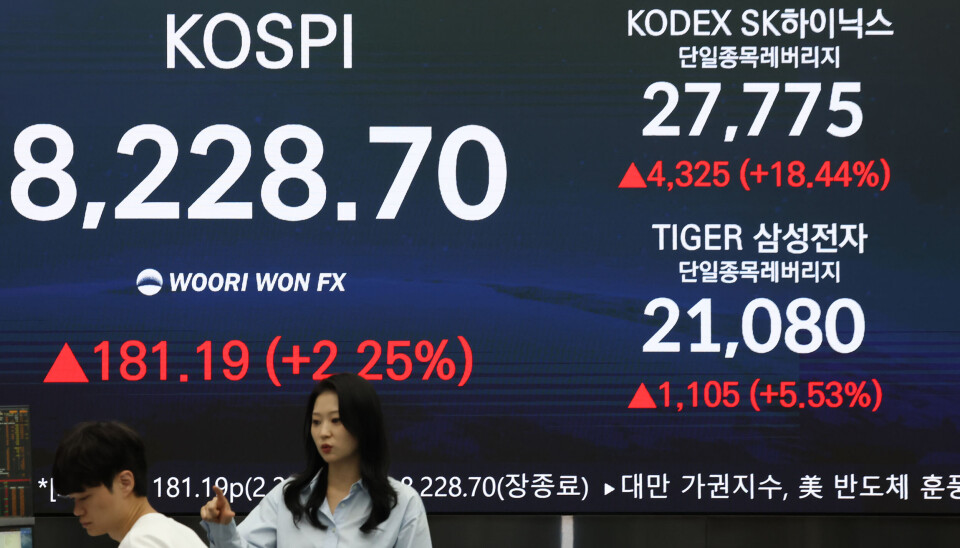
Electronic display boards at the Woori Bank's trading room in central Seoul show the closing Kospi index and the closing prices of the Kodex SK hynix Single Stock Leverage ETF and the Tiger Samsung Electronics Single Stock Leverage ETF on May 27.YONHAP
Regulators also plan to strengthen mandatory investor education administered by the Korea Financial Investment Association before trading these products.
Some in the financial industry, however, warned that the measures could create new risks.
With daily trading value in leveraged ETFs recently reaching around 10 trillion won, a rapid withdrawal of funds could weaken overall market activity.
"Investors could pull money out and shift it to overseas markets, or the measures could accelerate the broader downturn in the domestic stock market," an industry source said.
Others cautioned that the higher deposit requirement could push investors to sell individual stocks to free up cash for leveraged ETF trading, potentially weighing on the Kosdaq market. Some market participants also argued that the measures fall short because they do not include more direct tools such as limits on daily turnover or temporary trading halts.
Financial authorities said they are prepared to introduce additional measures if the market remains unstable.
"It is certainly unusual to introduce supplementary measures just a month and a half after these products were launched," Byeon Je-ho, director general of the Capital Markets Bureau at the Financial Services Commission, said. "But the concentration of trading was much greater than we had anticipated, leaving us with little choice but to act to maintain market stability and protect investors."
This article was originally written in Korean and translated by a bilingual reporter with the help of generative AI tools. It was then edited by a native English-speaking editor. All AI-assisted translations are reviewed and refined by our newsroom.