U.S. President Donald Trump, front, makes an announcement in the Oval Office at the White House in Washington on Sept. 30.REUTERS/YONHAP
A liquefied natural gas (LNG) project in Alaska could hand Korean steelmakers and shipbuilders a wave of new orders, from a 1,300-kilometer (808-mile) pipeline to LNG carriers. But with costs, construction delays and buyer demand still uncertain, industry sources say it is far too early to celebrate.
The Alaska LNG project calls for transporting natural gas from the North Slope in northern Alaska to Nikiski in the south, where the gas would be liquefied and exported to Asia. The project is estimated to cost between $44.5 billion and $54.5 billion.
Korea's potential participation has drawn attention because of the $350 billion Seoul pledged to invest in the United States during tariff negotiations with Washington last year. U.S. President Donald Trump has also pressed Korea to invest in the project.
Minister of Trade, Industry and Resources, Kim Jung-kwan reiterated during a National Assembly audit on Tuesday that the government is still reviewing the project, saying, “Any review would have to be premised on its commercial viability.”
One of the biggest questions is whether the project can secure enough buyers.
“Whether sales contracts are in place is just as important as the project’s economic viability,” an LNG industry source said. “Companies need long-term contracts as collateral to raise financing through loans and other means.”
Minister of Trade, Industry and Resources Kim Jung-kwan speaks during a government audit in Yeongdeungpo District, western Seoul, on Oct. 6.NEWS1
The project needs long-term contracts for 16 million tons of LNG a year to secure financing, according to U.S. energy company Glenfarne Group, the lead developer. Potential agreements currently cover 13 million tons a year, but most are reportedly nonbinding.
Even Posco International, which has signed a heads of agreement to buy 1 million tons annually, is waiting for Glenfarne to complete financing, the source said.
Construction poses another challenge. The pipeline would have to cross permafrost, while higher material and labor costs as well as permitting issues could push up expenses and extend the construction schedule.
“The LNG project in Canada that Korea participated in also took longer than expected to build its pipeline because it passed through Indigenous lands,” a gas industry source said. “Alaska could face all sorts of variables beyond the extreme cold.”
Whether LNG would remain commercially attractive by the time the project is completed is also uncertain.
The Posco No. 1 liquefied natural gas Terminal at the Gwangyang National Industrial Complex in Geumho-dong, Gwangyang, Jeonnam-Gwangu, is seen in this undated photo.POSCO INTERNATIONAL
“Many expect the project could be delayed by environmental impact assessments and other procedures, with completion pushed beyond 2040,” a source at the Korea Energy Economics Institute said. “If construction is delayed, there is a question over whether LNG [which is a fossil fuel] would still retain the level of economic viability currently projected.”
The source added that lower demand under the global push for carbon neutrality could eventually create a buyers’ market and force suppliers to sell LNG “below cost.”
“It is true that the project did not move forward in the past because its commercial viability was clearly low,” Industry Minister Kim said. “But the war in the Middle East has clearly created new strategic value.”
That is because cargoes from Alaska could reach Northeast Asia without transiting the Strait of Hormuz, at a time when the Russia-Ukraine war and instability in the Middle East continue to raise concerns over energy security.
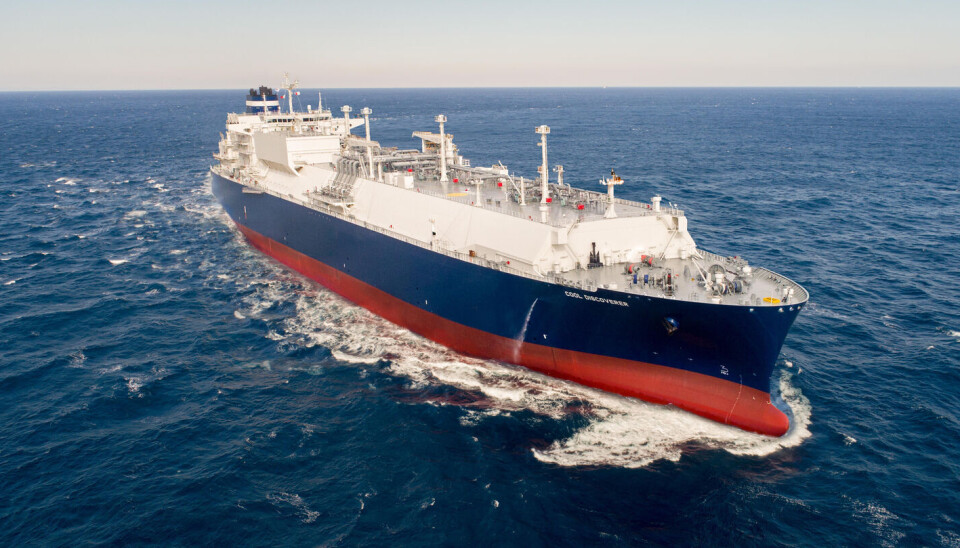
A liquefied natural gas carrier constructed by HD Hyundai Heavy Industries sails the seas in an undated photo.HD KOREA SHIPBUILDING & OFFSHORE ENGINEERING
Steelmakers and pipe manufacturers could be among the first Korean companies to benefit if the project goes ahead. Pipe makers such as SeAH Steel could turn the materials into large-diameter line pipe.
“A 1,300-kilometer pipeline would be a very large project by the standards of Korea’s domestic gas pipeline network,” a steel industry source said. “It would create demand that did not exist before, so it would obviously be a positive for an industry that has been struggling.”
The project could also generate demand for high-grade steel capable of withstanding Alaska’s extreme cold.
Korean shipbuilders could benefit as well if annual LNG exports reach 20 million tons and create demand for new carriers.
“Most existing LNG carriers are already tied up transporting other cargoes, so a large new source of demand would require additional vessels,” a shipbuilding industry source said. “But there are still far too many stages the project must go through before that happens.”
This article was originally written in Korean and translated by a bilingual reporter with the help of generative AI tools. It was then edited by a native English-speaking editor. All AI-assisted translations are reviewed and refined by our newsroom.