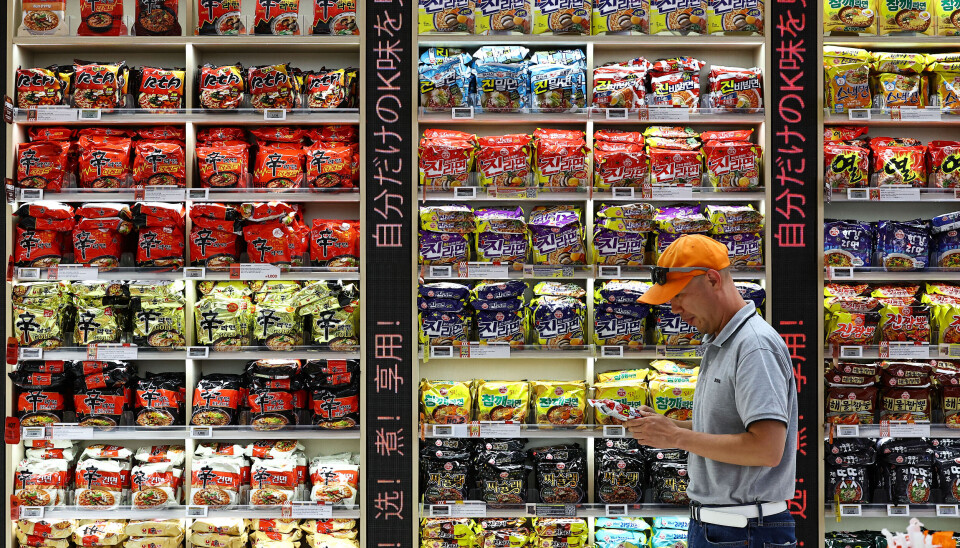
Foreign tourists browse ramyeon on a display wall at Emart24’s K-Food Lab Myeongdong store in Jung District, central Seoul, on Sept. 30. The wall, on the store’s second floor, stands 2.8 meters (9 feet and 2 inches) tall and holds about 170 kinds of ramyeon.KIM JONG-HO
Korean instant noodles could top $2 billion in exports for the first time this year, and the boom has spread well beyond Samyang Foods’ fiery Buldak ramyeon.
Ramyeon exports hit a record $935.4 million in the first half, up 27.9 percent from a year earlier, according to the Korea Agro-Fisheries & Food Trade Corporation (aT). That is already about 62 percent of last year’s full-year total of $1.52 billion.
A few years ago, the global craze centered on Samyang Foods’ Buldak ramyeon. Now a wider range of spicy noodles from Nongshim, Otoki and Paldo is selling abroad as well.
Export data by country and region show how far the appetite has spread. China bought the most Korean ramyeon last year, $385.4 million worth, up 47.9 percent on year, according to the Ministry of Agriculture, Food and Rural Affairs. The vast market, with tastes in some ways close to Korea’s, remains a loyal customer.
China is far from the only one. Exports to the United States rose 18.2 percent to $254.7 million, and those to Asean countries grew 12.4 percent to $223.2 million. Shipments also climbed to Central Asia, up 38.7 percent to $82.4 million; Japan, up 23.6 percent to $77.3 million; and the Middle East, up 22 percent to $47.5 million.
The spread means exporters are not overly dependent on China, and Korean ramyeon is winning fans in countries once thought to have very different tastes. Double-digit growth in Japan, the birthplace of instant noodles, shows how deep overseas demand has become.
“Most of the Korean ramyeon popular overseas is spicy,” an aT official said. “It is not competing with Japanese ramen, which is mostly mild and sweet, but creating demand of its own.”
Packs of ramyeon fill the shelves of a large supermarket in Seoul on Sept. 15. Ramyeon exports have risen 27.2 percent to $1.31 billion so far this year, the steepest increase of any product, according to the Korea Agro-Fisheries & Food Trade Corporation.YONHAP
Along with Buldak ramyeon, domestic bestsellers proven over decades, such as Nongshim’s Shin Ramyun, Otoki’s Jin Ramen and Paldo’s Bibimmen, are also catching on abroad.
Ramyeon makers’ earnings reflect the boom. Samyang Foods’ overseas sales rose 46.7 percent on year to 645.8 billion won ($481.9 million) in the second quarter. Nongshim’s grew 30.6 percent to 328.6 billion won, and Otoki's 15.1 percent to 110.6 billion won.
“Ramyeon makers are growing both sales and operating profit, led by their overseas business,” Park Sang-jun, an analyst at Kiwoom Securities, said.
Overseas sales made up about 83 percent of Samyang Foods’ first-half revenue, or 1.23 trillion won out of 1.48 trillion won. Nongshim’s overseas subsidiaries posted 641.4 billion won in first-half sales, up 26.8 percent. Their share of the company’s total rose to 33.9 percent from 28.7 percent a year earlier.
The industry and experts point to several reasons for the global popularity. The “deliciously spicy” flavor that made Buldak a hit has itself gone global. For years, popular Korean dramas and films have shown actors happily slurping ramyeon as a late-night snack, and YouTube Shorts and Instagram videos of ordinary people taking on spicy-noodle challenges have multiplied. Both drew more consumers to Korean ramyeon.
Buldak instant noodles are being made at Samyang Foods’ first plant in Miryang, South Gyeongsang, in a photo the company released on June 11, 2025. Samyang said at the time that the plant would mainly make Buldak for export to China, Korean ramyeon’s biggest buyer.SAMYANG FOODS
Buldak sat at the center of that challenge trend, and cumulative sales of the Buldak ramyeon series passed 10 billion packs at the end of May.
Overseas consumers who have tried Buldak again and again are now curious about other spicy Korean noodles and take to them readily, a virtuous cycle that analysts say has formed in recent years.
“Korean ramyeon, which first took off abroad with the hallyu, is gaining synergy from changing perceptions among overseas consumers, new products the industry launched in step with them and a revival of old-style ramyeon spread through retro content,” Suh Yong-gu, a business professor at Sookmyung Women’s University, said. “It is the result of the market growing rapidly over the past several years.”
Samyang Foods’ Buldak Bokkeum Myeon is displayed at a supermarket in Kuala Lumpur, Malaysia. Korean ramyeon exports to Asean countries rose 12.4 percent to $223.2 million in 2025.KIM DO-NYUN
Years of localization efforts are also paying off. Paldo collected experience in Russia, where its square-cup Dosirac noodles became a big hit, and later launched Koreno, a ramyeon brand made just for Vietnam. Sales at its Vietnamese subsidiary reached 139.9 billion won last year, up 75.5 percent from 2023.
“We built the Koreno lineup by dividing the spiciness into seven levels to suit local tastes and diversifying ingredients such as beef and seafood,” a Paldo official said.
In the United States, Otoki has stepped up exports with eight cheese ramyeon products aimed at local consumers who are used to cheese flavors.
“We adapted [our Korean cheese ramyeon] for consumers in the Americas,” an Otoki official said. “We expanded it into flavors such as cheddar, spicy and mascarpone, with both soup and stir-fried versions.”
Models present Nongshim’s new rosé-flavored Shin Ramyun at a press conference marking the brand’s 40th anniversary at Lotte Hotel Seoul in Jung District, central Seoul, on May 13. The product, which blends Shin Ramyun’s savory gochujang flavor with tomato and cream, went on sale in Korea and Japan on May 18.NEWS1
Shifting demographics and eating habits are helping too. One-person households made up 36.6 percent of Korean households last year, and their share averages more than 30 percent across member countries of the Organisation for Economic Cooperation and Development. Living alone is a global trend, as people marry less, have fewer children and age.
“With one-person households surging overseas as well, home meal replacements that anyone can make quickly and easily are popular, and ramyeon is the leading example,” an industry source said.
The global home meal replacement market grew from $133.9 billion in 2024 to $149.2 billion last year and is projected to reach $322.4 billion by 2034, according to market research firm Market Growth Reports.
With overseas demand growing quickly, makers are scrambling to add capacity. Nongshim is building its first factory dedicated to exports in Busan.
“It is scheduled for completion next month, and we will first run three production lines to make 500 million packs of ramyeon a year,” a Nongshim official said.
Samyang Foods is building its first overseas plant in Zhejiang, China, and Otoki plans to build an export-only factory in Gumi, North Gyeongsang, by 2029.
“The next task for Korean ramyeon is to grow the market beyond simple exports by expanding production capacity and securing local distribution networks in earnest,” Jang Ji-hye, an analyst at DS Investment & Securities, said.
Responding quickly and accurately to changes in foreign regulations, which are particularly demanding for food, is another challenge for the industry.
This article was originally written in Korean and translated by a bilingual reporter with the help of generative AI tools. It was then edited by a native English-speaking editor. All AI-assisted translations are reviewed and refined by our newsroom.