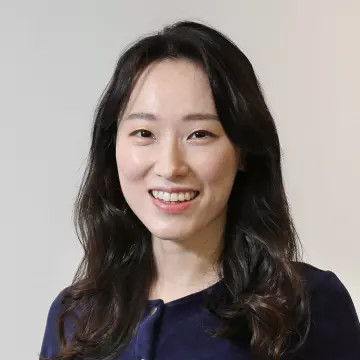
Kevin Sneader, the firm's president of Asia Pacific ex-Japan, added that Korea's big question will be whether it can turn strong corporate earnings into more durable shareholder value.
Kevin Sneader, president of Asia Pacific ex-Japan at Goldman Sachs, speaks at the opening ceremony of Korea Premium Weeks 2026, a government-backed investor relations event aimed at promoting Korea’s capital market to global investors, at the Grand Lotte Seoul in central Seoul on Sept. 28.YONHAP
[INTERVIEW]
Faster share buybacks and immediate cancellation of treasury shares are the keys to translating Korea’s cash windfall from the AI memory boom into higher stock valuations for global investors, said a senior Goldman Sachs executive, weeks after Korea's major chipmakers unveiled record shareholder return plans.
“To effectively translate this cash boom into per-share equity value, accelerating share buybacks and coupling them with immediate treasury share cancellations is essential,” said Kevin Sneader, Hong Kong-based President of Asia Pacific ex-Japan, Goldman Sachs, in a written interview with the Korea JoongAng Daily and JoongAng Ilbo.
The comments came after SK hynix announced a 40 trillion won ($29.5 billion) share-buyback program in August. Samsung Electronics, by contrast, unveiled a shareholder-return packagethat could beas much as 110 trillion won for 2026, including an estimated 30 trillion won in cash dividends for the third quarter. Details of the remaining returns, including any share buybacks and cancellations, won’t be decided until a board meeting in January 2027.
The lack of clarity over the buyback and cancellation plans disappointed investors, sending Samsung shares down 8.7 percent in the next trading session.
“By combining demand-aligned capital expenditures [focused on AI-related chips] with consistent dividend growth and proactive share cancellations, Korean companies can build a world-class capital allocation framework that appeals to both domestic and international investors,” he added.
The New York-based investment bank estimates that major Korean semiconductor producers will generate approximately 150 trillion won ($110 billion) in net cash flow in 2026, equivalent to nearly 5 percent of the country’s GDP, before the figure doubles to 300 trillion won in 2027.
Sneader spoke ahead of his visit to Seoul for Korea Premium Weeks 2026, which kicked off Monday at the Grand Lotte Seoul in central Seoul. At the opening ceremony, he expressed optimism about Korea’s benchmark stock index, citing Goldman Sachs’ 12-month Kospi target of 12,000 points, set in June.
Below are edited excerpts from the interview.
A screen displays the Goldman Sachs logo on the floor at the New York Stock Exchange in New York on May 7, 2025.REUTERS/YONHAP
Q. Korea has taken steps to address the “Korea discount.” Which reforms have mattered most to investors, and what remains to be done?
I think the most important development has been the consistency of the commitment to reform and the willingness of the authorities to engage directly with both domestic and international market participants. Measures to improve settlement infrastructure, including the Settlement Facilitation Fund, as well as greater flexibility around offshore affiliate borrowing, are tangible steps toward making the Korean market easier for global investors to access and navigate.
There is still work to do. For international investors, liquidity and the efficiency of settlement and margin processes matter enormously, and some operational frictions remain. Continued progress in these areas, together with effective implementation of the reforms already announced, will be important.
Korean equities have seen significant volatility and foreign outflows this year. Is this mainly cyclical, or does it reflect structural weaknesses in the market?
The recent volatility in Korean equities appears to reflect a mix of global market trends and domestic trading dynamics, rather than a fundamental change in Korea’s long-term outlook.
Korea’s market is closely linked to the global semiconductor cycle. Following strong gains in technology shares, some international investors reduced positions to manage portfolio concentration. This contributed to foreign selling, even as the earnings and cash-flow outlook for major semiconductor companies remained strong.
Domestic trading factors also amplified short-term moves. High retail participation and activity in leveraged products increased sensitivity to market swings, although these pressures have eased as positioning has become more balanced and stabilization measures have taken effect.
Looking ahead, the key issue is whether Korea can translate strong corporate earnings into more durable shareholder value. Continued progress on corporate governance, disciplined capital allocation and more consistent shareholder returns could help narrow the valuation gap and support a more sustained improvement in Korean equities.
Kevin Sneader, president of Asia Pacific ex-Japan at Goldman Sachs, left, and Joud Abdel Majeid, co-head of the Global Partners Office at BlackRock, rear left, listen to Lee Eog-weon, chairman of the Financial Services Commission during a private meeting following the opening ceremony of Korea Premium Week at Grand Lotte Seoul in central Seoul on Monday.YONHAP
How should Korean companies allocate the cash generated from the global semiconductor boom to achieve a sustainable improvement in their valuations?
Historically, capital allocation in Korea has favored broad, asset-heavy manufacturing capacity expansion. To maximize capital efficiency, leading companies are shifting toward highly targeted capital expenditures. This involves focusing on customized memory and high bandwidth memory (HBM) to address surging global artificial intelligence demand. Beyond capital reinvestment, a balanced strategy would prioritize shareholder returns to address historically low payout ratios.
You said last year that Asia ex-China was attracting significant capital inflows. How much of that capital has stayed in the region, and how much has flowed into Korea?
Capital flows within emerging Asia ex-China have transitioned from a phase of rapid accumulation to active, technical portfolio rebalancing. Cumulative Foreign Institutional Investor outflows from EM Asia ex-China markets reached $189 billion in 2026 as of mid-September, with Korea experiencing a significant share of this trend, representing $120 billion in cumulative outflows during the same period.
Rather than indicating structural capital flight, these outflows have been heavily concentrated in heavyweight semiconductor leaders, driven by long-only global investors trimming positions as surging valuations pushed those holdings above 10 percent single-stock concentration limits. This technical rebalancing brought foreign ownership of the Korean semiconductor sector to levels significantly below its long-term average, indicating lighter positioning in this dominant equity market segment. However, due to the strong broader performance of the Kospi, foreign ownership in absolute value terms actually increased substantially as the rising market value of retained positions offset the selling.
This positioning dynamic has created a far more balanced and healthy technical foundation for the market. While emerging market mutual funds remain underinvested in Korea as of end-August, hedge fund allocations also moderated from their previous peaks. Consequently, overall market positioning has become much more resilient following a decline in leveraged ETF assets, lower retail margin exposure, and normalized institutional allocations.
These dynamics are supporting broader market participation. As global investors face concentration constraints in Korea's two leading memory giants, incremental foreign flows have begun rotating toward other AI beneficiaries, advanced manufacturing, and industrials. We expect this trend to persist as investors actively seek uncorrelated opportunities and broader exposure across Korea's technology supply chain.
Goldman Sachs has been expanding its investment in Korea’s hotel market, acquiring Mercure Ambassador Seoul Hongdae last year and emerging as the preferred bidder for Timewalk Myeongdong. What makes Korea’s hospitality market particularly attractive?
Korea’s hospitality market reflects several broader trends that we believe are making the country increasingly interesting from an investment perspective. Inbound tourism has grown strongly, supported not only by traditional sources of demand but by the increasingly global reach of Korean culture across music, film, food and fashion.
At the same time, hotel supply has remained constrained following the pandemic and by higher construction and financing costs. That combination of growing and increasingly diversified demand with limited new supply has created an attractive environment for well-located assets where we see opportunities to invest capital and enhance their long-term value.
But our interest in Korea extends well beyond hospitality. Over multiple decades, Korean companies have developed from predominantly Asian businesses into global leaders, particularly in areas such as semiconductors, advanced manufacturing and technology. Korea’s importance is increasing as global supply chains place greater value on technological capability, resilience and strategic manufacturing capacity.
Domestically, we also see opportunities emerging from the next wave of AI and digital transformation, supported by sophisticated consumers, world-class digital infrastructure and a deep technology ecosystem. Retail and other consumer-facing sectors can also benefit from increasing tourism and, over time, from the continued development of Korea’s domestic capital markets.