AI could soon get you more interest on your money. But banks may not like it.
AI agents could shift idle cash into higher-yield accounts, optimizing consumer returns but directly impacting the bottom line at financial institutions that have for years relied on consumer “laziness.”
A robotic hand types in this illustration created on Sept. 23.REUTERS/YONHAP
What if AI moved your cash around for you to earn better rates while you slept? For consumers, it could come to billions in extra interest. But for banks, it could mean a serious dent in their profits.
That money represents the price consumers pay for inertia — a “laziness tax” that comes from leaving cash in low-interest accounts instead of moving it to better-paying products. As AI evolves from a tool that answers questions into an agent that can act on a user’s behalf, some of that money could start flowing back to customers.
“U.S. banks face their own end times,” Reuters wrote on Oct. 6 in an analysis of the potential impact of AI on more than 500 U.S. banks.
If $3.8 trillion in U.S. savings deposits moved into accounts paying 4 percent a year on AI advice, banks could face an additional $79 billion in annual interest costs. The amount would be enough to wipe out the net income of 32 banks.
The impact could be even greater if AI kept only the minimum necessary amount in checking accounts and moved the rest into products yielding 4 percent. As many as 78 banks could fall into the red under that scenario, Reuters estimated.
The Financial Times estimated on Wednesday that as much as $500 billion across the U.S. banking system could be at risk as AI drives deposits toward better-paying products.
The development amounts to a major challenge for a financial industry that has long benefited from consumer inertia.
OpenAI dots and Meta Muse logos are seen in this illustration taken on Sept. 29.REUTERS/YONHAP
Meta introduced its AI agent Muse last month. The service connects to users’ bank accounts, identifies unnecessary spending and can cancel services or switch users to cheaper alternatives with their approval.
OpenAI’s dots can continue working on assigned tasks through its own cloud computer even after the user steps away.
Korea has plenty of money sitting idle in low-interest accounts, too.
Savings and demand deposits at Korean banks totaled about 681 trillion won ($510 billion) at the end of July. Much of that money remains in accounts that allow withdrawals at any time despite offering low interest rates.
Korea has also begun early experiments aimed at putting that idle money to better use.
Meta's new AI agent Muse can review different strollers, choose one and then purchase it.META
The Financial Services Commission launched a MyData service in February that allows designated providers to review information such as a user’s income and credit score with consent and automatically ask banks to lower loan interest rates.
Some 162,000 people benefited from the service through July. They saved a combined 100.3 billion won in interest, or an average of 610,000 won per person.
The service is expected to expand to debt restructuring, refinancing, applications for government-backed financing, relief for voice phishing victims and claims for unclaimed insurance benefits.
Koreans also use AI for finance and investment at particularly high rates, which could give financial AI agents fertile ground for growth.
The Claude logo is seen in this illustration created on June 5.REUTERS/YONHAP
Investment research accounted for 3.5 percent of Claude usage observed in Korea in May, the highest share among 79 countries for which data was available, a JoongAng Ilbo analysis of raw economic index data released by Claude developer Anthropic found on Sunday.
“Buying and investing” accounted for 4.42 percent of usage, also the highest among 106 countries.
YUN YOUNG
Consumers are still largely at the stage of asking AI questions such as where they should invest. Once AI is given authority to act, however, it could eventually compare and recommend products, submit applications and execute transactions on a user’s behalf.
But consumers around the world are still wary of handing AI the keys to their wallets.
Some 34 percent of respondents said they would allow AI to cancel unused subscriptions, while 32 percent said they would let it automatically switch them to cheaper products, according to a survey of 14,300 consumers in 13 countries conducted by global security company Thales in January and February.
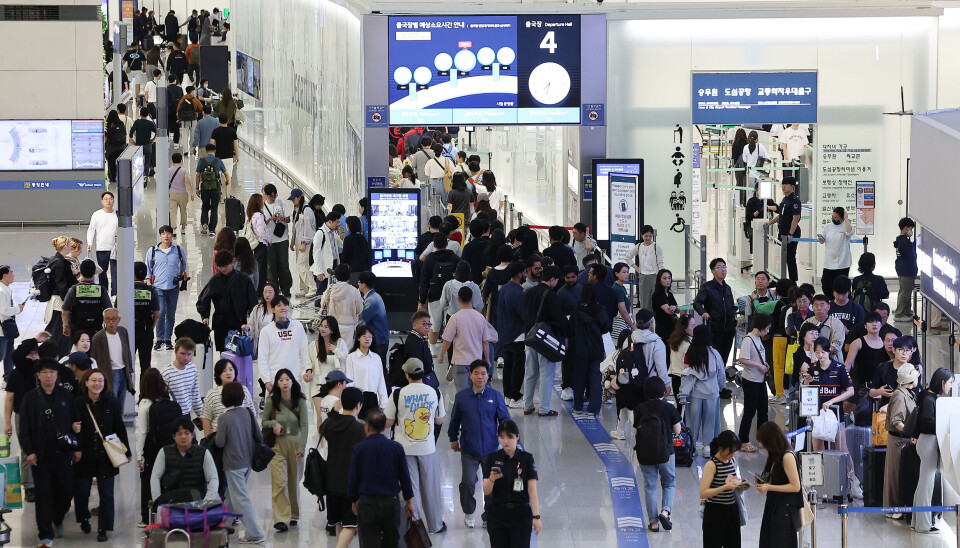
Travelers fill the departure hall at Incheon International Airport’s Terminal 1 during the Chuseok holiday on Oct. 6, 2025.NEWS1
The numbers dropped sharply for more sensitive tasks. Only 11 percent said they would allow AI to change travel bookings, while just 7 percent would let it transfer money between bank accounts.
“The more authority an AI agent has, the greater the risk that those powers could be abused if the system is hacked,” Park Chan-am, CEO of Stealien and an adviser to the Presidential Council on National Artificial Intelligence Strategy, said. “We need to carefully manage not only convenience but also how much authority AI should be given for each task.”
Laws and regulations are not yet ready to fully support AI that can take action on a user’s behalf.
Current law imposes strict rules on identity verification and payment methods in financial transactions, which limits AI’s ability to move money or make payments for users. Even services that allow AI to request lower interest rates on behalf of consumers operate only under special regulatory exemptions granted by financial authorities.
Bank ATMs are seen in Seoul on Oct. 5.NEWS1
“AI services that compare and recommend financial products such as investments and insurance are highly likely to be regarded as solicitation under the Act on the Protection of Financial Consumers,” Baik Yeon-ju, a research fellow at the Korea Institute of Finance, said. “The logic behind generative AI outputs is opaque, which makes it difficult to guarantee the same level of reliability, ethical standards and expertise expected of humans.”
The challenge is to keep AI that could eliminate that consumer laziness tax from becoming a new threat to the financial sector.
“We cannot simply put the walls back up because AI is risky when not using it would leave us behind in productivity and response capabilities,” Moon Jong-hyun, head of Genians Security Center, said. “In an era when AI is up against [other] AI, what matters more than adopting the technology is deciding how much authority to give it and how people will remain in control.”
This article was originally written in Korean and translated by a bilingual reporter with the help of generative AI tools. It was then edited by a native English-speaking editor. All AI-assisted translations are reviewed and refined by our newsroom.


![메타의 인공지능(AI) 에이전트 ‘뮤즈’가 이용자 대신 유모차를 검색하고 구매하는 과정. 상품 비교부터 주문·결제까지 AI가 수행하고, 이용자는 최종 결제만 승인하면 된다. [출처:중앙일보] https://www.joongang.co.kr/article/25468712](https://image.koreajoongangdaily.com/12915711.webp?imageId=12915711&width=960&height=548&format=jpg)