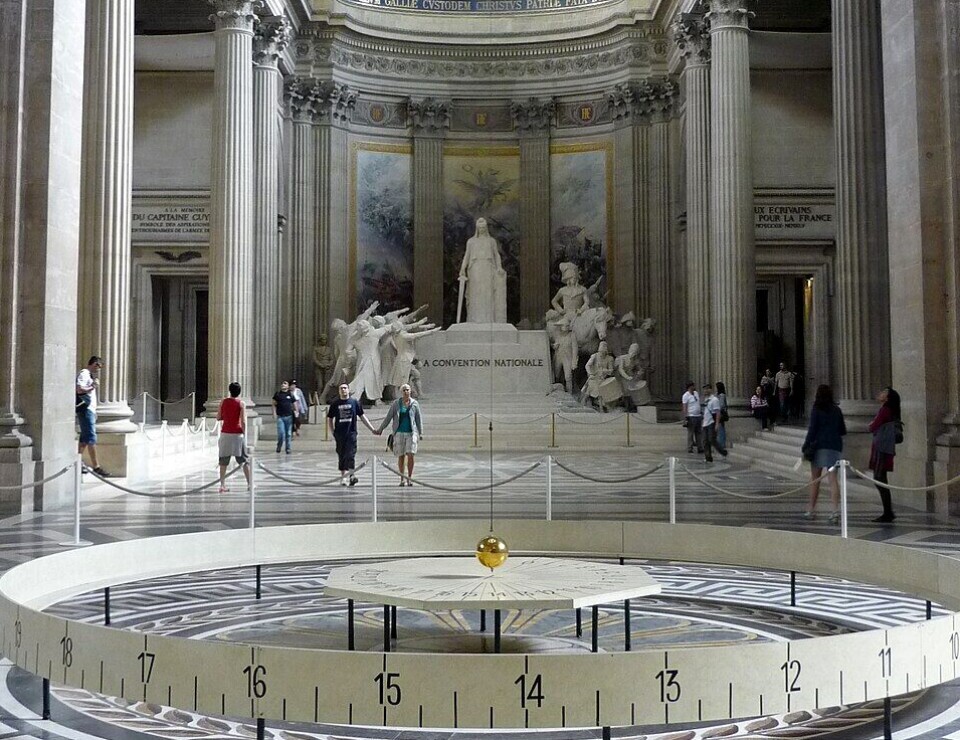
Foucault's pendulum in the Panthéon, ParisWIKIPEDIA
Park Kyung-ryul
The author is a professor at the KAIST Graduate School of Science and Technology Policy.
Watching the pendulum of a wall clock brings a curious sense of reassurance. Perhaps it comes from the belief that however far it swings, it will eventually return to the center.
A pendulum’s motion is an honest exchange of potential and kinetic energy. It descends carrying all the energy stored as it rises, then climbs just as high on the opposite side. In 1583, at Pisa Cathedral, 19-year-old Galileo is said to have measured the period of a swinging ceiling lamp against his pulse. Whether the swing was wide or narrow, each round trip seemed to take the same time. This is the isochronism of the pendulum, which later became the basis of the pendulum clock.
But there is a condition. It holds only when the angle of motion is small. As the amplitude increases, the period grows longer.
In a pendulum swinging violently, I see our society. The farther it travels toward one side, the farther it swings toward the opposite extreme. Extremism on one side invariably becomes the justification for extremism on the other, making the next swing wider. Recovery takes longer, and all of us hanging from the pendulum pay the price.
There is also a critical point that must not be crossed. Once the pendulum goes over the top, it loses its balance and spins in one direction. Just as a clock cannot measure time with a pendulum that never returns, a society thrown off its orbit cannot move toward the future.
What, then, can reduce a dangerously widening amplitude? Friction. It is the kind of thing we usually find bothersome, like air resistance or stiffness at the pivot. In society, it means tedious dialogue and compromise, principles that withstand discomfort and tolerance of others. Only by enduring that arduous process, and refusing to lose sight of the center even while swinging, can our social clock recover its proper rhythm.
I look again at the wall clock. Perhaps what Galileo noticed in the lamp was not the swing but the return. The clock’s hands move forward not because the pendulum surges violently to one side, but because it unfailingly descends and passes through its lowest point.
The most powerful force moving the world, too, is not the pull toward opposing extremes, but the steady restoring force that insists on finding the center again. A healthy society does not stop swinging altogether. It keeps moving, but within shared bounds that allow disagreement without destroying the common center.
진자
박경렬 KAIST 과학기술정책대학원 교수
벽시계의 추를 보고 있으면 묘한 안도감이 든다. 어디로 흔들려도 결국 중심으로 돌아온다는 믿음 때문일 것이다. 진자의 운동은 위치에너지와 운동에너지의 정직한 교환이다. 올라간 높이만큼의 에너지를 고스란히 품고 내려와, 반대편에서도 그만큼 솟아오른다.
1583년 피사의 대성당. 열아홉의 갈릴레오는 흔들리는 천장 램프의 주기를 자신의 맥박으로 측정했다고 전해진다. 폭이 크든 작든 한 번 왕복에 걸리는 시간은 같아 보였다. 훗날 진자시계의 바탕이 된 진자의 등시성이다. 그런데 조건이 있다. 움직이는 각도가 작을 때만 성립한다. 진폭이 커지면 주기는 길어진다.
거칠게 흔들리는 진자에 우리 사회의 모습이 겹쳐 보인다. 한쪽으로 멀리 나가면 반대쪽도 그만큼 끝으로 쏠린다. 한쪽의 극단은 늘 반대편 극단의 이유가 되어 다음번 진폭을 더 크게 키운다. 회복의 시간은 길어지고, 그 대가는 추에 매달린 우리 모두가 치러야 한다. 넘지 말아야 할 임계점도 있다. 진자가 꼭대기를 넘는 순간 균형을 잃고 한 방향으로만 헛돈다. 돌아오지 않는 시계추로 시간을 잴 수 없듯, 궤도를 이탈한 사회의 시간은 미래로 흐르지 않는다.
그렇다면 무엇이 위태롭게 커진 진폭을 줄일 수 있을까. 마찰이다. 공기의 저항이나 축의 뻑뻑함처럼 우리가 늘 성가시게 여기는 것들이다. 현실에선 지루한 대화와 타협, 불편함을 견디는 원칙과 관용이다. 그 지난한 과정을 거치며, 흔들려도 중심을 서로 놓지 않을 때 우리 사회는 비로소 제 박자를 찾는다.
벽시계를 다시 바라본다. 갈릴레오가 램프에서 주목한 것은 흔들림이 아니라 돌아옴이었을지 모른다. 시곗바늘이 앞으로 가는 것은 진자가 한쪽으로 격하게 움직여서가 아니라, 어김없이 내려와 가장 낮은 곳을 지나기 때문이다. 세상을 움직이는 가장 강력한 힘 역시, 양극단을 향한 쏠림이 아니라 기어이 가운데를 되찾으려는 묵직한 복원력이다.
This article was originally written in Korean and translated by a bilingual reporter with the help of generative AI tools. It was then edited by a native English-speaking editor. All AI-assisted translations are reviewed and refined by our newsroom.