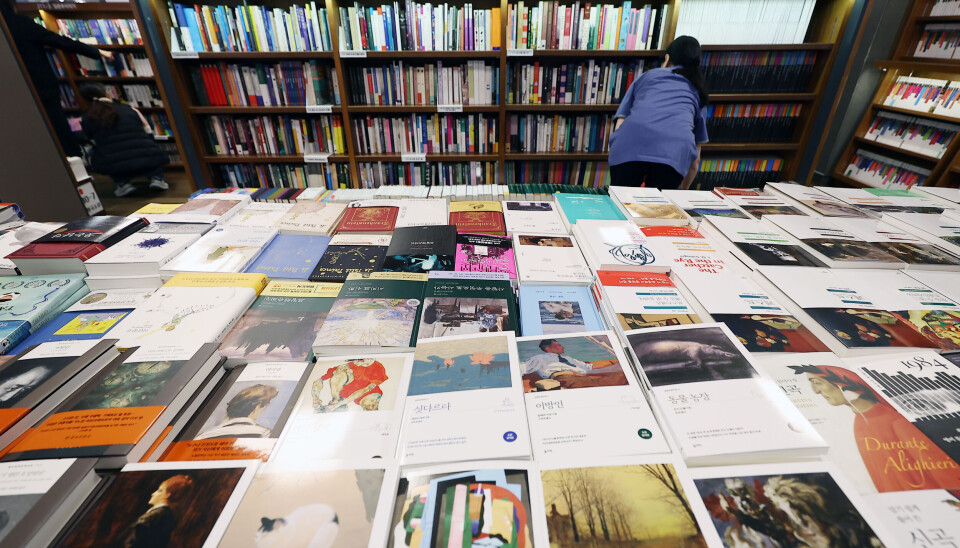
Books are displayed at a large bookstore in Seoul on Nov. 13, 2025.YONHAP
Shin June-bong
The author is an editorial writer at the JoongAng Ilbo.
Publishing may seem like a refined cultural industry, but it has never been unrelated to the cutting-edge technologies of its time. It has always sought to expand its readership by making use of new technologies. And during such periods of technological transition, disputes and even acts of plunder among the people involved have often occurred.
Johannes Gutenberg’s successes and failures in the 15th century are a case in point. He developed a technology for mass-producing type and printed the Bible, making a major contribution not only to the development of modern publishing but also to the Reformation. Yet his later years were unhappy. His business partner, Johannes Fust, sued him and took away everything, including the Bibles and even the printing press.
The recent controversy in Korea’s publishing industry over AI company Anthropic’s mass purchase of books is connected to much the same pattern. Valuable intellectual assets are being taken away amid deficiencies in Korea’s copyright laws, the publishing industry’s shortsighted pursuit of immediate profit and a lack of attention from government authorities. The amount of books that have leaked out through the wholesaler Woongjin Book Centre has so far reached about 160 tons. The volume is estimated at roughly 410,000 books — equivalent to buying one copy each of all new titles published in Korea over the past six or seven years.
Even more dismaying is the fact that the industry appears powerless despite having suffered such intellectual plunder. According to publishing industry sources, it does not appear easy to secure compensation, regardless of how Anthropic uses the 410,000 books. Like relevant U.S. law, Korea’s copyright law allows “fair use.” The concept of fair use is that if books purchased by paying a legitimate price are used purely for AI training, the use is not considered a problem. But “purely for training” is an ambiguous standard. How can we determine after the fact whether the use was purely for training or commercial exploitation that could harm the existing publishing market?
The Korean Publishers Association, an organization representing publishing companies, has issued an “Appeal to the Republic of Korea,” calling for the attention of the government and National Assembly, and is collecting signatures. Among its demands are that AI companies disclose the sources of their training data and provide fair compensation. As of Tuesday afternoon, 216 organizations and 607 individuals had signed. Yet a considerable number of major book publishers are nowhere to be seen, at a time when even standing together would not be enough.
AI 시대의 학습과 출판물 약탈
신준봉 논설위원
출판은 고상한 문화산업 같지만 당대의 첨단 기술과 무관하지 않다. 언제나 새로운 기술을 활용해 독자를 늘리려 했다. (『옥스퍼드 출판의 미래』) 그리고 그 기술적 전환기에는 관련 인물들 간 다툼이나 약탈이 발생하곤 했다.
가령 15세기 구텐베르크의 성공과 실패가 그런 공식에 들어맞는다. 활자 대량 생산 기술을 개발해 성경을 찍어 근대 출판은 물론 종교 개혁에 크게 기여했지만 말년이 불우했다. 동업자 요하네스 푸스트가 소송을 걸어 성경책은 물론 인쇄기까지 몽땅 가져가 버렸기 때문이다.
최근 국내 출판계를 달군 AI 기업 앤트로픽의 국내 도서 대량 매집 사태도 그런 흐름에 닿아 있다. 국내 저작권법 미비, 당장 목전의 이익을 챙기려는 출판계의 근시안, 정부 당국의 관심 부족 속에 소중한 지식 자산을 뺏기고 있어서다. 도매상 웅진북센을 통한 도서 유출 규모는 현재까지 160여t. 〈중앙일보 10월 19일자 B5면〉 41만 권가량으로 추산돼 국내에서 6~7년간 출간된 신간을 1종당 1권씩 모두 사 간 것과 같은 규모라고 한다.
출판계에 따르면 앤트로픽이 41만 권을 어떻게 활용하든 그에 대한 보상을 받아내기는 쉽지 않아 보인다. 미국의 관련법처럼 국내 저작권법도 ‘공정이용’을 허용한다. 순수하게 AI 학습을 위한 용도라면 정당한 대금을 지불하고 사간 도서의 경우 문제 삼지 않는다는 게 공정이용의 개념이다. 그런데 ‘순수한 학습’이라는 게 모호한 잣대다. 순수한 학습인지, 기존 출판 시장에 악영향을 끼칠 수 있는 상업적 활용인지를 사후적으로 어떻게 따질 것인가. 한국출판인회의는 정부와 국회의 관심을 촉구하는 ‘대한민국 호소문’을 발표하고 연명을 받고 있다. AI 기업으로 하여금 ▶학습데이터 출처를 밝히고 ▶정당한 보상을 요구하는 등의 내용이다. 20일 오후 현재 216개 단체와 607명이 서명했다. 그런데 굵직한 단행본 출판사 상당수가 보이지 않는다. 똘똘 뭉쳐도 모자랄 판에.
This article was originally written in Korean and translated by a bilingual reporter with the help of generative AI tools. It was then edited by a native English-speaking editor. All AI-assisted translations are reviewed and refined by our newsroom.