Korean teqball player Lee Jun-suk sheds tears after winning gold in the men’s singles teqball final at the Asian Games Aichi-Nagoya 2026 at Higashi Sports Center in Nagoya, Japan, on Sept. 20.NEWS1
NAGOYA, Japan — "Mom, I won a gold medal!"
That cry reverberated in the Nagoya Higashi Sports Center after Lee Jun-suk clinched the top prize in men's singles teqball at the Asian Games Aichi-Nagoya 2026 on Sunday.
The 2-0 victory over Iraq's Jalil Mezher Alelayawi was the culmination of grit, hard work — and the full faith of a mother.
The 27-year-old's journey started with a stint in the K4 League, the division just below the professional tier in Korean football. He then took up jokgu (Korean foot volleyball) before discovering teqball, a Hungarian-born sport that is essentially table tennis played with the feet and head, in which players send a football over a curved table, with up to three touches allowed before it must go over the net. The sport is making its Asian Games debut at the Aichi-Nagoya Games.
After Lee passed the national team trials, he quit his production job at a large company to train full time.
Because the Korea teqball federation is not a regular member of the Korean Sport & Olympic Committee, Lee could not train at Jincheon National Training Center. He rented a jokgu court in Icheon, Gyeonggi, instead and also went to Hungary to train.
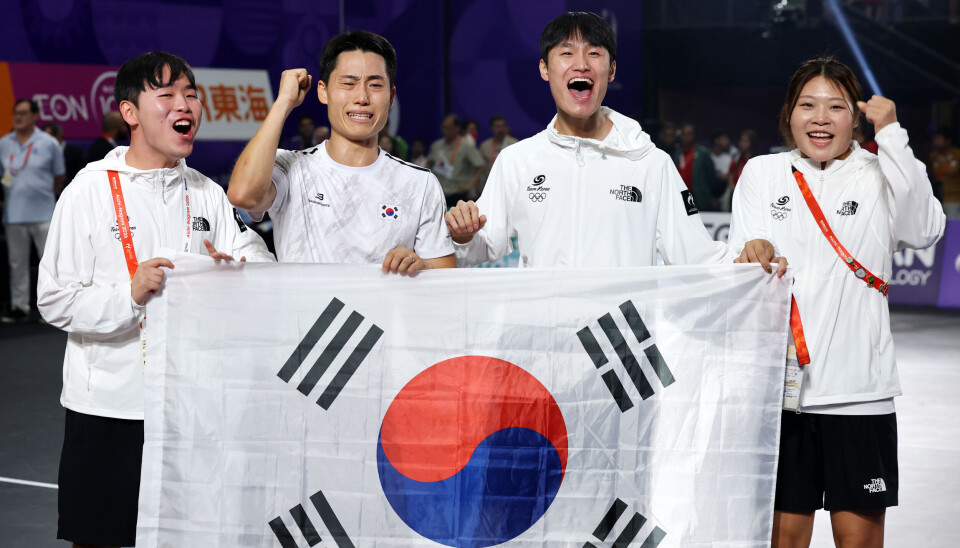
Korea’s Lee Jun-suk, second from left, poses with coaching staff after winning gold in the men’s singles teqball final at the Asian Games Aichi-Nagoya 2026 at Higashi Sports Center in Nagoya, Japan, on Sept. 20.NEWS1
His future was uncertain, but his mother believed in his dream. "Whenever I said there was something I wanted to do, my mother encouraged me by saying, 'Do it. But you have to give it your best. I believe in you,'" Lee said. "If she hadn't trusted my choice, I would never have come this far."
His mother, Yoon Seon-jeong, who watched her son reach the podium after winning the final in straight sets of 12-11 and 12-5 in Nagoya, said she wanted to back whatever he loved.
"Jun-suk is a boy with sound thinking and a clear philosophy of his own," she said. "I supported him with the idea that he should do whatever he wanted to do." She spent more than 2 million won ($1,400) on a teqball table for him.
That resolve was tested early in the final, however.
"The atmosphere was different from the group stage and the semifinal because there were so many spectators, so I was very nervous and made a lot of mistakes early on," Lee said. "But I thought that if I settled down and chased, I could come back. The start of the first set was the turning point of the match."
He roared after every point in the second set.
"I did a slightly over-the-top celebration because I felt I couldn't let the momentum slip," he said. "When I got to 11 points first, I was sure I would win. I'm really happy that I could create a scene I had dreamed of."
Lee's win comes despite the conditions at the Games. The teqball team sourced its own meals after the lunches provided by the organizing committee proved inadequate, and it stayed in a cramped business hotel.
"Teqball players train in very poor conditions, and there are no corporate teams," Lee said. "Many players put aside their livelihoods and take on a reckless challenge. I hope corporate teams are created and players can train in a stable environment."
This article was originally written in Korean and translated by a bilingual reporter with the help of generative AI tools. It was then edited by a native English-speaking editor. All AI-assisted translations are reviewed and refined by our newsroom.