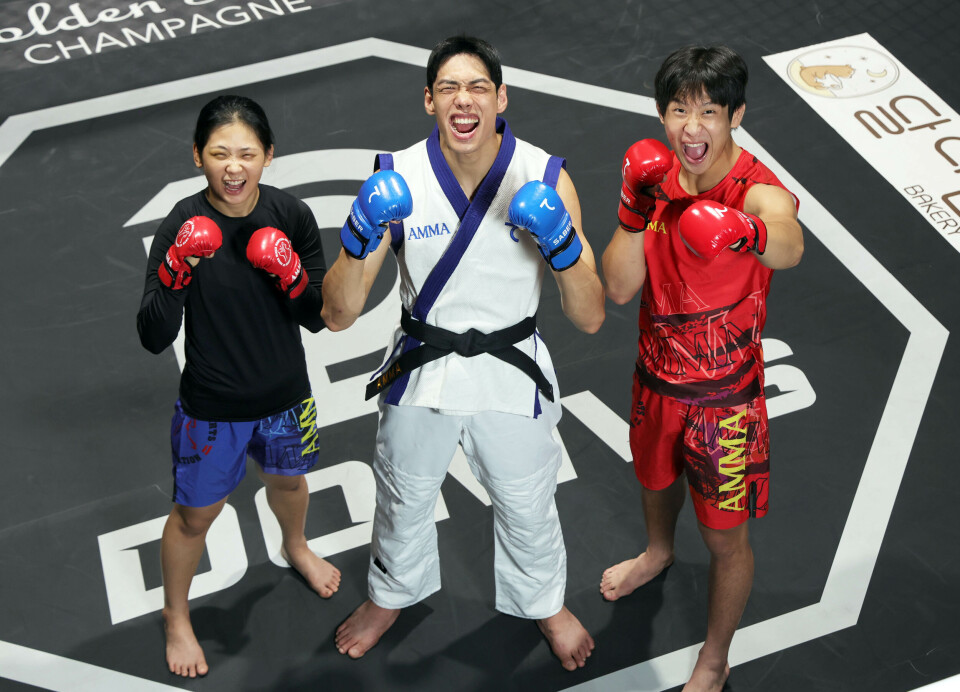
Three Korean national team fighters who will represent Korea at the 20th Asian Games Aichi-Nagoya 2026. From left are Lee Bo-mi, Yoon Tae-young and Choi Eun-seok.KANG JUNG-HYUN
MMA will make its Asian Games debut as an official medal sport this year, and three Korean national team fighters are preparing to chase the country's first gold despite training in conditions far removed from those enjoyed by most national teams.
Lee Bo-mi, Yoon Tae-young and Choi Eun-seok will represent Korea at the 20th Asian Games Aichi-Nagoya 2026, set to take place from Sept. 19 through Oct. 4. Unlike athletes in many established sports, the three cannot train at the national training center.They move between gyms in Seoul, Gwangju in Gyeonggi and Wonju in Gangwon instead.The three also stay in goshiwon — low-cost and compact rooms commonly used as inexpensive accommodation among students.
They receive no training allowance,just relying on contributions from several sponsors to help cover training and medical expenses.
The contrast is particularly stark as MMA prepares to award Asian Games medals for the first time.
The competition is divided into two disciplines: Modern and Traditional. Modern MMA, in which fighters wear rash guards and shorts, features three weight classes: men's 60- and 71-kilogram (132- and 157-pound) classes and a women's 54-kilogram class. For traditional MMA — fought in traditional martial arts uniforms — also features three classes: 65- and 77-kilogram classes for men and a 60-kilogram class for women.
A total of six gold medals will be awarded. Unlike professional MMA bouts fought inside a cage, Asian Games matches take place on an octagonal mat, with two three-minute rounds and two five-minute rounds in the finals.
Yoon is the reigning Road FC welterweight champion and will compete in the men's Traditional MMA 77-kilogram category.
Choi, aged 20, made his professional debut while still in high school and will compete in the men's Modern MMA 71-kilogram category. Veteran Lee is to enter the women's Modern MMA 54-kilogram category.
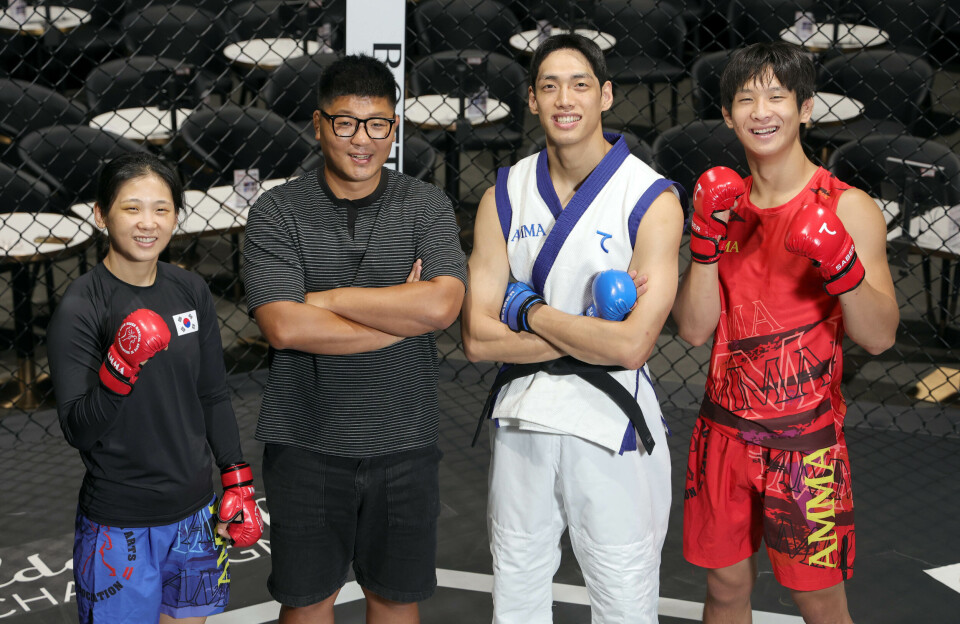
Three Korean national team fighters who will represent Korea at the 20th Asian Games Aichi-Nagoya 2026, and their head coach. From left are Lee Bo-mi, head coach Kwon A-sol, Yoon Tae-young and Choi Eun-seokKANG JUNG-HYUN
Former Road FC champion Kwon A-sol is serving as the national team's head coach. Road FC is a Korea-based MMA promotion that stages professional events as well as amateur and developmental competitions.
"I've never felt this level of pride and patriotism before, knowing that I'll be representing Korea at a major multisport event," Choi said with a smile. "I'm really glad I chose MMA. We're now in our second month of training together, and Tae-young, Bo-mi and I have become like siblings."
For professional MMA fighters in Korea, however, financial instability is a familiar part of the sport.
While top UFC stars can earn millions of dollars in fight purses or payments for competing in a bout, Korean fighters typically receive only several million won per fight. With only three or four bouts a year and sponsorships difficult to secure, many work other jobs to pay for training and living expenses.
Winning a championship can substantially increase a fighter's purse, but maintaining a steady income still requires fighting regularly.
National team athletes line up for free food at an event held at Jincheon National Training Center in North Chungcheong on May 19, ahead of the 20th Asian Games Aichi-Nagoya 2026.KOREAN SPORT & OLYMPIC COMMITTEE
The national team's circumstances reflect many of the same challenges. MMA is a relatively new organized sport in Korea, and Korea-Mixed Martial Arts — its governing body — is only an associate member of the Korean Sport & Olympic Committee. That status leaves the team ineligible to use the Jincheon National Training Center in North Chungcheong.
The fighters have grown leaner as they cut weight ahead of the games. They say, however, the difficult circumstances have only strengthened their determination.
"Getting injured alone can cost a lot of money," Lee said. "I push myself even harder because I want to repay the people who are helping us."
Yoon described the team's biggest weapon as what Koreans often call a "hungry spirit" — a determination forged through hardship and limited resources.
"The only weapon we've gained from not being able to train in an environment like the national training center is that 'hungry spirit,'" Yoon said. "I need to perform well to help MMA overcome its status as a minor sport."
Yoon Tae-young, right, gets training from Jung Chan-sung, a former UFC fighter well known as "The Korean Zombie," in a video uploaded on Aug. 12 on head coach Kwon A-sol's YouTube channel "Kwon A-sol's Fighter 100" (translated).SCREEN CAPTURE
For all three, the financial hardship and constant risk of injury have not diminished their attachment to the sport. Each has spent much of their youth training in gyms since their middle or high school years, enduring the injuries, weight cuts and the uncertain income that come with professional fighting.
The team has also found a prominent supporter in Jung Chan-sung, better known as "The Korean Zombie," who once rose as high as No. 3 in the UFC featherweight rankings.
Jung retired from professional competition in 2023 and now runs a gym, where he has been sharing techniques and practical fighting experience with the national team.
"My skills are improving quickly since I'm learning directly from my idol and sparring with him," Choi said. "As a student of Jung, I want to show what the 'K-Zombies' can do at the Asian Games."
For Yoon, simply becoming one of Korea's first Asian Games MMA representatives is not enough.
Lee Bo-mi, left, and a former UFC fighter Jung Chan-sung take a selfie together during the training, preparing for the 20th Asian Games Aichi-Nagoya 2026.JOONGANG ILBO
"As we have received guidance from a legend, I cannot be satisfied with just participating,” he said. "I'm going to become the first Asian Games MMA gold medalist."
Lee said an Asian Games victory would offer something even a professional MMA championship cannot.
"You don't get to hear the Korean national anthem after winning in professional MMA," Lee said. "If I stand at the top of the Asian Games podium and hear the national anthem, I think I'll be overwhelmed with emotion."
Jung said he would do what he could to help the three fighters achieve their goal.
"We can make up for what each of us lacks," Jung said. "I'll also do everything I can so that we can improve together."
Amid hard-working athletes, Road FC Chairman Jeong Moon-hong has said to “pledge 300 million won [$214,000] in prize money for an Asian Games gold medal.”
This article was originally written in Korean and translated by a bilingual reporter with the help of generative AI tools. It was then edited by a native English-speaking editor. All AI-assisted translations are reviewed and refined by our newsroom.