Four years of free fall: Hong, the KFA and the beautiful game's descent into disgrace
Korea’s World Cup group-stage exit capped four years of managerial upheaval, federation missteps and a national team that insiders say lost its style and direction.
The Korean national football team sing the anthem before a group A match at the FIFA World Cup 2026 in Monterrey, Mexico, on June 24.XINHUA/YONHAP
Korea’s failure to reach the World Cup knockout stage was not a one-off disappointment but the result of four years of flawed decisions that stripped the national team of its identity on the pitch, football insiders said.
The Taeguk Warriors' journey in the FIFA World Cup 2026 ended in humiliation. Led by manager Hong Myung-bo, the team finished with one win and two losses and was sent packing from the group stage despite an expanded tournament that saw eight more teams move on to the knockout round.
Now, one question is echoing among fans: "What exactly did the national team do with the last four years?"
Many hoped Korea might go on a decent run this year after advancing to the Round of 16 at the 2022 FIFA World Cup in Qatar under manager Paulo Bento.
"Under Bento, Korean football had an identity," said Lee Chun-soo, a left midfielder of the famed 2002 side that went on a Cinderella run to the semifinals on home soil. “They should have given Bento another four years. Even when people criticized him, he stuck to his philosophy. As someone in football, I was disappointed when they decided not to renew his contract."
Then-Korea national team manager Paulo Bento, left, comforts Hwang In-beom, center, during the FIFA World Cup 2022 Round of 16 match between Brazil and Korea in Doha, Qatar, in 2022.EPA/YONHAP
His remarks captured a growing sense that the national team had lost a clear style or identity.
The tailspin began after Bento stepped down following Qatar. In February 2023, the Korea Football Association (KFA) appointed Jürgen Klinsmann as his successor.
The German, who guided his national side to third place in the 2006 World Cup, abandoned the organized build-up play that Bento had put in place without offering a clear system of his own. Instead, Korea came to rely on the individual brilliance of players such as Son Heung-min, which later weakened the team's overall cohesion.
Klinsmann's off-field comportment also ruffled feathers. He mostly worked remotely while spending more time at his home in the United States than in Korea and appearing on overseas television while serving as the gaffer of the Warriors.
Fans in Gwanghwamun Square in central Seoul supporting Korea watch a match against South Africa in the FIFA World Cup 2026 on June 25.XINHUA/YONHAP
Korean fans accused him of showing greater interest in vacations and side gigs than in managing the national team.
The consequences came in February 2024, when Korea suffered a 2-0 defeat to Jordan in the semifinals of the AFC Asian Cup 2023. Klinsmann had confidently declared his team would win the tournament, yet Korea failed to register a single shot on target.
The disappointment only deepened when reports emerged during the tournament that Son Heung-min and Lee Kang-in had been involved in a scuffle. The KFA dismissed Klinsmann after just one year, while forking over about 7 billion won ($4.56 million) in termination fees.
Rather than immediately appointing a permanent successor, the KFA relied on interim managers in the form of former national team players Hwang Sun-hong and Kim Do-hoon. That decision also proved costly. Korea failed to qualify for the Olympic men's football tournament for the first time in 40 years.
Calls urging KFA President Chung Mong-gyu to resign intensified as the failures mounted.
Following Klinsmann's dismissal, the KFA spent five months interviewing foreign candidates with proven track records in Europe, including Jesse Marsch, who has just led Canada out of the World Cup group stage for the first time. Yet after all that, it turned to Hong at the last minute.
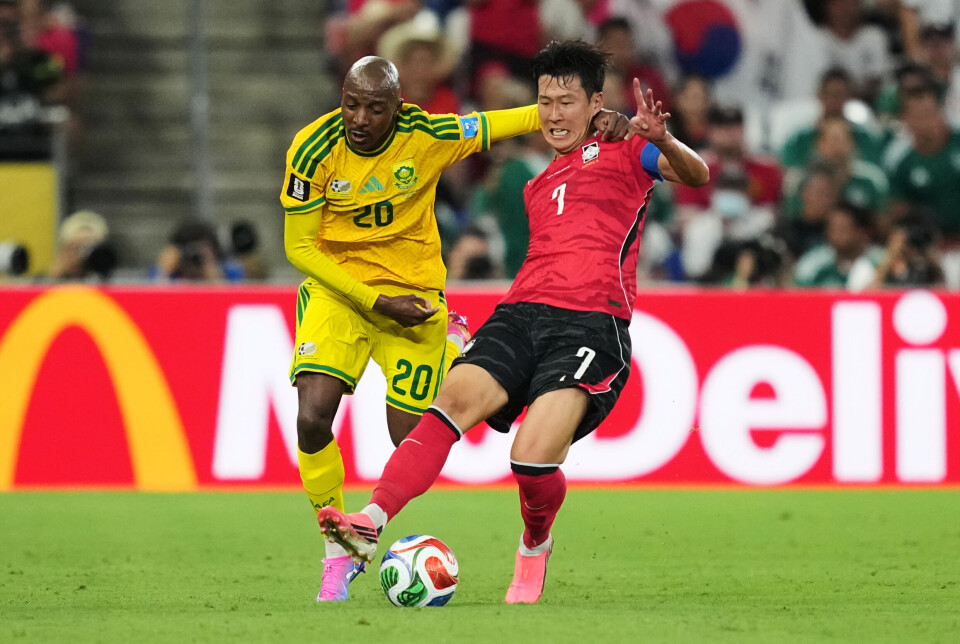
Korea's Son Heung-min, right, and South Africa's Khuliso Mudau battle for the ball during the World Cup Group A match in Guadalupe, near Monterrey, Mexico, on June 24.AP/YONHAP
The appointment was not well-received, to say the least, as fans recalled his dismal performance at the helm in 2014 in Brazil, when Korea divebombed out of the tournament on one draw and two losses.
The controversy only grew when Park Joo-ho, a former member of the KFA's National Teams Committee, revealed that he “had not even known Hong had been selected.”
"There were many committee members who unconditionally supported hiring a domestic manager,” Park said.
His remarks cast a dark shadow of doubt over the selection process's credibility.
An audit by the Ministry of Culture, Sports and Tourism later identified procedural flaws in the appointment, including Chung's involvement in the process.
Hong's leadership came under pressure from the start. In his first match against Palestine in September 2024, he was greeted by boos from a crowd of 60,000.
Although he secured qualification for the World Cup main rounds in July of last year, warning signs continued to emerge. Korea stumbled to draws against minnows such as Palestine and Oman during qualifying.
At last July's East Asian Football Federation’s E-1 Football Championship, Korea were outplayed by a Japanese side made up largely of reserve players. In friendlies, Korea also suffered heavy defeats, losing 5-0 to Brazil and 4-0 to Ivory Coast.
National team manager Hong Myung-bo observes a training session in Mexico on June 28.NEWS1
The cost of ignoring those warning signs became painfully clear on the biggest stage in sports.
Despite boasting what could arguably be considered a golden generation of players — including Kim Min-jae, Son Heung-min and Lee Kang-in — and benefiting from a favorable group draw, Hong's side delivered one of the country's most disappointing World Cup campaigns.
“I don’t know why we lost,” Hong said after the defeat to South Africa. His remarks left many baffled.
"It was a repeat of the 2014 World Cup," said 2002 hero Park Ji-sung, serving as a JTBC commentator during the tournament. "The people running Korean football are doing it wrong."
In four short years, it would seem that Park is saying, the beautiful game has become hard to look at, guided by people who have lost sight of the goal.
National team defender Seol Young-woo reacts after the team's 1-0 defeat to South Africa on Wednesday at the FIFA World Cup 2026.NEWS1
Chung, who secured a fourth term as KFA president in February last year despite pressure from the Ministry of Culture, Sports and Tourism, has decided to step down after the World Cup. Hong's departure also appears inevitable.
But many in Korean football argue that “replacing the coach alone cannot be the end of the story.”
"We've paid a heavy price for wasting four years," one football insider said. "This time, it can't end with changing the coach. The KFA, the K League, referees and youth development all need to be rebuilt if Korean football is to have a future.”
Park echoed that sentiment.
"It will take at least 10 years to build a proper system," he said.
While Korean football spent four years moving backward because of administrative failures and unilateral decision-making, Japan — once regarded as Korea's rival — has continued to surprise the world at this World Cup. The Samurai Blue went toe-to-toe with global powerhouses the Netherlands and Sweden, and glided to the Round of 32 as the Taeguk Warriors prepared to limp back home.
This article was originally written in Korean and translated by a bilingual reporter with the help of generative AI tools. It was then edited by a native English-speaking editor. All AI-assisted translations are reviewed and refined by our newsroom.