North Korea's nuclear arsenal is portrayed as the Kim regime's ultimate survival tool — a stance that explains why other states are reluctant to abandon their nuclear capabilities.
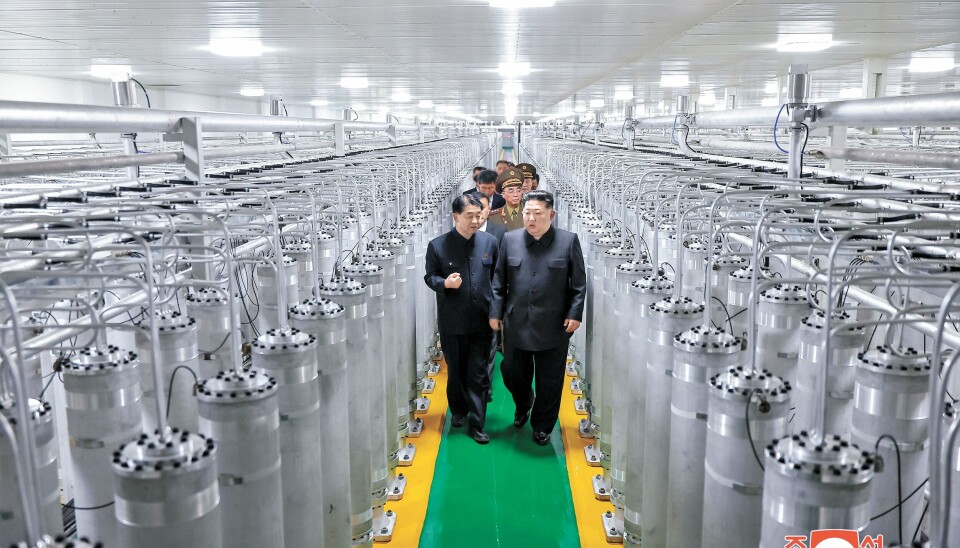
North Korean leader Kim Jong-un, front right, inspects a newly operational nuclear material production facility, walking between centrifuges inside the plant, on June 3 in this photo released by North Korea's state media.YONHAP
Jang Seok-kwang
The author is the general secretary of the Academy of National Intelligence.
The United States and Iran continue negotiations over a cease-fire and Tehran’s nuclear program. Regardless of the outcome, the central issue remains Iran’s determination to retain its nuclear capabilities. The concern is not simply whether Iran will openly declare itself a nuclear weapons state. Rather, Tehran appears intent on preserving its status as a nuclear threshold state — one that possesses the capability to develop nuclear weapons if necessary.
Why are states so reluctant to abandon nuclear capabilities?
Since the Russian invasion of Ukraine, attitudes in Ukraine have changed significantly. The country’s decision to surrender the world’s third-largest nuclear arsenal under the 1994 Budapest Memorandum on Security Assurances is no longer viewed as an unquestionably wise choice.
A similar debate has emerged in Taiwan. As military pressure from China increases and uncertainty surrounding U.S. security commitments persists, some observers have begun reconsidering whether Taiwan was right to halt its nuclear development efforts in the late 1980s.
While Ukraine and Taiwan are revisiting past decisions, North Korea has taken a very different course.
For Pyongyang, nuclear weapons have become far more than a military asset. They are a central pillar of regime survival. North Korea wrote its status as a nuclear state into its constitution in 2012, declared the policy irreversible in 2023 and further codified nuclear command and authorization structures this year. On Sunday, Kim Yo-jong, the sister of North Korean leader Kim Jong-un, again insisted that North Korea’s position as a nuclear weapons state was an “absolute and irreversible red line.”
The history of nuclear competition is also a history of intelligence warfare. Espionage and covert operations have accompanied nuclear development since the Cold War. During years spent investigating North Korean defectors and spies, I encountered many stories reflecting that reality.
One particular story often comes to mind.
According to an anecdote widely shared among defectors in the early 1990s, North Korean founder Kim Il Sung once posed a question during a gathering attended by military officers and the late North Korean leader Kim Jong-il.
“What would you do if we lost a war?” he asked.
The officers reportedly replied in unison that North Korea would never lose. Kim Il Sung repeated the question. This time, the room fell silent. Kim Jong-il then allegedly stood up and declared, “A world without [North Korea] is unnecessary. The Earth should be destroyed.”
Whether the incident actually occurred is impossible to verify, but it is a story frequently repeated by people arriving from North Korea, regardless of their rank or social background. At the time, I regarded it as propaganda intended to glorify Kim Jong-il’s decisiveness and loyalty. Looking back, however, it may have reflected something deeper. The phrase “a world without North Korea” may not have been a rhetorical exaggeration. It may have symbolized the worldview of North Korea’s leadership. For the Kim family regime, survival has always taken precedence over every other value.
Another memory supports that interpretation.
In July 1994, I was a member of the team responsible for the debriefing, protection and press arrangements of defector Kang Myong-do. Kang came from the Kang family of Chilgol, Kim Il Sung’s maternal lineage, and was the son-in-law of former North Korean Prime Minister Kang Song-san. At the time, he was among the highest-ranking defectors with direct connections to the North Korean leadership.
During a press conference, Kang stated that North Korea already possessed nuclear weapons and was continuing related development efforts. The remarks caused a stir among reporters.
After the event, the Blue House sent a substantial monetary reward in recognition of what was considered a successful briefing. Staff members prepared a celebratory dinner.
The atmosphere changed only hours later.
Instructions arrived directing officials to restrict Kang’s contact with outsiders, especially the media. The internal mood surrounding both Kang and the press conference shifted noticeably. As a working-level official, I did not know the precise reason for this change. But the episode left a lasting impression. Whether Kang’s claims were accurate or not, the North Korean nuclear issue had already become far more than a military matter. It was directly connected to international security and the future of the North Korean regime.
More than three decades later, I participated in a seminar examining the implications of North Korea’s “hostile two-state theory” for South Korea’s security.
My conclusion was that the central objective underlying North Korea’s policies toward the South remains the preservation of the Kim family regime. Political, diplomatic and military policies may be explained through different narratives, but they ultimately converge on a single goal: regime survival.
From Kim Jong-un’s perspective, unification is not necessarily advantageous. Even if it occurred under North Korean leadership, the North could eventually be absorbed by the South’s stronger economy, institutions and cultural influence. The hostile two-state theory, therefore, appears less an ideological declaration than a practical strategy for survival.
North Korea’s nuclear arsenal serves the same purpose. It is not merely a deterrent against external threats but the regime’s ultimate insurance policy. Pyongyang has closely observed the fate of leaders and states that either abandoned nuclear ambitions or lacked nuclear deterrence. Saddam Hussein in Iraq, Muammar Gaddafi in Libya and recent developments involving Iran have likely reinforced the belief that nuclear weapons are essential to regime survival.
Iran continues difficult negotiations with Washington. Ukraine and Taiwan are reconsidering past decisions. Why are states so unwilling to relinquish nuclear capabilities?
The history of the past three decades suggests that North Korea’s leadership may have answered that question long ago.
This article was originally written in Korean and translated by a bilingual reporter with the help of generative AI tools. It was then edited by a native English-speaking editor. All AI-assisted translations are reviewed and refined by our newsroom.