Editorials
Why make tuition-free college the answer to saving regional universities?
The government's proposed full-tuition aid for regional national universities aims to revive local higher education, but critics say deeper reforms are needed to improve quality, fairness and jobs.
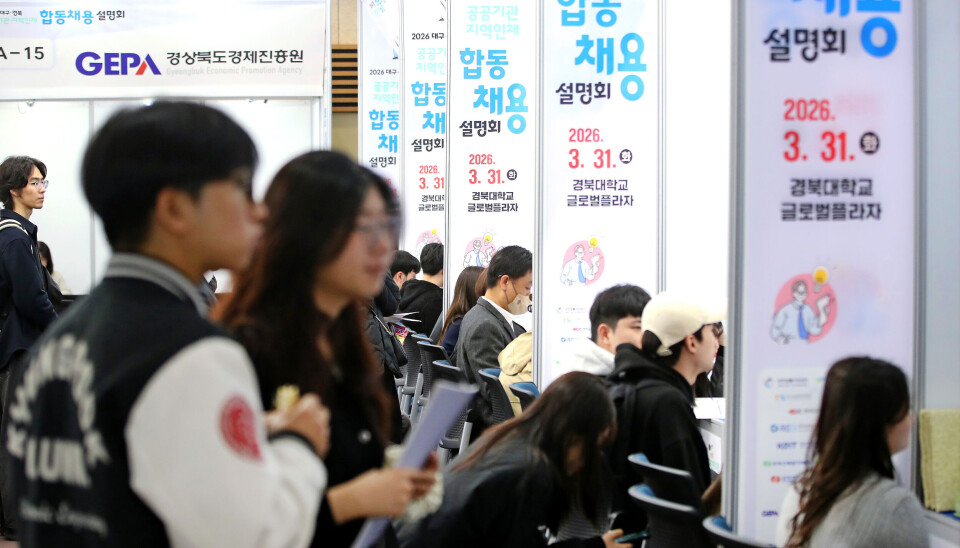
Job seekers look around a public sector job fair at Kyungpook National University in Buk District, Daegu, on March 31.
NEWS1
The Ministry of Education announced during its presidential policy briefing on Wednesday that it is considering a new “regional balance scholarship” for students at 30 national universities outside the Seoul metropolitan area, including the nation’s nine flagship regional national universities. Under the proposal, all freshmen at those institutions could receive full tuition support as early as next year, with the program gradually expanding to upperclassmen depending on available funding. The government estimates that exempting tuition for all incoming students would require roughly 100 billion won ($70.2 million) in additional funding; extending the benefit to all undergraduates would cost another 400 billion won annually.
The proposal raises immediate questions about its effectiveness. The assumption that eliminating tuition will draw talented students to regional universities is difficult to reconcile with reality. About 60 percent of students at the 30 regional national universities already receive government scholarships, but many choose Seoul universities despite paying substantially higher tuition. The attraction of metropolitan institutions lies not in lower costs but in stronger academic reputations, broader career opportunities and greater access to jobs.
If the government is serious about revitalizing regional universities, it would be wiser to invest in recruiting distinguished faculty, improving the quality of teaching and research, modernizing educational programs and building stronger partnerships with local industries that create employment and entrepreneurial opportunities. These reforms may take longer to produce results, but they address the underlying reasons causing students to leave.
The plan has also sparked concerns about fairness. Concentrating benefits on regional national universities risks placing regional private universities at an even greater disadvantage. Many of those institutions already face severe financial difficulties because of declining enrollment. Private universities in the Seoul metropolitan area are hardly in a better position. Since 2009, the Education Ministry has effectively forced private universities to freeze tuition by linking participation in the national scholarship program to tuition restraint. That policy has distorted university finances for years, leaving higher education chronically underfunded.
As a result, public spending per university student has fallen below that for elementary school students, whose education is supported through generous allocations from the local education grant, which receives 20.97 percent of domestic tax revenue. Students from provincial regions who choose private universities in the greater Seoul area because they believe doing so will improve their employment prospects would also be excluded from the proposed scholarship, raising another equity concern.
The goal of preventing talented young people from leaving regional communities, encouraging students to settle outside the capital from the beginning of their university years and laying the foundation for balanced national development through education are understandable and worthwhile. The real question is whether tuition waivers are the right place to begin. Rather than relying on what amounts to another cash-transfer program, the government should pursue more fundamental reforms that strengthen the competitiveness, quality and long-term appeal of regional higher education.
This article was originally written in Korean and translated by a bilingual reporter with the help of generative AI tools. It was then edited by a native English-speaking editor. All AI-assisted translations are reviewed and refined by our newsroom.