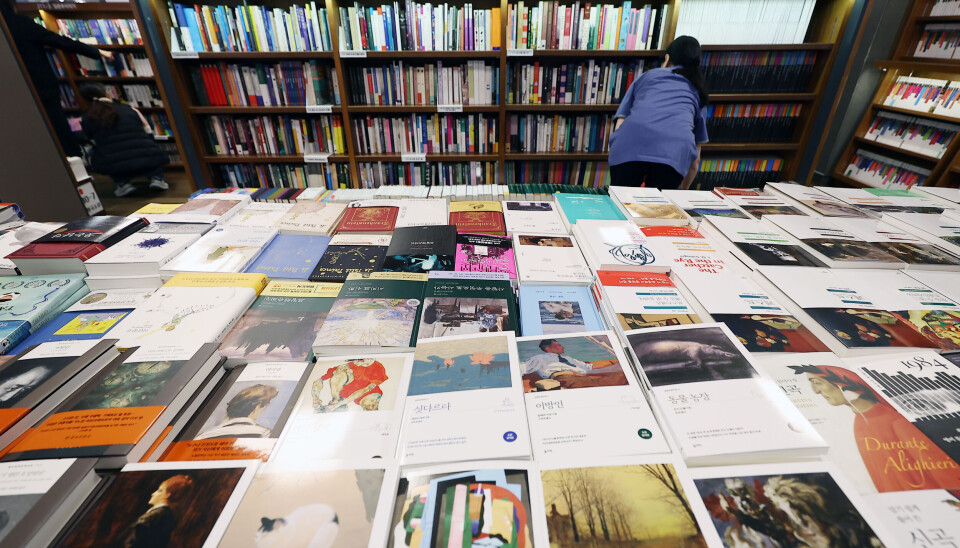
Books are displayed at a large bookstore in Seoul on Nov. 13, 2025.YONHAP
Shin June-bong
The author is an editorial writer at the JoongAng Ilbo.
Publishing may seem like a refined cultural industry, but it has never been unrelated to the cutting-edge technologies of its time. It has always sought to expand its readership by making use of new technologies. And during such periods of technological transition, disputes and even acts of plunder among the people involved have often occurred.
Johannes Gutenberg’s successes and failures in the 15th century are a case in point. He developed a technology for mass-producing type and printed the Bible, making a major contribution not only to the development of modern publishing but also to the Reformation. Yet his later years were unhappy. His business partner, Johannes Fust, sued him and took away everything, including the Bibles and even the printing press.
The recent controversy in Korea’s publishing industry over AI company Anthropic’s mass purchase of books is connected to much the same pattern. Valuable intellectual assets are being taken away amid deficiencies in Korea’s copyright laws, the publishing industry’s shortsighted pursuit of immediate profit and a lack of attention from government authorities. The amount of books that have leaked out through the wholesaler Woongjin Book Centre has so far reached about 160 tons. The volume is estimated at roughly 410,000 books — equivalent to buying one copy each of all new titles published in Korea over the past six or seven years.
Even more dismaying is the fact that the industry appears powerless despite having suffered such intellectual plunder. According to publishing industry sources, it does not appear easy to secure compensation, regardless of how Anthropic uses the 410,000 books. Like relevant U.S. law, Korea’s copyright law allows “fair use.” The concept of fair use is that if books purchased by paying a legitimate price are used purely for AI training, the use is not considered a problem. But “purely for training” is an ambiguous standard. How can we determine after the fact whether the use was purely for training or commercial exploitation that could harm the existing publishing market?
The Korean Publishers Association, an organization representing publishing companies, has issued an “Appeal to the Republic of Korea,” calling for the attention of the government and National Assembly, and is collecting signatures. Among its demands are that AI companies disclose the sources of their training data and provide fair compensation. As of Tuesday afternoon, 216 organizations and 607 individuals had signed. Yet a considerable number of major book publishers are nowhere to be seen, at a time when even standing together would not be enough.
This article was originally written in Korean and translated by a bilingual reporter with the help of generative AI tools. It was then edited by a native English-speaking editor. All AI-assisted translations are reviewed and refined by our newsroom.