

Samsung Electronics posts historic $38.6B Q1 profit, fueled by AI chip shortage
Published: 30 Apr. 2026, 17:26
-
- LEE JAE-LIM
- [email protected]
Audio report: written by reporters, read by AI
![Samsung Electronics' headquarters in Suwon, Gyeonggi, on April 30 [YONHAP]](https://koreaseafood.online/data/photo/2026/04/30/9910220d-994b-4499-b081-b99805e2d2c5.jpg)
Samsung Electronics' headquarters in Suwon, Gyeonggi, on April 30 [YONHAP]
[NEWS ANALYSIS]
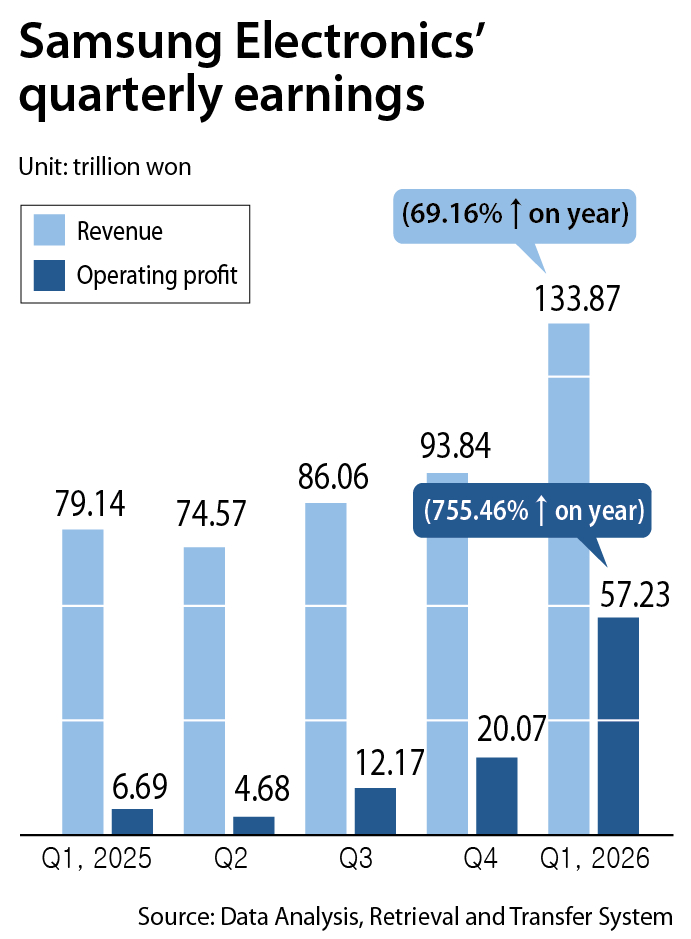
Samsung Electronics reported an operating profit of 57.23 trillion won ($38.6 billion) for the first quarter of this year, the highest in the company's history, as a global shortage in memory chips has sent customers racing to secure supplies for their AI data center build-outs.
Samsung Electronics' first-quarter operating profit represents a 755.46 percent increase from the same period last year and beat the market consensus of 40.2 trillion won, compiled by FnGuide. Notably, the figure already surpasses the company's entire annual operating profit of 43.6 trillion won in 2025.
Its revenue rose 69.26 percent on year to 133.87 trillion won, surpassing analysts' estimates of 119 trillion won, and its net profit climbed 474.31 percent to 47.23 trillion won, above the 35.83 trillion won forecast.
Semiconductors were overwhelmingly responsible for the strong performance, contributing nearly 94 percent to the total operating profit — a roughly 48-fold increase from the first quarter of 2025 — driven by surging demand for high bandwidth memory (HBM) used in AI infrastructure.
The report highlights a broader change in the semiconductor industry. Major technology companies have been signing multiyear supply agreements with Samsung and SK hynix — a marked departure from the short-term, trust-based arrangements that historically characterized the sector.
“Unlike prior supply arrangements based on mutual trust, these long-term supply contracts carry a [...] higher degree of binding commitment,” said Kim Jae-june, the executive vice president of memory business at Samsung. “In an environment where investment and capacity management risks have risen sharply across every dimension — including capital outlay, contract duration and technological complexity — these agreements are expected to enhance business stability and visibility for both customers and companies.”
The company confirmed that contracts with select customers have already been finalized, with additional discussions ongoing.
Regarding capital expenditure for the quarter, Samsung allocated 91 percent of its 11.2 trillion won to semiconductors, focusing on expanding wafer production capacity. Construction of additional manufacturing space at the P4 and P5 facilities within its Pyeongtaek campus in Gyeonggi is being accelerated to secure incremental memory output.
HBM outlook and foundry progress
Samsung projects its HBM revenue to more than triple this year compared to last year. Its latest-generation HBM4 is entirely sold out and is expected to account for over half of its total HBM revenue beginning in the third quarter. First samples of the next-generation HBM4E are also scheduled for shipment in the second quarter.
On the foundry side, Samsung's second-generation 2-nanometer process is on track for mass production in the second half of the year, with the company targeting double-digit improvements in both revenue and earnings from the node.
![Samsung Electronics' Seocho office in southern Seoul on April 30 [NEWS1]](https://koreaseafood.online/data/photo/2026/04/30/365a2f5c-7eed-4042-a034-237b03f6471f.jpg)
Samsung Electronics' Seocho office in southern Seoul on April 30 [NEWS1]
“The company is actively engaged in advanced collaboration discussions with multiple major AI and high-performance computing customers and expects to announce tangible outcomes with select customers in the near term,” said Kang Suk-chae, the executive vice president of Samsung Foundry.
Samsung's first factory at its Texas campus remains on schedule to begin operations this year and enter mass production in 2027. A second factory at the same site is in the preliminary planning stage.
Samsung reported no supply chain disruptions linked to the ongoing Middle East conflict, despite Korea's dependence on the region for key chip processing materials, including helium and bromine. According to the company, it has secured alternative logistics routes and diversified its supplier base, though it warned that rising oil prices could add to production costs through higher shipping rates.
Meanwhile, Samsung's union has announced that it will go on a general strike from May 21 to June 7, with negotiations over bonus accruals still ongoing. Management said that it would “take all available measures within the bounds of applicable law” to prevent production disruptions.
“We remain committed to prioritizing dialogue with the union and reaching an amicable resolution,” said Park Soon-cheol, the vice president and chief financial officer at Samsung.
![Samsung Electronics' headquarters in Suwon, Gyeonggi on April 30 [YONHAP]](https://koreaseafood.online/data/photo/2026/04/30/c033c3f5-6b48-47d7-90bc-e8d9ae0d48b1.jpg)
Samsung Electronics' headquarters in Suwon, Gyeonggi on April 30 [YONHAP]
Nonsemiconductor divisions under pressure
Outside of chips, results were mixed. The mobile and network division posted an operating profit of 2.8 trillion won, down 35 percent on year, as rising memory costs weighed on handset margins despite robust sales of the Galaxy S26 Ultra. The consumer electronics division, which includes TVs and home appliances, saw profit fall 33 percent to 200 billion won, squeezed by intensifying competition, particularly from Chinese rivals, as well as tariffs and input price inflation.
Samsung Display reported 400 billion won in operating profit this year, marking a 20 percent decrease from last year. The subsidiary cited seasonal fluctuations and weaker downstream demand tied to higher memory prices. Harman, Samsung's automotive electronics unit, posted 200 billion won in operating profit, down 33 percent due to multiple factors, such as tightened memory supply, seasonal headwinds and rising development costs.
BY LEE JAE-LIM [[email protected]]


with the Korea JoongAng Daily
To write comments, please log in to one of the accounts.
Standards Board Policy (0/250자)