

Vapes now regulated as 'tobacco' products, but concerns over loopholes, enforcement remain
Published: 28 Apr. 2026, 14:28
Updated: 29 Apr. 2026, 12:14
![Liquid-based e-cigarettes are seen inside a shop in Seoul on April 24, the same day that a revision to the Tobacco Business Act went into effect. [YONHAP]](https://koreaseafood.online/data/photo/2026/04/29/63c4e9d3-9cff-4ad3-9d92-22f51f751b35.jpg)
Liquid-based e-cigarettes are seen inside a shop in Seoul on April 24, the same day that a revision to the Tobacco Business Act went into effect. [YONHAP]
At a vape shop in Ansan, Gyeonggi, on Friday, customers browsed rows of refillable devices and sampled flavored liquids, which are now subject to tobacco product taxes following changes to Korean law.
But when asked whether he would raise his prices, the shop owner shook his head.
“I still have older stock on hand, so I can sell that cheaply for now,” he said.
The lack of change in prices — for now — was confirmed by a second-year high school student in a back alley in Sejong who was interviewed by the JoongAng Ilbo two days earlier.
“I bought it from an unmanned shop near my house,” said the student. “It’s definitely easier to get than regular cigarettes.”
E-cigarettes filled with synthetic nicotine liquids are now legally classified as “tobacco,” following the first revision to the Tobacco Business Act in 37 years, which took effect on Friday.
The amendment, which expands the definition of tobacco products from those made with tobacco leaves to those containing either tobacco or nicotine, is intended to bring a long-unregulated segment of the market into the formal regulatory framework.
But while the change is expected to boost tax revenues and tighten oversight, industry observers and public health experts say loopholes remain and enforcement — particularly regarding youth access — may prove difficult.
Liquid-based e-cigarettes first gained traction in Korea around 2015 and saw a rapid increase in use over the past decade. The number of vape retail outlets consequently rose from around 500 in 2019 to more than 2,000 in 2024, according to the Korea Electronic Cigarette Industry Association.
The sector grew quickly in part because it required no special licensing and relatively low startup costs, leading to the proliferation of even unmanned stores.
.
Weak age controls have also fueled demand. A survey by the Korea Health Promotion Institute found that 83.9 percent of unmanned vape shops either kept their doors open at all times or lacked proper age-verification systems. Among teenagers, liquid e-cigarettes have become a widely accessible alternative to conventional cigarettes, which are more tightly regulated. Products disguised as USB drives or keychains have further blurred the lines.
Usage among adolescents has risen accordingly. Data from the Korea Disease Control and Prevention Agency show that the share of high school students using liquid e-cigarettes nearly doubled from around 2 percent in 2020 to over 4 percent in 2024.
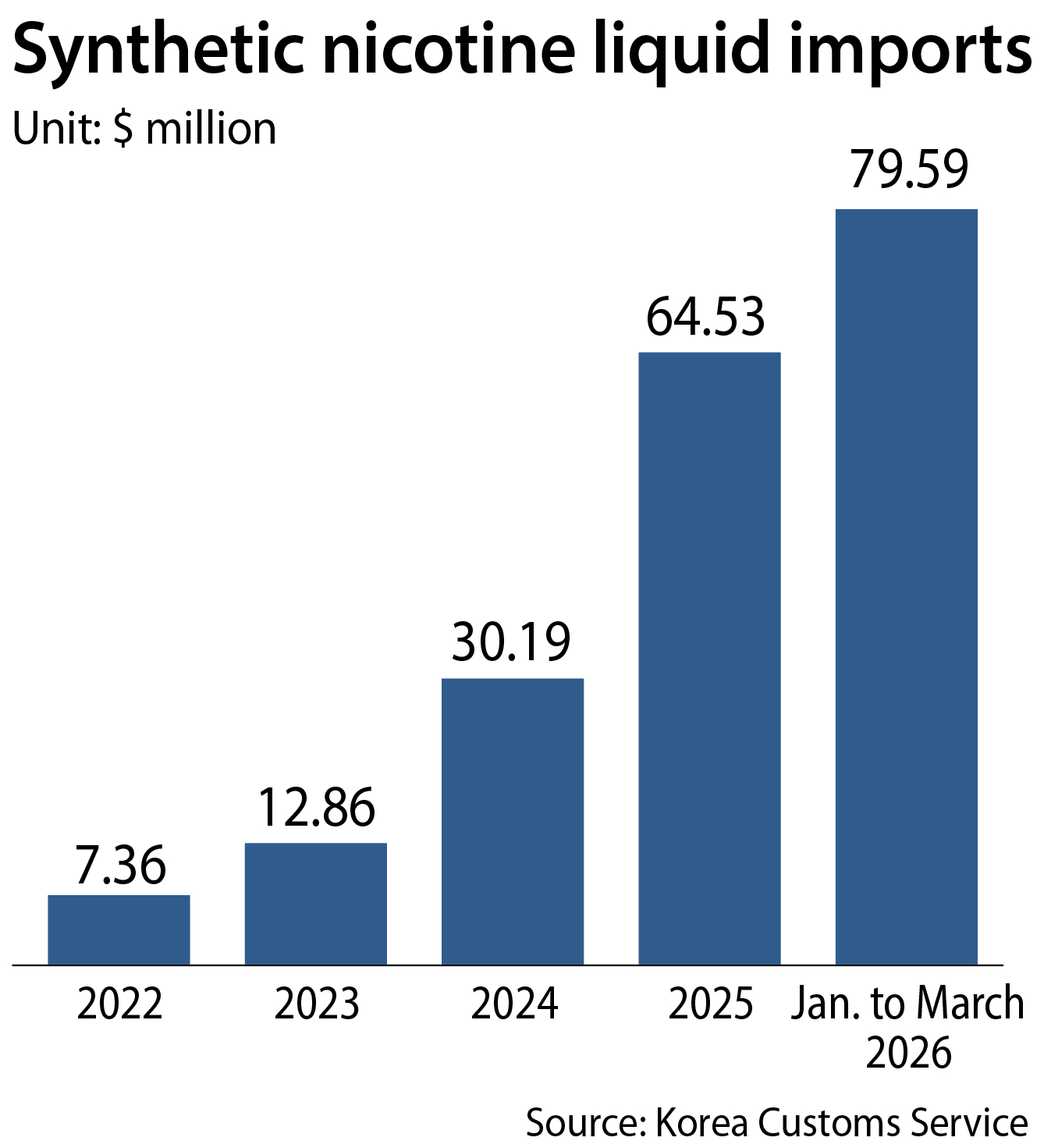
Imports of synthetic nicotine solutions have also surged. According to the Korea Customs Service, imports rose from $7.36 million in 2022 to $64.53 million last year.
Imports surged to $79.59 million in the first three months of this year alone as companies rushed to build inventory ahead of the law’s implementation.
That stockpiling may blunt the immediate impact of the new rules. Under the revised law, taxes are applied based on the date of manufacture or shipment. Products released before the law took effect can still be sold without the new tax burden.
However, the legal redesignation of e-cigarettes does bring some immediate changes. Online sales are now banned, while retailers must obtain tobacco retail licenses. Unmanned stores are also required to install age-verification systems. Liquid e-cigarettes are also subject to a tax of 1,799 won ($1.2) per milliliter, though the government plans to halve the rate for the first two years to ease the industry’s transition.
Even so, the added tax could significantly raise prices. A 30-milliliter (1 ounce) bottle of synthetic nicotine liquid could incur roughly 27,000 won in new taxes — potentially doubling the price of products that previously sold for around 20,000 won.
Critics say the measures may come too late to be fully effective, as many companies have built up tax-free inventories over years of legislative delay.
Although the government has said it will take measures to prevent the sale of products manufactured more than six months before taxation took effect, such as forcibly recalling or destroying noncompliant goods, questions remain about how strictly these measures can be enforced.
Concerns also persist over whether the new rules will meaningfully curb youth access.
“Even after the law takes effect, strict oversight of the entire distribution system and proper education for retailers are essential,” said Lee Sung-kyu, head of the Korea Center for Tobacco Control Research and Education.
This article was originally written in Korean and translated by a bilingual reporter with the help of generative AI tools. It was then edited by a native English-speaking editor. All AI-assisted translations are reviewed and refined by our newsroom.
BY JANG WON-SEOK [[email protected]]


with the Korea JoongAng Daily
To write comments, please log in to one of the accounts.
Standards Board Policy (0/250자)