

The conscription age cap may rise to 43. Who is affected, and what can happen to draft dodgers?
Published: 24 Apr. 2026, 07:00
Updated: 24 Apr. 2026, 10:14
-

- PAIK JI-HWAN
- [email protected]
![Men undergo physical examinations at the Busan Ulsan Regional Office of the Military Manpower Administration in Busan on Jan. 15. [YONHAP]](https://koreaseafood.online/data/photo/2026/04/24/9866c403-6ba0-41d0-aae1-b9d64eca4ca7.jpg)
Men undergo physical examinations at the Busan Ulsan Regional Office of the Military Manpower Administration in Busan on Jan. 15. [YONHAP]
[EXPLAINER]
For Korean men overseas planning to return home after aging out of mandatory military service, they may soon have to wait five more years to be exempt from conscription.
The parliamentary National Defense Committee approved a bill raising the maximum age for military service from 38 to 43 on April 14, which is pending approval in the Legislation and Judiciary Committee before reaching a plenary session. Thus, those who have evaded military service by staying overseas may have to reconsider a return to Korea.
All able-bodied men in Korea must serve in the military for 18 to 21 months, with outright avoidance — from falsifying medical records to refusing to enlist — resulting in criminal charges. That said, tens of thousands have skipped military service over the past few years without any repercussions by residing outside Korea until turning 38, according to government data.
The bill aims to close a loophole that has allowed some men to evade service, as a 2021 projection by Korea’s Board of Audit and Inspection estimates that the number of conscription-eligible men will fall to about 151,000 by 2039, far short of the 500,000 deemed necessary for wartime mobilization.
To prevent attempts to avoid mandatory military service, the proposed law also includes a provision that lets authorities publicly disclose the personal information of people who dodge mandatory military service without valid reasons on official websites and to the media if requested, to raise awareness of the consequences of draft evasion.
But what other impact will this proposed law have on men who have already reached the legal exemption age or those trying to only visit Korea without having finished military duties?
Will individuals who turned 38 before the law takes effect still be subject to conscription?
No. The law will only apply to those who are 37 years or younger as of the day after its promulgation.
![Soldiers conduct a parade during a media day event for the 74th Armed Forces Day at Gyeryongdae in Gyeryong, South Chungcheong, on Sept. 29, 2022. [NEWS1]](https://koreaseafood.online/data/photo/2026/04/24/f9d27243-1fc4-435d-9851-3157f74a0bb8.jpg)
Soldiers conduct a parade during a media day event for the 74th Armed Forces Day at Gyeryongdae in Gyeryong, South Chungcheong, on Sept. 29, 2022. [NEWS1]
“Even after this law takes effect, the authorities will continue to apply the previous rules to anyone who is already exempt from military service because they are 38 or older while staying either in Korea or abroad,” a representative from People Power Party Rep. Yu Yong-weon's office told the Korea JoongAng Daily. Yu was one of the lawmakers who proposed the bill.
Those who were aged out of conscription can thus still visit Korea without being drafted into the military. The same goes for those who avoided the mandatory service by renouncing their Korean citizenship, although they can only stay in Korea within the visa-free entry period or on a visa.
A notable exception is singer Steve Yoo, who remains banned from entering Korea.
After debuting in 1997, Yoo became a U.S. national in 2002 shortly before his military service, losing his Korean nationality in a move widely viewed as draft dodging.
Unlike most former Koreans who renounced citizenship and mainly face work visa limits tied to military service, the Ministry of Justice took the extraordinary step of banning Yoo from entering Korea. The government singled out his case as a high-profile example of draft evasion.
Yoo's move also sparked criticism from the public as he had said in multiple interviews that he intended to serve.
![Singer Steve Yoo [YONHAP]](https://koreaseafood.online/data/photo/2026/04/24/afb0f42a-f897-4fcc-8e0a-ec35b75909c8.jpg)
Singer Steve Yoo [YONHAP]
Yoo cannot bring an end to the ban by finishing military service as he is 49 years old, well above both the current and newly introduced legal age limit for military service.
Can men who have not completed military service stay overseas until 43?
Yes, but they need an overseas travel permit from the Military Manpower Administration.
The overseas travel permit is a formal permission that men above the age of 24 must obtain in order to legally postpone military service and stay overseas. When they have the permit, they are classified as those still subject to conscription but have not yet enlisted.
![A staff member organizes newly issued passports at the issuance desk of the Dalseo District Office in Daegu on Feb. 11. [NEWS1]](https://koreaseafood.online/data/photo/2026/04/24/b1cd8f2b-f906-4bb7-9ce8-df6028f60a7d.jpg)
A staff member organizes newly issued passports at the issuance desk of the Dalseo District Office in Daegu on Feb. 11. [NEWS1]
The yet-to-be-enlisted personnel can therefore enter Korea, but cannot stay for longer than a total of six months.
If they reside in Korea for six months in a calendar year, they lose their permit along with their right to postpone enlistment, according to the Ministry of Government Legislation.
The same rule applies to those who engage in paid work for 60 days or more in a year — for example, by being employed, running a business or earning over 10 million won ($6,800) from freelance or other paid work.
But as long as those with the permit do not fall into one of those categories, they can visit Korea and fly out again.
What happens to men who evade military service by remaining overseas after 43?
Those who reach 43 without completing military service must report to the police if they return to Korea. If authorities determine that they stayed abroad to evade their military obligation, they can face one to five years in prison.
Even under current law, Korean men aged 24 or older who have not completed their military service must obtain an overseas travel permit for extended stays abroad such as for study or work. Failure to do so may result in the Military Manpower Administration filing a criminal complaint with the police.
![A man undergoes a military service evaluation at the Busan Ulsan Regional Office of the Military Manpower Administration in Busan on Jan. 15. [NEWS1]](https://koreaseafood.online/data/photo/2026/04/24/ad21a26c-a0d7-4586-aaed-a155da56074f.jpg)
A man undergoes a military service evaluation at the Busan Ulsan Regional Office of the Military Manpower Administration in Busan on Jan. 15. [NEWS1]
This happened to the son of former Financial Services Commission Chairman Eun Sung-soo in 2021.
Eun's son, who was 31 at the time and held a U.S. green card but remained subject to military service due to his Korean citizenship, departed for the United States on a three-month overseas travel permit. He applied to extend his stay from the United States, but the government denied it and instead ordered him to return to Korea by May 2022.
He did not return on time, however, and the Military Manpower Administration eventually filed a criminal complaint.
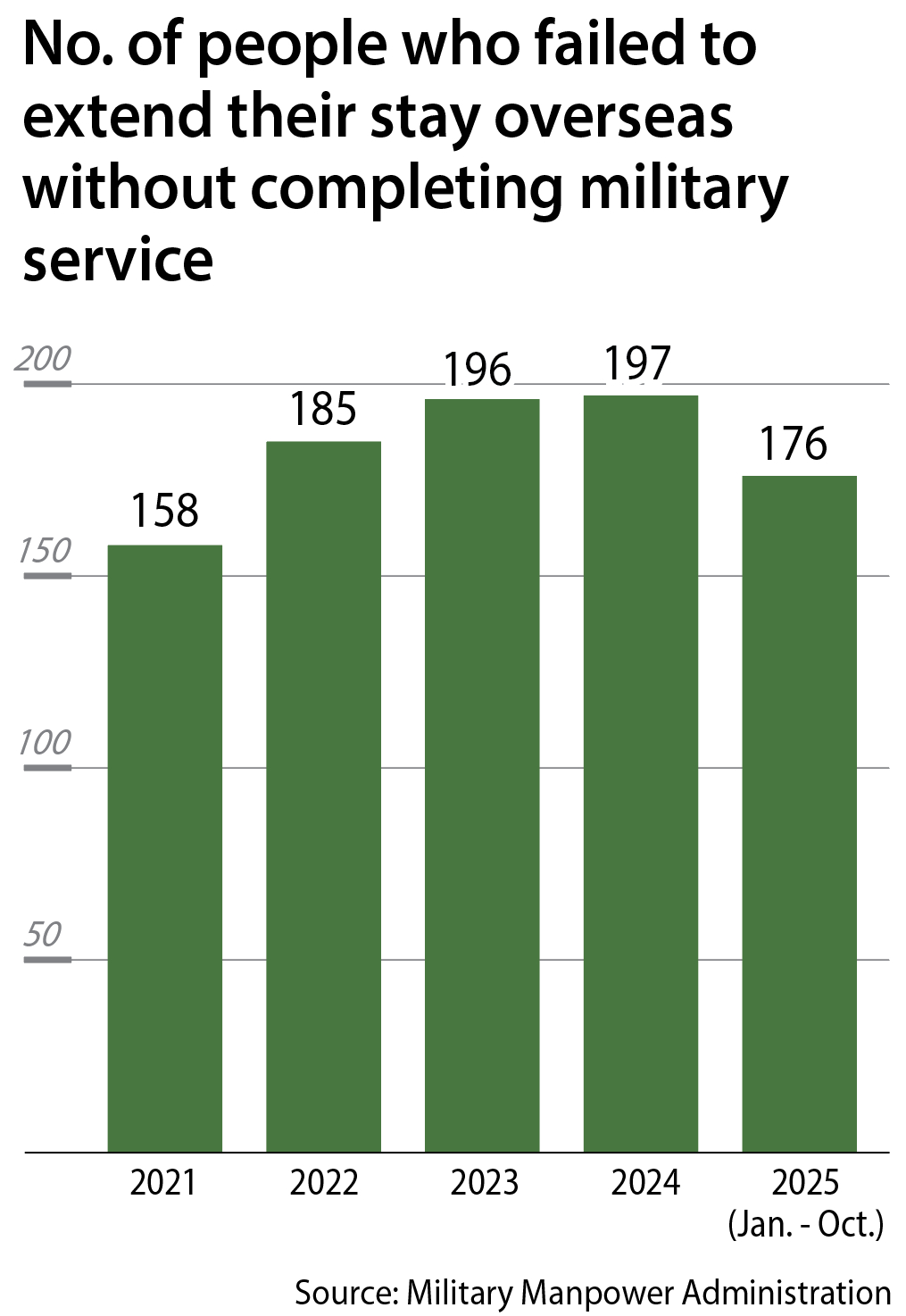
And he was not alone. Around 150 to 200 people each year from 2021 to October 2025 failed to legally extend their stay overseas without completing military duties, according to data from the Military Manpower Administration in December 2025, with legal action pursued against some.
What other penalties await draft evaders?
Whether the government will introduce new penalties for draft evaders under the new law remains unclear. A Military Manpower Administration representative told the Korea JoongAng Daily on Wednesday that no new disciplinary rules have been set, as the bill has only cleared the National Defense Committee.
Under the current penalties, government agencies and local governments cannot hire them and must dismiss them if they are already employed.
Government agencies and local governments must also deny them approval to operate businesses that require official authorization — such as companies in the construction, lodging and restaurant sectors — and revoke any permits, registration or other approval they already have.
Despite the consequences, there have still been many cases of military evasion. The newly introduced law cannot forcibly repatriate men for enlistment, but it prolongs their eligibility for the draft, which could work in favor of both men who want to live freely in Korea — by giving them more time to serve and avoid suspicions of draft-dodging if they were to return long-term — and a country struggling with a declining number of troops.
BY PAIK JI-HWAN [[email protected]]


with the Korea JoongAng Daily
To write comments, please log in to one of the accounts.
Standards Board Policy (0/250자)