

Gov't to launch campaign to encourage commuters to stand on both sides of escalators
Published: 23 Apr. 2026, 18:15
![People use an escalator at Seoul Station in central Seoul on April 22. [KWAK JOO-YOUNG]](https://koreaseafood.online/data/photo/2026/04/23/70703b34-3758-46b7-937a-8c33372db9fc.jpg)
People use an escalator at Seoul Station in central Seoul on April 22. [KWAK JOO-YOUNG]
Impatient commuters who use the subway in Korea have two choices during the morning rush: They can either sprint up the escalators on the left side or stand still on the right and watch precious minutes tick by.
That may soon change — to the frustration of those in a hurry.
The government is mulling ways to revise Koreans’ longstanding habit of lining up on the right side of escalators to stand idly and let the platform take them to their destination while leaving the left side empty for those who want to walk, according to the Ministry of the Interior and Safety on Wednesday. It plans to launch a nationwide campaign to encourage people to stand on both sides in cooperation with the state-run Korea Elevator Safety Agency.
The move comes amid continued concerns over a series of escalator-related accidents, as well as criticism that a one-sided line wears down escalators quickly and leads to higher social costs.
The initiative, if implemented, will be in place from 2026 to 2030.
Earlier in January, Interior and Safety Minister Yun Ho-jung mentioned the campaign during a ministerial briefing. The ministry and the agency formed a joint project body on March 27 and held their first meeting to discuss how to raise awareness of the policy change among the public.
![Small-sized flags are attached to the wall to inform people to stand in two lines on escalators at Seodaemun Station in western Seoul in 2013. [PARK JONG-KEUN]](https://koreaseafood.online/data/photo/2026/04/23/346d6705-fe71-45ac-b40a-19488f50492b.jpg)
Small-sized flags are attached to the wall to inform people to stand in two lines on escalators at Seodaemun Station in western Seoul in 2013. [PARK JONG-KEUN]
Resistance to the policy appears likely: The one-sided standing culture is firmly settled, and many view it as efficient.
“Even now, it’s frustrating when someone suddenly stops in front of me while I’m walking up the escalators,” Han, a commuter who regularly passes through the busy hub of Yeouido Station in western Seoul, said. “I think that I would be even more angry if I were told that people would now be standing on both sides. As many stations lack stairs, it is questionable whether the policy would be effective.”
The issue of whether to stand on one side or both has been brought up multiple times over the past 30 years.
In 1998, when there was little social consensus on escalator etiquette, the government and civic groups began promoting single-file standing, which soon became a nationwide practice among the public during the 2002 FIFA World Cup in Korea.
In 2007, the government shifted its stance and advised people to stand on both sides. The public response was lukewarm, as many were already used to standing in a single line. The government ultimately failed to provide a clear justification for the change and abandoned the campaign in 2015.
More recently, however, safety concerns have surfaced.
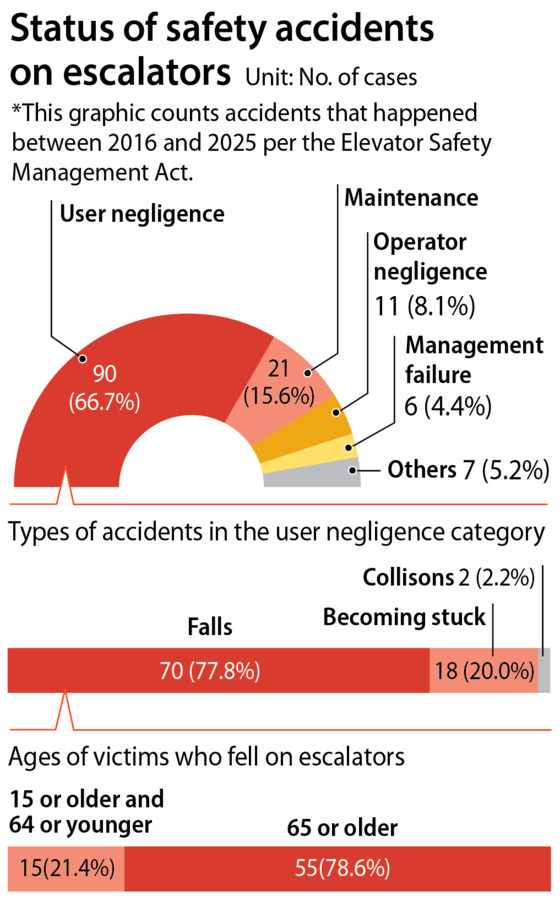
A total of 135 escalator-related major accidents have occurred between 2016 and last year, according to the elevator agency. Among them, 90 cases, or 66.7 percent, were attributed to user negligence. Within that category, falls accounted for the largest share at 77.8 percent, with most victims aged 65 or older.
Escalator-related major accidents refer to incidents resulting in death or in injuries requiring a week or more of hospitalization or three weeks or more of treatment, according to the Elevator Safety Management Act.
The data includes a fatal case in which an older adult tried to step aside for someone approaching from behind, lost their footing and fell backward. The government believes many similar accidents occur when people move aside to let others pass.
![People use escalators at Seoul Station in central Seoul on April 22. [KWAK JOO-YOUNG]](https://koreaseafood.online/data/photo/2026/04/23/ed221ffb-5657-4ebd-a915-4a65cca95ee8.jpg)
People use escalators at Seoul Station in central Seoul on April 22. [KWAK JOO-YOUNG]
Kim, another commuter, remained skeptical of the initiative despite the safety concerns driving it.
“Are morning commuters supposed to miss our trains?” Kim said. “Wouldn’t it be better to build sturdier machines so one-sided standing isn’t even an issue in the first place?”
The government, aware of the potential backlash, is reportedly preparing to present data-backed reasons for the campaign. The Korea Institute for Industrial Research will complete an analysis report on the impact of one-sided standing on escalators — a project commissioned by the ministry.
The chain wheels and guide rails on the right side of escalators were found to erode more than 95 percent more quickly than those on the left, according to the initial findings. The imbalance also shortens the time between major repairs by approximately 15 to 20 percent compared to the average, adding to maintenance costs.
“Escalators were originally designed with the assumption that all users will stand still,” said Jang Gye-ryeon, a leading researcher of the study. “Single-line standing, which makes room for people to walk or run [on escalators], increases both the risk of malfunction and the likelihood of accidents.”
![An escalator at Busan Station is broken in January. [YONHAP]](https://koreaseafood.online/data/photo/2026/04/23/1c203c1a-c856-429f-932b-120b36f5a899.jpg)
An escalator at Busan Station is broken in January. [YONHAP]
An elevator agency official acknowledged that the shift won’t happen overnight.
“Escalator accidents have been a persistent issue,” the official said, noting that it had received “complaints about one-line standing, which came from all directions.”
“We know we can’t force people to change, and [current] habits don’t disappear quickly. We want to start by making people know that they should not feel pressured for standing still,” the official added.
This article was originally written in Korean and translated by a bilingual reporter with the help of generative AI tools. It was then edited by a native English-speaking editor. All AI-assisted translations are reviewed and refined by our newsroom.
BY KWAK JOO-YOUNG [[email protected]]


with the Korea JoongAng Daily
To write comments, please log in to one of the accounts.
Standards Board Policy (0/250자)