

Despite upcoming law, children of incarcerated parents lack emotional and financial support
Published: 23 Apr. 2026, 07:00
![People walk by the Daejeon Correctional Institution in Daejeon on Oct. 26, 2020. [NEWS1]](https://koreaseafood.online/data/photo/2026/04/23/38745646-de57-4eb7-80e4-0474eb5a408c.jpg)
People walk by the Daejeon Correctional Institution in Daejeon on Oct. 26, 2020. [NEWS1]
After his father was jailed in 2024, a fourth-grade boy and his sibling were sent to live with his 72-year-old grandmother, who lives two-and-a-half hours away from his home.
The family soon fell into severe financial distress, twice receiving emergency livelihood support payments and continuing to struggle with expenses including the grandmother’s hospital bills, the children’s education costs and money sent to their father for basic necessities in prison.
His older sibling later moved to a grandaunt’s home, as the grandmother’s limited means could not support two children.
The boy has since been diagnosed with attention deficit hyperactivity disorder, struggling to adjust to his new school life, and receiving monthly treatment.
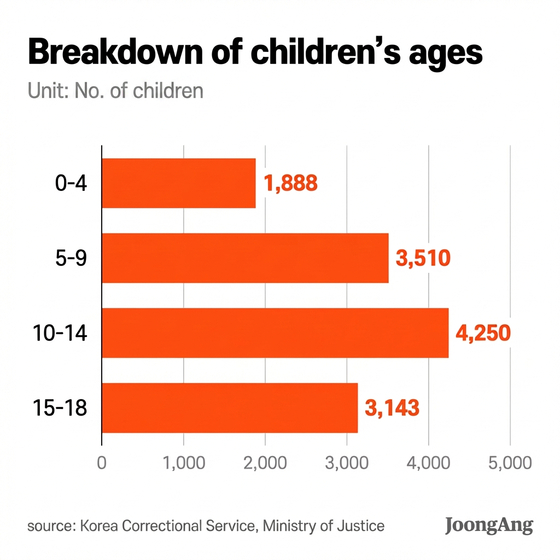
He is one of an estimated 13,000 children with incarcerated parents — those sentenced after trial as well as those held in detention facilities while awaiting trial — who face economic and emotional difficulties during their formative years, effectively bearing the consequences of their parents’ punishment.
The arrests are often sudden, families told the JoongAng Ilbo on Sunday. And, in many cases, they added, the person involved has concealed details of the crime and legal proceedings from family members. As a result, the children are left unprepared and vulnerable to financial hardship.
An extreme case occurred last month in Ulju County, Ulsan, where a father and four children were found dead at home after the children’s mother had been detained.
After the loss of the mother, who had been the family’s primary provider, the remaining family fell into severe financial distress. The father reportedly struggled to maintain stable employment while caring for four children, including a 5-month-old infant.
A person who wished to remain anonymous said they were similarly raising four children alone after their spouse was detained.
“When my spouse was detained and I was working three jobs, I became so exhausted during early morning delivery work that I even thought about letting go of the steering wheel,” the person said in an interview with the JoongAng Ilbo on April 5.
“I held on, thinking of the children.”
A 19-year-old whose father was detained had to quit school in the first year of high school to earn a living.
He worked at a barbecue restaurant on weekdays and at construction sites on weekends. After spending 600,000 won ($400) on his father’s commissary account and repayment obligations, there was little money left.
“I used to do well in school, earning grades in the top tier,” he said. “I plan to try again for college admission next year.”
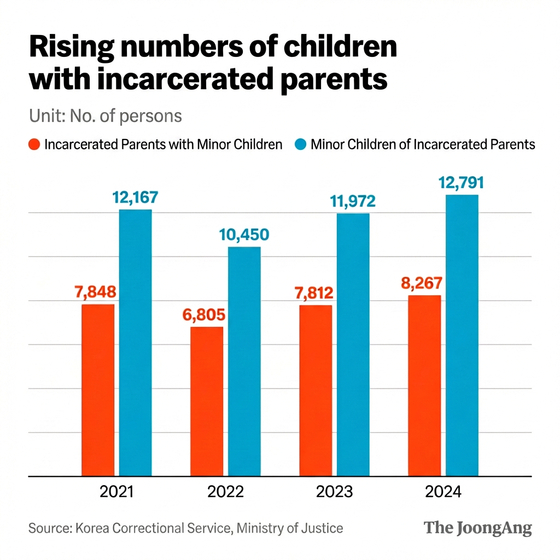
There were 12,791 minor children of incarcerated people nationwide in 2024, an increase of 819, or 6.8 percent, from the previous year, data from the Korea Correctional Service of the Ministry of Justice showed.
Of them, 45.9 percent, or 8,267, said their current financial situation was “difficult.” As periods of detention continue, the financial conditions of remaining family members are likely to worsen.
![A worker at the Korea Correctional Service of the Ministry of Justice [NEWS1]](https://koreaseafood.online/data/photo/2026/04/23/5ac13469-3032-4173-aa71-5fb992f3a374.jpg)
A worker at the Korea Correctional Service of the Ministry of Justice [NEWS1]
Support for the protection of children of incarcerated people was formally written into law for the first time through a revision to the Act on the Execution of Sentences and Treatment of Inmates in December last year, establishing an institutional basis to assist them. But the measure has yet to take effect, as it is only slated to come into force at the end of this year. Current support for the families is limited to a one-time provision of goods.
Experts say sustained attention is needed to ensure that a parent’s detention does not become a form of social punishment for minor children.
“We are often asked why children of incarcerated people should be supported, but the international community has agreed that all children should be helped if they need protection, regardless of their parents’ crimes,” Lee Kyung-rim, executive director of Seum, a welfare organization for children of incarcerated people, said in an interview with the JoongAng Ilbo.
She added that supporting these children also has significant social benefits, including reducing the likelihood of parents reoffending.
Among the 27,917 people released in 2016, 25.2 percent, or 7,039, were reincarcerated within three years, data from the Korea Correctional Service showed. By contrast, only 5.7 percent of parents whose children were supported through family relationship recovery programs run by Seum returned to prison, based on a survey conducted between Sept. 29 and Oct. 12, 2020, involving 50 children.
Even helping children visit incarcerated parents or deliver letters to maintain family ties can significantly reduce reincarceration rates. “If incarcerated parents are able to stay in touch with their children and feel reassured that they are doing well, it can help prevent reoffending after release,” Kang Kyung-rae, a professor of police administration at Daegu Catholic University, said.
Experts also emphasize the importance of emotional support. A 2017 survey by the National Human Rights Commission of Korea of 260 caregivers of minors with incarcerated parents found that 42 percent reported behavioral problems in the children, suggesting that emotional instability and gaps in caregiving caused by a parent’s incarceration can lead to such issues.
Most children of incarcerated people, however, do not receive adequate emotional support. While the Ministry of Justice provides some with emergency relief supplies, emotional support is largely absent. Seum is one of the few organizations offering such services, but it reached only 683 children last year — a small fraction of the roughly 13,000 affected nationwide. In most cases, families had to contact Seum directly or were referred by investigators or correctional officials.
“Children of incarcerated parents may struggle to adjust to school or experience mental health issues such as depression due to emotional shock,” Lee Ji-sun, a professor of social welfare at Ewha Womans University, said. “Providing ongoing psychological care and showing them that there are trustworthy adults can help prevent the cycle of crime and poverty from being passed down.”
There are also calls for closer cooperation among police, the Ministry of Justice and local governments to provide more comprehensive support. From the point of arrest through incarceration, authorities should work with local communities to identify whether individuals have children and who is caring for them, advocates say.
“If children of incarcerated people become isolated, it can lead to delinquency, but with emotional support and restored family relationships, they can grow up in a stable environment,” Lee Kyung-rim said. “Protecting these children ultimately benefits society as a whole.”
This article was originally written in Korean and translated by a bilingual reporter with the help of generative AI tools. It was then edited by a native English-speaking editor. All AI-assisted translations are reviewed and refined by our newsroom.
BY IM SOUNG-BIN, KIM YE-JUNG, OH SAM-GWON [[email protected]]


with the Korea JoongAng Daily
To write comments, please log in to one of the accounts.
Standards Board Policy (0/250자)