

Korean special envoy, Iranian foreign minister discuss safety of vessels stranded in Strait of Hormuz
Published: 23 Apr. 2026, 17:42
Updated: 23 Apr. 2026, 17:56
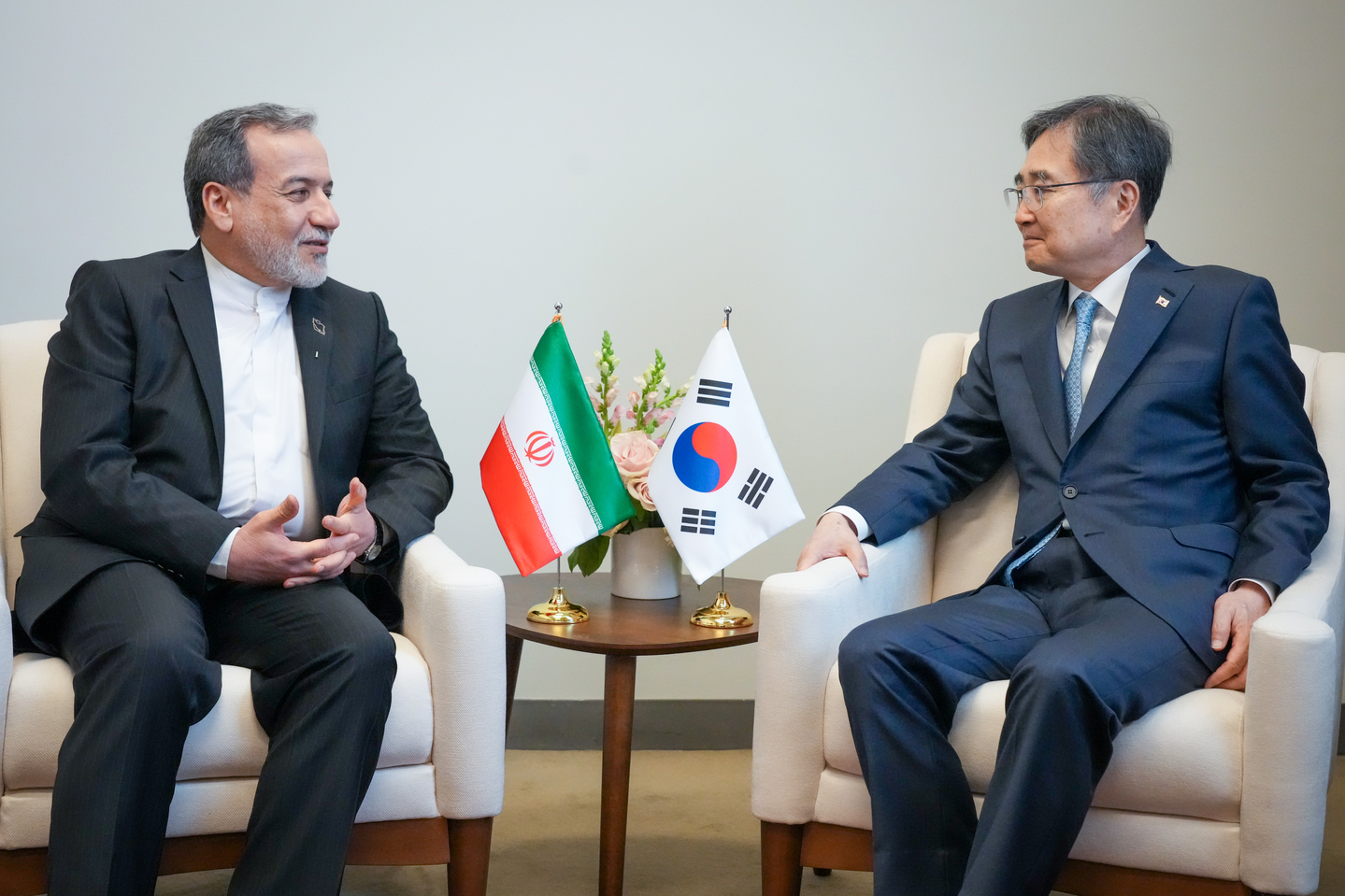
![This photo, released by Iran's Foreign Ministry on April 23, shows Korea's special envoy, Chung Byung-ha, left, meeting with Iranian Foreign Minister Abbas Araghchi, in Tehran. [YONHAP]](https://koreaseafood.online/data/photo/2026/04/23/e824959f-34b4-4e39-9d03-86ac53854c98.jpg)
This photo, released by Iran's Foreign Ministry on April 23, shows Korea's special envoy, Chung Byung-ha, left, meeting with Iranian Foreign Minister Abbas Araghchi, in Tehran. [YONHAP]
Chung Byung-ha, special envoy to Korea's foreign minister, met with Iranian Foreign Minister Abbas Araghchi in Tehran on Wednesday to discuss the situation in the Middle East and bilateral issues, including the safety of stranded Korean vessels in the Strait of Hormuz.
During the meeting, Chung stressed the need to ensure the safety of 26 Korean-flagged vessels and their crews in the strait, as well as around 40 Korean nationals in Iran, the Foreign Ministry said Thursday.
Chung also emphasized the importance of guaranteeing freedom of navigation in the strait and requested cooperation to ensure the swift and safe passage of all vessels.
“I hope that relations between Korea and Iran will continue to develop,” said Chung, conveying greetings from Foreign Minister Cho Hyun, referencing the two recent phone calls between the foreign ministers, a director-general-level policy consultation held last year and humanitarian aid worth $500,000 delivered through the International Committee of the Red Cross.
The comments were seen as reaffirming the intention to continue cooperation in areas such as high-level exchanges, humanitarian assistance and the protection of nationals abroad.
Chung has been meeting with senior Iranian officials since April 11, including the vice foreign ministers for political and economic affairs and the director-general for consular affairs, to discuss bilateral issues and measures to ensure the safety of vessels and crews in the Strait of Hormuz.
Earlier, a Korean-flagged vessel that had been in Qatar attempted to pass through the Strait of Hormuz on Saturday, but the attempt failed, although it had received prior clearance from Iran’s Foreign Ministry, which had announced a full reopening of the strait. The plan fell through after the Islamic Revolutionary Guard Corps, which controls maritime security, said it would resume control "in response to the U.S. blockade.”
![Cargo ships in the Gulf, near the Strait of Hormuz, as seen from northern Ras al-Khaimah, near the border with Oman’s Musandam governance, amid the U.S.-Israeli conflict with Iran, in the United Arab Emirates, on March 11. [REUTERS/YONHAP]](https://koreaseafood.online/data/photo/2026/04/23/c683c8c9-3585-4e13-99f1-672c1df1f53c.jpg)
Cargo ships in the Gulf, near the Strait of Hormuz, as seen from northern Ras al-Khaimah, near the border with Oman’s Musandam governance, amid the U.S.-Israeli conflict with Iran, in the United Arab Emirates, on March 11. [REUTERS/YONHAP]
Tensions have continued in the strait, with the Guard attacking three container ships and seizing two near the area on Wednesday.
“We hope that peace and stability in the region will be restored at an early date through the resumption of negotiations between the United States and Iran,” Chung said during the meeting.
“We appreciate the dispatch of a special envoy under difficult circumstances and the continued operation of the Korean Embassy in Iran without interruption,” Araghchi responded. “We hope that relations between the two countries will develop in a stable manner.”
Araghchi also added that close attention should be paid to ensuring the safety of Korean nationals in Iran.
While most countries have withdrawn their diplomatic personnel since the United States and Israel launched strikes against Iran in February, the Korean Embassy in Iran has continued its operations. This has been viewed as a positive factor in maintaining bilateral communication, including two phone calls between the foreign ministers and the dispatch of a special envoy.
Foreign Minister Cho Hyun, right, talks with Iranian Foreign Minister Abbas Araghchi during the United Nations General Assembly High-level Week in September 2025.
Iran’s Foreign Ministry also said through its Telegram account that Araghchi emphasized the importance of strengthening relations between Iran and Korea and expressed willingness to cooperate during the meeting with Chung.
It added that Araghchi also stressed the need to take a clear and firm stance in condemning the United States and Israel’s aggression and crimes against the Iranian people.
He argued that threats from the United States and Israel were the root cause of instability in the Strait of Hormuz, saying, “Iran has taken measures to protect its security in accordance with international and domestic law."
Iran also disclosed the outcome of the meeting through social media without prior consultation with Korea. The release devoted a significant portion to criticism of the United States and Israel, which is seen as an extension of its ongoing propaganda efforts since the early stage of the conflict and as an attempt to drive a wedge in the Korea-U.S. alliance from experts.
This article was originally written in Korean and translated by a bilingual reporter with the help of generative AI tools. It was then edited by a native English-speaking editor. All AI-assisted translations are reviewed and refined by our newsroom.
BY SHIM SEOK-YONG [[email protected]]


with the Korea JoongAng Daily
To write comments, please log in to one of the accounts.
Standards Board Policy (0/250자)