

Naphtha prices surge 68% in March, driving sharpest producer price hike in 4 years
Published: 22 Apr. 2026, 17:14
Updated: 22 Apr. 2026, 19:37
-

- CHO YONG-JUN
- [email protected]
![Vinyl products are stacked at a store in Jung District, central Seoul, on April 22. [NEWS1]](https://koreaseafood.online/data/photo/2026/04/22/ee055830-08d5-4644-a8f1-eccbfaa443ef.jpg)
Vinyl products are stacked at a store in Jung District, central Seoul, on April 22. [NEWS1]
Naphtha prices surged 68 percent in March, driving Korea’s producer prices to their sharpest monthly increase in nearly four years, the Bank of Korea (BOK) said Wednesday.
The jump showed how the oil shock driven by the Iran war is spreading through the domestic economy. As costs for petroleum and chemical materials climb, concerns are growing that the pressure will spill over into consumer prices and further weigh on domestic demand.
Naphtha is a key intermediate material used to make petrochemical products such as ethylene and propylene and is widely used across industries. As a result, higher naphtha prices could trigger a chain reaction in prices for products ranging from plastics and vinyl to medical supplies.
Korea’s producer price index, with 2020 as the base year, rose 1.6 percent from a month earlier to 125.24 in March.
That matched the increase recorded in April 2022, just after the outbreak of the Russia-Ukraine war, and marked the steepest monthly rise in three years and 11 months. Producer prices have now risen for seven straight months since September of last year.
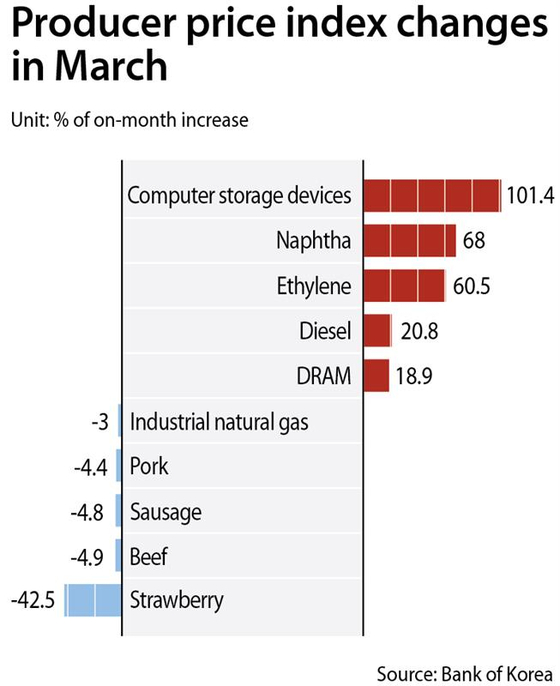
Petroleum and chemical products led the increase this time around. Among manufactured goods, prices for coal and petroleum products jumped 31.9 percent from the previous month, the steepest rise since December 1997, during the Asian financial crisis.
The increase was especially sharp in basic materials. Naphtha surged 68 percent on month, and solvents rose 115.6 percent.
Semiconductor prices also pushed up producer prices. Prices for computer storage devices rose 101.4 percent from a month earlier, while dynamic random-access memory prices climbed 18.9 percent as demand linked to artificial intelligence expanded.
The domestic supply price index, which includes imports, rose 2.3 percent from the previous month.
![A driver fills up his vehicle at a gas station in Seoul. [NEWS1]](https://koreaseafood.online/data/photo/2026/04/22/36597a21-f4c3-44bf-86a0-aa67871217dd.jpg)
A driver fills up his vehicle at a gas station in Seoul. [NEWS1]
Higher prices have already started passing through each stage of production, with raw materials up 5.1 percent, intermediate goods up 2.8 percent and final goods up 0.6 percent. The total output price index, which reflects producers’ shipment prices, also rose 4.7 percent.
By contrast, prices for agricultural, forestry and fishery products fell 3.3 percent, while electricity, gas and water edged down 0.1 percent. Service prices were flat for now, but the buildup in costs could eventually feed into service inflation with a time lag.
“Given that producer prices have now risen for seven straight months and posted a sharp increase in March, they could act as an upward factor for consumer prices as well,” Lee Moon-hee, head of the BOK's price statistics team, said.
If uncertainty over negotiations between the United States and Iran continues, international oil prices could remain volatile and inflation pressure could last longer.
A sharp rise in producer prices could also push consumer prices higher again and become a factor behind future interest rate hikes.
This article was originally written in Korean and translated by a bilingual reporter with the help of generative AI tools. It was then edited by a native English-speaking editor. All AI-assisted translations are reviewed and refined by our newsroom.
BY KIM-WON [[email protected]]


with the Korea JoongAng Daily
To write comments, please log in to one of the accounts.
Standards Board Policy (0/250자)