

Shareholders have more of a say thanks to recent Commercial Act revisions
Published: 17 Apr. 2026, 18:11
![Korea Zinc’s 52nd annual general shareholders’ meeting is held at Hotel Koreana in central Seoul on March 24. [JOINT PRESS CORPS]](https://koreaseafood.online/data/photo/2026/04/17/1fe30b8e-4214-4222-8f08-b776e55432ec.jpg)
Korea Zinc’s 52nd annual general shareholders’ meeting is held at Hotel Koreana in central Seoul on March 24. [JOINT PRESS CORPS]
Shareholder activism is increasingly reshaping corporate governance disputes in Korea, expanding beyond what had long been seen as internal conflicts among controlling families into broader battles between major shareholders and minority investors or activist funds.
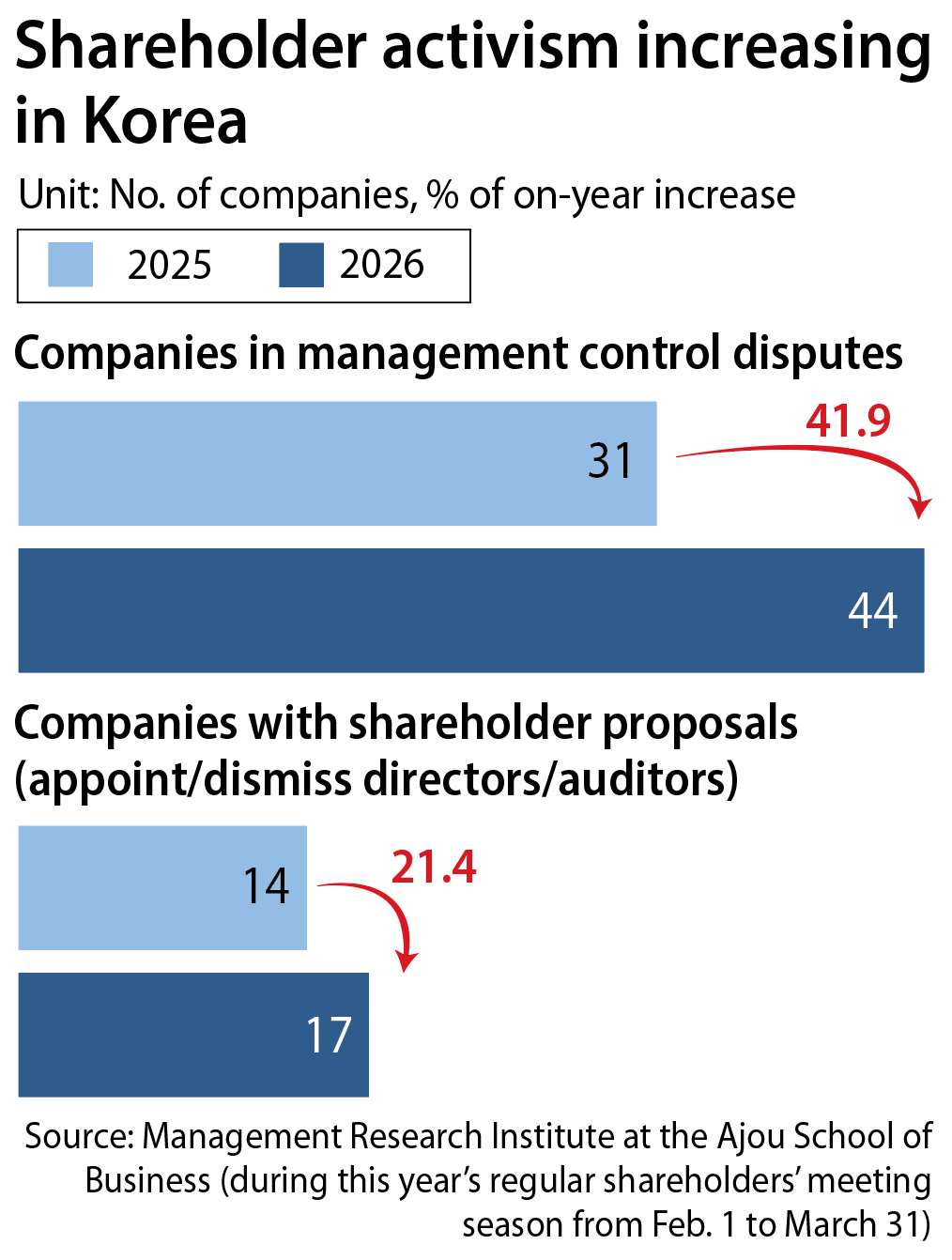
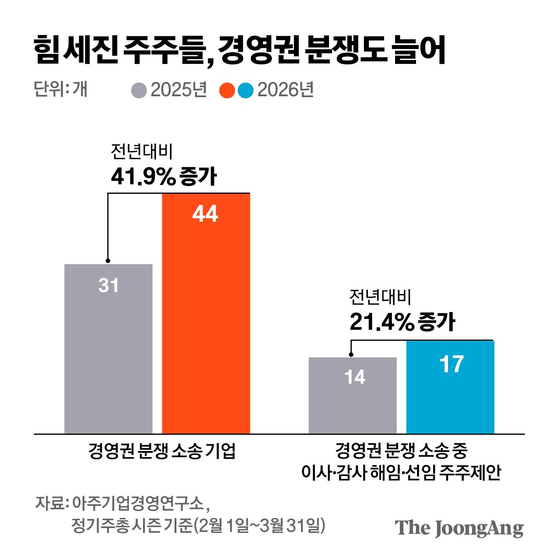
A total of 44 companies faced management control disputes during this year’s regular shareholders’ meeting season from Feb. 1 to March 31, up 41.9 percent from 31 companies a year earlier, according to an analysis of disclosures by the JoongAng Ilbo and the Management Research Institute at the Ajou School of Business.
Among those companies, shareholders at 17 firms proposed the appointment or dismissal of specific directors or auditors, an increase of 21.4 percent from 14 cases last year.
Even at companies without active control disputes, shareholders submitted a growing number of proposals. A total of 206 shareholder proposals were filed at 56 companies during this year’s meeting season, growing from 167 proposals at 43 companies last year.
Proposals related to the appointment or dismissal of directors or auditors accounted for the largest share with 80 cases, followed by amendments to articles of incorporation with 66 cases and shareholder return measures with 30 cases.
“The recent revisions to the Commercial Act and the spread of the stewardship code have created an environment in which shareholders can more actively intervene in board composition and management decision-making,” said Kim Nam-eun, head of the Ajou management institute. “Shareholder proposals are moving beyond simple expressions of opinion and entering a stage where they exert tangible influence on corporate governance.”
A recent case involving Cosmax NBT highlights this shift.
![A Cosmax NBT factory in Icheon, Gyeonggi [COXMAX NBT]](https://koreaseafood.online/data/photo/2026/04/17/cb77f82f-9115-4e8a-822c-022db1f8dff7.jpg)
A Cosmax NBT factory in Icheon, Gyeonggi [COXMAX NBT]
A minority shareholder group at Cosmax NBT, a health functional food affiliate of Cosmax, won a court decision on April 9 granting access to the company’s accounting books. The group had filed a management dispute lawsuit in February with the Suwon District Court, seeking to identify the causes of the company’s six-year string of losses.
The shareholder group argued that “The biggest reason for the accumulated losses is a failed investment in the U.S. subsidiary,” adding, “We will secure evidence through accounting records to show that governance and board functions were not operating properly and demand corrective action, and take civil and criminal measures if necessary.”
The group had also attempted to appoint a new auditor through a shareholder proposal ahead of last month’s regular shareholders’ meeting but failed to secure approval.
Overseas, minority shareholders, activist funds and institutional investors have long played an active role in shaping corporate strategies.
![Shareholders are checked before entering Samsung Electronics’ 57th annual general meeting at Suwon Convention Center in Yeongtong District, Suwon, Gyeonggi, on March 18. [YONHAP]](https://koreaseafood.online/data/photo/2026/04/17/7971ca5b-ddcc-4466-96ea-dcf2ae19608c.jpg)
Shareholders are checked before entering Samsung Electronics’ 57th annual general meeting at Suwon Convention Center in Yeongtong District, Suwon, Gyeonggi, on March 18. [YONHAP]
Nintendo, which recorded losses for three consecutive years starting in 2012, for example, had focused on its core console business. Activist fund Oasis Management Company, which held less than 1 percent of shares, sent three public letters urging the company to enter the mobile market and gained support from major institutional investors such as JPMorgan. Nintendo eventually launched the augmented reality mobile game Pokémon Go in 2016, and its stock price doubled within 10 days of release.
In another case, activist fund Engine No. 1 replaced three out of four board members at ExxonMobil in 2021 despite holding just 0.02 percent of shares, after openly criticizing the company’s fossil fuel-centered strategy.
In Korea, Align Partners Asset Management succeeded in appointing a director through a shareholder proposal at DB Insurance’s shareholders’ meeting this year — the first such case in the insurance industry and among listed companies with a market capitalization exceeding 10 trillion won ($6.8 billion).
shareholder activism graphic
However, concerns are also growing that excessive exercise of shareholder rights could undermine long-term and stable management strategies.
“If activist funds and the National Pension Service exercise voting rights excessively, it could increase the management burden on companies and dampen the vitality of the capital market as a whole,” said Kwon Jae-yeol, a professor at Kyung Hee University Law School.
Still, the trend itself may be worth noting to companies, according to Yi June-suh, a professor of business administration at Dongguk University.
“There may be temporary confusion as the rights of general shareholders are strengthened, but companies should use the shareholder-friendly trend as an opportunity to enhance corporate value and redesign capital policies," Yi said.
This article was originally written in Korean and translated by a bilingual reporter with the help of generative AI tools. It was then edited by a native English-speaking editor. All AI-assisted translations are reviewed and refined by our newsroom.
BY KIM KYUNG-MI, KIM SU-MIN [[email protected]]


with the Korea JoongAng Daily
To write comments, please log in to one of the accounts.
Standards Board Policy (0/250자)