

Korea's appeal as Asia-Pacific business hub weakening due to labor policies, regulations: Survey
Published: 15 Apr. 2026, 16:56
Updated: 15 Apr. 2026, 18:55
-

- MICHAEL LEE
- [email protected]
![A graphic illustration of the so-called yellow envelope law, which limits companies from claiming damages from workers who go on strike. [JOONGANG PHOTO]](https://koreaseafood.online/data/photo/2026/04/15/dde24953-fafd-4d91-8bd4-58764f1e11f2.jpg)
A graphic illustration of the so-called yellow envelope law, which limits companies from claiming damages from workers who go on strike. [JOONGANG PHOTO]
Korea’s appeal as a base for Asia-Pacific operations is weakening, with global companies increasingly pointing to labor policies and regulatory constraints as key risks, according to a survey by the American Chamber of Commerce in Korea (Amcham).
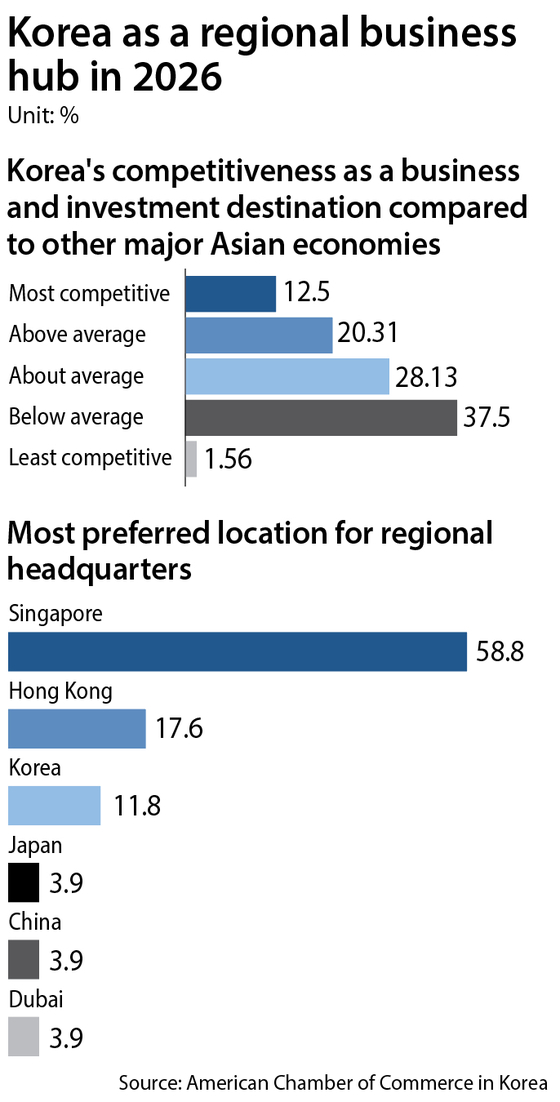
Korea ranked third as a preferred location for regional headquarters in Amcham’s 2026 business environment survey, slipping further behind first-ranked Singapore while Hong Kong rose to the No. 2 spot.
Only 11.8 percent of respondents selected Korea as their preferred hub for Asia-Pacific operations compared to 58.8 percent for Singapore and 17.6 percent for Hong Kong.
The shift marks the first time since 2022 that Korea has fallen to third place, reversing gains made during the Covid-19 pandemic, when strict lockdowns in China and Hong Kong had boosted Korea’s relative standing.
At the center of the change is a sharp deterioration in how companies assess Korea’s labor environment.
A majority of respondents — 71 percent — identified labor policy and labor market inflexibility as the biggest obstacle to doing business, far exceeding concerns about regulatory alignment with global standards and legal risks facing management.
Nearly 69 percent also described the broader regulatory environment as “restrictive” or “very restrictive,” reinforcing a view that structural constraints are undermining Korea’s competitiveness despite its reputation as a stable market.
Business groups say the shift in sentiment has been amplified by the implementation of the so-called Yellow Envelope law, a revision to the Trade Union Act that limits companies’ ability to seek damages from striking workers and expands the definition of employers to include firms that indirectly control subcontracted labor.
The law takes its name from a civic campaign in the early 2010s that sent donations in yellow envelopes to unionized workers facing large court-imposed damages after strikes. The envelopes became a symbol of solidarity with the workers and of efforts to limit such liabilities.
Opponents argue the changes have heightened legal and operational uncertainty by broadening the scope of labor disputes and exposing companies and executives to greater risk.
The shift in perception has been swift. In last year’s survey, fewer than one in ten respondents cited labor policy as their biggest management challenge, with companies instead focused on regulatory unpredictability and political uncertainty.
Industry groups have warned that the evolving legal landscape could weigh on investment decisions. Amcham previously warned that the change in labor policy could affect U.S. firms’ willingness to invest, while the European Chamber of Commerce in Korea has cautioned that companies could reconsider their presence in the country.
Legal experts expect the uncertainty to persist. One lawyer and former senior judge said key aspects of the law — including the expanded definition of employers, the scope of management decisions subject to labor disputes, and procedures for collective bargaining — remain open to interpretation.
“Given the number of unresolved legal questions, disputes are likely to escalate into criminal cases,” the lawyer said. “Significant uncertainty and confusion in the field could last at least five years, until clearer precedents are set by the Supreme Court.”
“Korea’s drop to third place as a regional headquarters destination is a disappointing outcome, but it is also a clear signal that more needs to be done to strengthen its competitiveness,” said Amcham Chairman James Kim, though he added that the country “remains a stable and resilient market with strong growth potential, and with improvements in regulatory predictability and labor market flexibility, it is well-positioned to regain its standing.”
The chamber plans to share its analysis of the survey and make policy recommendations during its upcoming “Doing Business in Korea” seminar on April 21.
This article was originally written in Korean and translated by a bilingual reporter with the help of generative AI tools. It was then edited by a native English-speaking editor. All AI-assisted translations are reviewed and refined by our newsroom.
BY KIM SU-MIN, MICHAEL LEE [[email protected]]


with the Korea JoongAng Daily
To write comments, please log in to one of the accounts.
Standards Board Policy (0/250자)