

Chinese EV sales gain momentum with Korean consumers
Published: 15 Apr. 2026, 15:38
Updated: 16 Apr. 2026, 16:04
![The BYD Seal drives around a testing ground in Shenzhen, China. [BYD KOREA]](https://koreaseafood.online/data/photo/2026/04/16/e1dc6aca-1944-4eaa-b7cb-de06c3b19998.jpg)
The BYD Seal drives around a testing ground in Shenzhen, China. [BYD KOREA]
Chinese EVs are making deeper inroads into Korea as both mainland brands and cars built in China gain traction with local consumers.
BYD Korea, the Korean subsidiary of Chinese EV giant BYD, sold 10,075 vehicles in Korea by the end of March, just 11 months after the company began delivering to local customers on April 14 last year.
According to the company, 79 percent of customers were individual buyers, with people in their 40s and 50s accounting for 65 percent. This suggests that the brand has appealed more to middle-aged consumers focused on value and practicality, and less to people looking to buy their first car.
Sales are also accelerating. BYD Korea sold 6,107 vehicles over eight months last year, then sold 3,968 more in just the first quarter of this year.
“Crossing 10,000 sales in 11 months is the fastest pace in the imported car market,” a BYD Korea official said. “Our goal is to sell 10,000 vehicles this year and join the 10,000 unit club.”
BYD Korea sells four models in Korea: the Atto 3, Seal, Sealion 7 and Dolphin, the newest addition to the lineup, added this year. The company also plans to launch a plug-in hybrid model in the second half of the year. A plug-in hybrid uses both an internal combustion engine and batteries to power the vehicle.
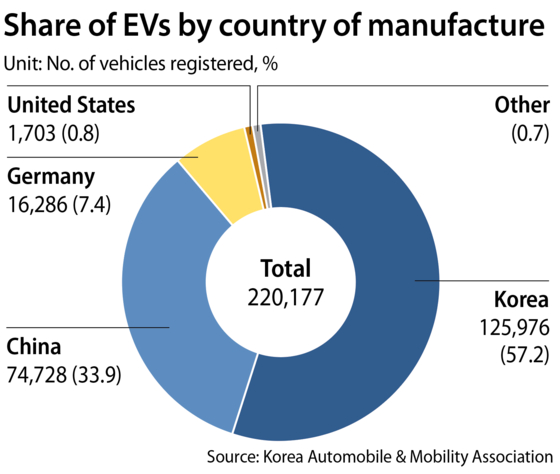
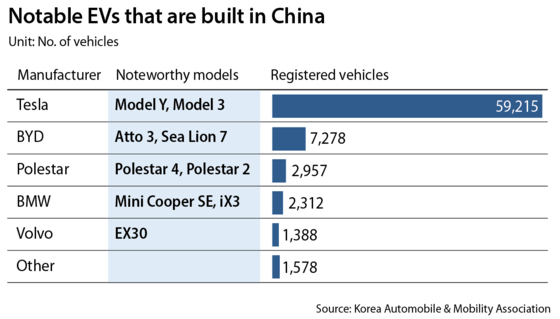
The increased sales of Chinese cars look even stronger when Chinese cars are defined more broadly as vehicles made in China. A total of 74,728 of the 220,177 new EVs registered in Korea last year were made in China, accounting for 33.9 percent of the total, according to the Korea Automobile & Mobility Industry Association. In other words, one out of every three newly registered EVs was built in China.
The biggest contributor was Tesla’s Model Y, which is produced in China and sold in Korea. The association said Tesla lowered prices for its China-built models while Chinese-affiliated brands such as BYD and Polestar drew both caution and interest from the market.
The report made a link between the oil crises of the 1970s, where car demand shifted from mid- and large-size cars to compact cars, helping Japan become the world's top automaker.
If high oil prices persist and EV demand rises, Chinese EV makers are likely to expand their market share further because they already have price competitiveness and production capacity, according to the report.
The government is also taking action to protect domestic automakers against the sudden influx of Chinese EVs.
The Ministry of Climate, Energy and Environment will, from this year, evaluate automakers, rather than individual models, as participants in the EV subsidy program. Carmakers that fail to score at least 80 out of 120 points in the government's comprehensive evaluation criteria will not qualify for subsidies.
![BYD Seal during the model's Korean launch at the Seoul Mobility Show in 2025. [BYD KOREA]](https://koreaseafood.online/data/photo/2026/04/16/381d5a0d-ef2f-426a-8161-153c2f3161c4.jpg)
BYD Seal during the model's Korean launch at the Seoul Mobility Show in 2025. [BYD KOREA]
The evaluation covers technology development, after-sales service and contribution to industry. Scores will be based on factors such as research and development investment, patent holdings, service network construction, support for domestic parts makers and whether parts are sourced in Korea.
“The structure is unfavorable to imported EVs because patents belong to headquarters and parts are made overseas,” an imported car industry insider said.
“Subsidies come from taxpayers’ money, so the purpose is to encourage contributions such as protecting domestic industry,” Climate, Energy and Environment Minister Kim Sung-whan said on April 8 in response to the criticisms in the National Assembly.
“The European Union is also expanding industrial protection policies as Chinese EVs spread,” Lee Hang-gu, a special professor at Pyeongtaek University, said. “But Chinese cars are overcoming even that through price, so Korean companies will ultimately struggle to survive unless they also become price competitive.”
This article was originally written in Korean and translated by a bilingual reporter with the help of generative AI tools. It was then edited by a native English-speaking editor. All AI-assisted translations are reviewed and refined by our newsroom.
BY LEE SU-JEONG [[email protected]]


with the Korea JoongAng Daily
To write comments, please log in to one of the accounts.
Standards Board Policy (0/250자)