

Despite a government push, the Kospi just feeds the housing beast
Published: 15 Apr. 2026, 05:00
Updated: 15 Apr. 2026, 10:17
-
- JIN MIN-JI
- [email protected]
![View of apartments in Seoul from Lotte World Tower in Songpa District, southern Seoul, on April 8. [NEWS1]](https://koreaseafood.online/data/photo/2026/04/15/7255591a-fa68-47e7-b4e2-c7dbddbbb256.jpg)
View of apartments in Seoul from Lotte World Tower in Songpa District, southern Seoul, on April 8. [NEWS1]
Korea’s ambitious initiative to shift money from real estate into stocks has paid off, sending the Kospi soaring by more than double in less than a year. But the success comes with an ironic twist: Many investors are now funneling their stock gains into buying homes, undercutting the government’s market reform strategy.
A Seoul-based office worker surnamed Cho is a case in point. She has watched the Kospi rally with amazement and invests in Korean stocks herself. But she doesn’t plan to hold onto them long-term. Instead, she intends to use the gains as a stepping stone to purchase a home in an even more desirable location.
“I plan to use the stock gains to either move to a better-located home or pay down the mortgage on the one I already own,” Cho said. “The Kospi has surged, yes, but with swings this wild, long-term investing feels too risky.”
Cho isn’t alone in shifting stock gains into properties. Sales of stocks and bonds for a home purchase in Seoul jumped more than 70 percent from 2.25 trillion won ($1.5 billion) in 2024 to 3.9 trillion won in 2025, according to data from housing purchase fund procurement plans submitted to the Ministry of Land, Infrastructure and Transport and obtained by Rep. Kim Jong-yang of the People Power Party. Sales were most prominent in October at 576 billion won, when the Kospi broke past 4,000 points for the first time. The number of housing transactions in the month totaled nearly 70,000, jumping 23.2 percent from a year earlier, according to the ministry data.
“People are parking their gains from stocks in the low-volatility asset of housing to consolidate their wealth,” said Park Won-gap, a real estate analyst at KB Kookmin Bank. The choice reflects the belief that a house is a better investment than stocks, despite the high interest rate of a mortgage, driven by fears of rising home prices amid a housing shortage and continued liquidity expansion under the government’s expansionary policies, he explained.
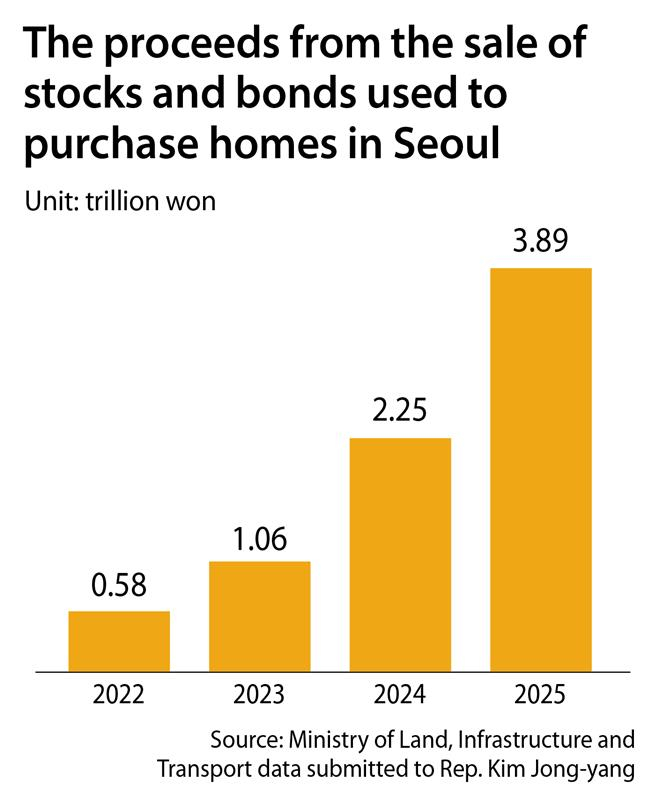
Stocks: The ticket home
While retail investors have emerged as staunch believers in the Korean market — standing out as the only net buyers in the Kospi this year amid foreign and institutional net selling — their confidence in real estate remains even stronger. President Lee Jae Myung’s increasingly scathing criticism of property investors — both owners of multiple homes and some single-home owners — has done little to dampen the public’s desire to buy a home.
If anything, it has fueled that desire, as growing anxiety over tightening regulations — such as stricter loan limits, including tighter restrictions on mortgages and even peer-to-peer lending — has made it much harder for would-be buyers to enter the market, while rising jeonse (lump-sum deposit) prices have only added to the urgency to secure a home.
“I recently felt an urgent need to buy a home, as both purchase prices and jeonse rents are rising," said a researcher surnamed Lee. She admitted that with raw material shortages from the Iran war pushing the prices of new builds up as well, the pressure to buy quickly is intense.
The quickest and easiest way she has found to grow her wealth to buy a home is by investing in stocks. So she has been investing aggressively in equities, locking in gains whenever returns reach between 5 and 20 percent on the stocks she trades short-term.
“Under such tight mortgage regulations, purchasing a home has become nearly impossible — even for dual-income households — without parental support,” she added.
![Hand holding bunch of keys. House appartment rental or sale concept. Buying car, renting apartment, rental payment concept. Business hand selling, buyer paying with cash. [GETTY IMAGE PRO]](https://koreaseafood.online/data/photo/2026/04/15/ce7fe68e-013a-49e4-b9d4-1276d70c85b6.jpg)
Hand holding bunch of keys. House appartment rental or sale concept. Buying car, renting apartment, rental payment concept. Business hand selling, buyer paying with cash. [GETTY IMAGE PRO]
Compounding the anxiety is a chronic, and worsening, housing shortage.
The number of units to be supplied in 2026 is projected to be 250,000, down 27 percent from last year, according to the Korea Housing Institute. The shortage in the metropolitan area is even more severe, as the number of completed units is expected to reach only 120,000 — less than half of the estimated annual demand of 250,000.
The rental market is also experiencing a supply squeeze. In Seoul, the number of available jeonse listings last week has fallen by 45 percent on year, while monthly rental listings have decreased by 25 percent, according to real estate data provider Asil. Seoul Mayor Oh Seo-hoon called the dramatic drop a “disaster,” warning that nearly 100,000 households with jeonse contracts expiring this year and next could be left without a place to live.
“As long as the housing shortage persists, which it will, demand for real estate will never fade,” said Kwon Dae-jung, a professor at the Graduate School of Economics and Real Estate at Hansung University.
“In 2024, the homeownership rate in Seoul stood at 48.1 percent, meaning 51.9 percent of households did not own a home. With limited land available to build houses to meet that demand, the desire for homeownership will remain resilient,” Kwon added, suggesting the demand will outweigh interest in more volatile stock market gains, which many see as “unstable.”
![Listings for house sales are displayed outside a real estate agency office in Songpa District, southern Seoul, on April 9. [NEWS1]](https://koreaseafood.online/data/photo/2026/04/15/2f5d51bc-a47e-4e32-9a8e-5fe82d936f9a.jpg)
Listings for house sales are displayed outside a real estate agency office in Songpa District, southern Seoul, on April 9. [NEWS1]
Stocks for speed, homes for stability
While nearly a 150 percent gain in the Kospi since last year is impressive, outpacing the U.S. S&P 500 by 17 percent, the volatility that such growth entails is leading investors to treat stocks as a short-term investment and ultimately park their assets in what they consider more stable holdings: a home.
Last month, the turnover rate of domestically listed Korean stocks reached 40.55 percent — the highest in three years — signaling a sharp rise in short-term trading. That means roughly four out of every 10 listed shares changed hands, underscoring heightened market activity, as illustrated by the 12 percent plunge in a single session on March 4 following the outbreak of the Iran war.
“Stability is the main reason I want to buy a home,” said an office worker and active stock investor surnamed Jeong, who is building up assets to purchase an apartment in Seoul. “I see real estate as offering more practical security because it’s something I can actually live in, unlike stocks, which are purely financial assets. So even if market prices fluctuate, it still holds real value for me.”
Like Jeong, many Koreans have an enduring commitment to home ownership. In a survey of 1,000 respondents conducted in October by Seoul-based public opinion firm Korea Research, 86 percent said they believe in owning a home regardless of fluctuations in housing prices. The conviction was consistent across all age groups, with ownership support exceeding 80 percent in every category.
Such solid belief in real estate is consistent among the wealthy. Among individuals with at least 1 billion won in financial assets and 1 billion won in real estate assets in 2025, 54.8 percent of assets were in real estate and a distant 37.1 percent were financial assets, with the remainder in alternative and tangible assets such as art, according to the Korea Wealth Report, released by the KB Financial Group Management Research Institute in December.
Generally, the larger an individual’s wealth, the greater the share of real estate in their portfolio — a pattern that has remained consistent over the past five years, the report showed.
“If people truly believed housing prices would crash, they wouldn’t buy homes,” said Lee Eun-hyeong, a research fellow at the Research Institute for Construction Policy. “With asset prices rising across the board, including equities, many find it hard to imagine that home values, especially in the metropolitan area, would decline. Money in stocks is simply capital placed in the market, but housing provides residential stability — something people experience every day.”
With real estate remaining the favored investment despite the stricter rules, investors are shifting strategies, redirecting stock gains into property.
“Today, people secure definite gains from stocks first and then move those profits into real estate,” said Park from KB Kookmin Bank. “That is unlike in the past when buyers mostly relied on large loans to purchase a home. For them, investing acts like a flexible partition, allowing assets to be shifted as opportunities arise.”
BY JIN MIN-JI [[email protected]]


with the Korea JoongAng Daily
To write comments, please log in to one of the accounts.
Standards Board Policy (0/250자)