

Nearly 9,000 apply for Korea's new community-based integrated care program, but questions remain
Published: 14 Apr. 2026, 17:10
Updated: 14 Apr. 2026, 18:41
![A senior citizen registers for the new community-based integrated care program at a community service center in Geuncheon District, southern Seoul, on March 27. [YONHAP]](https://koreaseafood.online/data/photo/2026/04/14/c7c5b33a-8922-4d8d-83cd-b5fafa011335.jpg)
A senior citizen registers for the new community-based integrated care program at a community service center in Geuncheon District, southern Seoul, on March 27. [YONHAP]
Nearly 9,000 people applied for Korea’s new community-based integrated care program in the first two weeks after its nationwide launch, but only 1.2 percent of applicants were disabled people under 65, government figures showed Tuesday.
The Ministry of Health and Welfare said 8,905 people had applied for the Community Integrated Care Services as of last Friday, after the full program began nationwide on March 27.
The system is designed to enable older adults and people with severe disabilities to receive medical care, long-term care and other support at home through a single application process. Prior to the integrated care program, there was no single national care system, so older adults and disabled people generally had to individually apply to separate programs for medical care, long-term care, welfare and daily support.
Applications averaged 809 per working day, up 4.6 times from 174 during the pilot period from January through March this year. Requests were filed in every one of Korea’s 229 administrative regions except Ulleung County in North Gyeongsang.
By province and major city, South Jeolla recorded the highest number of applications per 10,000 residents age 65 or older at 18.2, followed by Busan at 17 and Daejeon at 16.6.
Gyeonggi, Ulsan and Jeju posted relatively low rates at 4, 5.1 and 5.3, respectively. At the city, county and district level, Busan’s Jung District logged the highest rate at 112.5, followed by Muju County in North Jeolla at 59.6 and Damyang County in South Jeolla at 48.4.
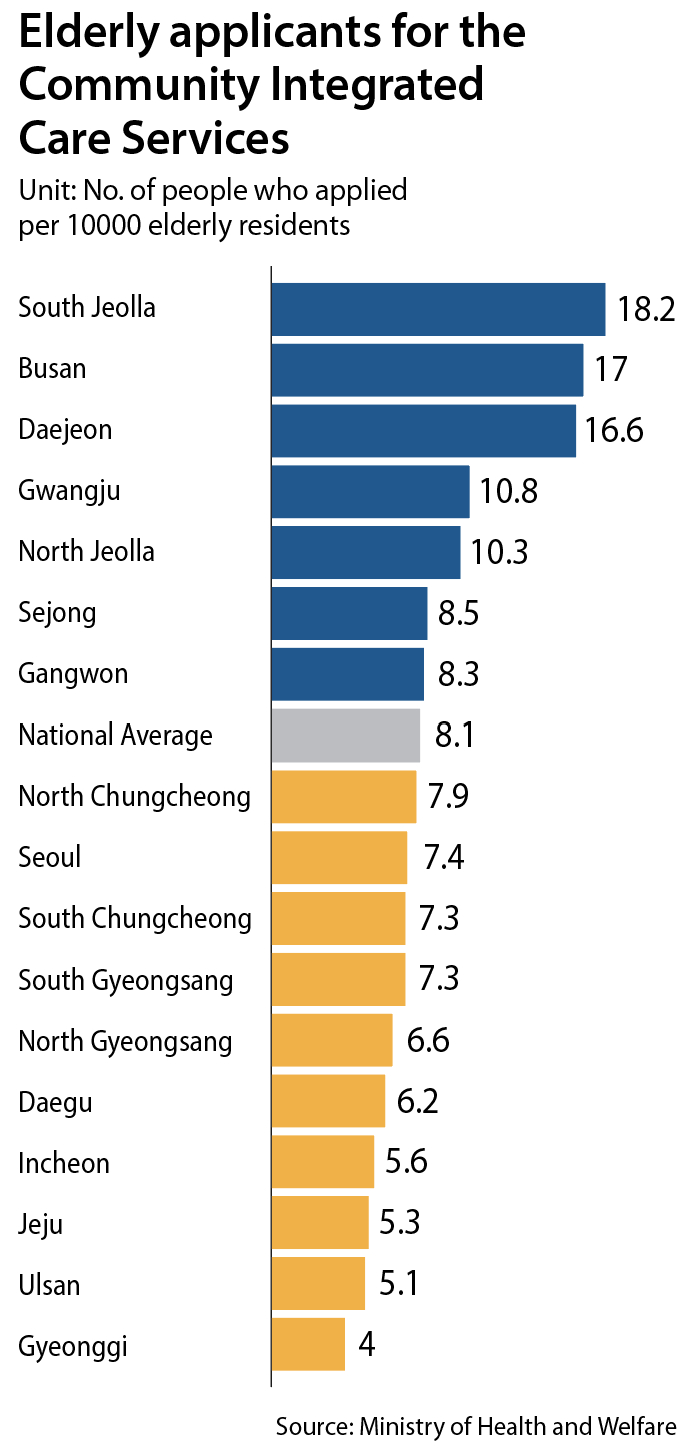
Older adults aged 65 and over made up nearly all applicants. Of the total, 8,799, or 98.8 percent, were older adults, including 2,870 older adults with disabilities.
By contrast, only 106 applicants, or 1.2 percent, were disabled people younger than 65, including those with conditions such as brain lesions and physical disabilities. Outside Seoul, Busan, Gyeonggi and South Jeolla, every other province or major city recorded single-digit applicant numbers. Of all applicants, 279 were patients discharged from one of 964 partner hospitals and linked to services in their communities.
A total of 3,250 applicants have been approved for service connections so far, including those who applied during the pilot program. Among the 8,905 people who applied after the full rollout began, 643 have been matched with services. It usually takes about one to two months from application to being linked to a medical service.
Recipients are expected to receive an average of 3.3 services each. Daily living support accounted for the largest share at 42.8 percent, including housekeeping help, mobility assistance, meal support and in-home barber and beauty services.
![A poster for the new community-based integrated care program is seen at a community service center in Geuncheon District, southern Seoul, on March 27. [YONHAP]](https://koreaseafood.online/data/photo/2026/04/14/10d8af7a-7524-4a07-ab94-b128185c6818.jpg)
A poster for the new community-based integrated care program is seen at a community service center in Geuncheon District, southern Seoul, on March 27. [YONHAP]
The program still faces criticism for lacking staff, budget and other infrastructure.
Korea has designated 422 home medical care centers, which serve as key institutions for home visits. But three areas — Gijang County in Busan, Hongcheon County in Gangwon and Yecheon County in North Gyeongsang — are struggling to provide services due to staffing shortages and recruitment challenges. The ministry said it plans to open another round of applications in April and May to designate additional home medical care centers, including in those areas.
Integrated care for disabled people under 65 is available in only 102 administrative regions, highlighting wide regional disparities. The ministry said it plans to gradually expand coverage while encouraging more local governments that do not yet offer the service to join the program.
“As the program is still in its early stages, it is important to raise awareness of the system and stabilize operations in the field,” Health and Welfare Minister Jeong Eun-kyeong said. “The government will continue to strengthen support in the field, including by assigning dedicated personnel to local governments, while continuing outreach so the public can more easily understand and use the system.”
This article was originally written in Korean and translated by a bilingual reporter with the help of generative AI tools. It was then edited by a native English-speaking editor. All AI-assisted translations are reviewed and refined by our newsroom.
BY JUNG JONG-HOON [[email protected]]


with the Korea JoongAng Daily
To write comments, please log in to one of the accounts.
Standards Board Policy (0/250자)