

The F-4 visa is an easy shortcut to Korean residency. Unless you're a man.
Published: 10 Apr. 2026, 07:00
Updated: 10 Apr. 2026, 08:55
-

- PAIK JI-HWAN
- [email protected]
![Travelers walk through Incheon International Airport on March 19. [NEWS1]](https://koreaseafood.online/data/photo/2026/04/10/dd4af108-3755-46c1-84e9-4ae3ee3a9d39.jpg)
Travelers walk through Incheon International Airport on March 19. [NEWS1]
Foreigners coming to Korea to study, work or live often face a routine set of inconveniences.
These troubles can also affect Koreans who renounced their citizenship or individuals who are direct descendants of people who once held Korean nationality, who are not granted special privileges over other foreign nationals.
That is, until they apply for the F-4 visa, a shortcut to Korean residency permitting most forms of employment.
Unless you're a man.
For men who did not complete mandatory military service — despite being a citizen of another country — the visa may be entirely out of reach, at least for some time.
But how does eligibility differ for men who did not complete conscription?
Military catch
The F-4 visa is available to those who were once Korean citizens, as well as to their descendants of any generation, provided they can verify their lineage, according to the Ministry of Government Legislation.
Visa applicants must submit documents such as a family relationship certificate, documents verifying the reasons for and the date of acquisition of foreign nationality by both the applicant and their direct ancestor.
The visa allows recipients to work in Korea for up to three years, with an extension required if they wish to remain longer. The number of visa holders has gradually increased, growing from 372,533 in 2016 to 555,968 in 2024.
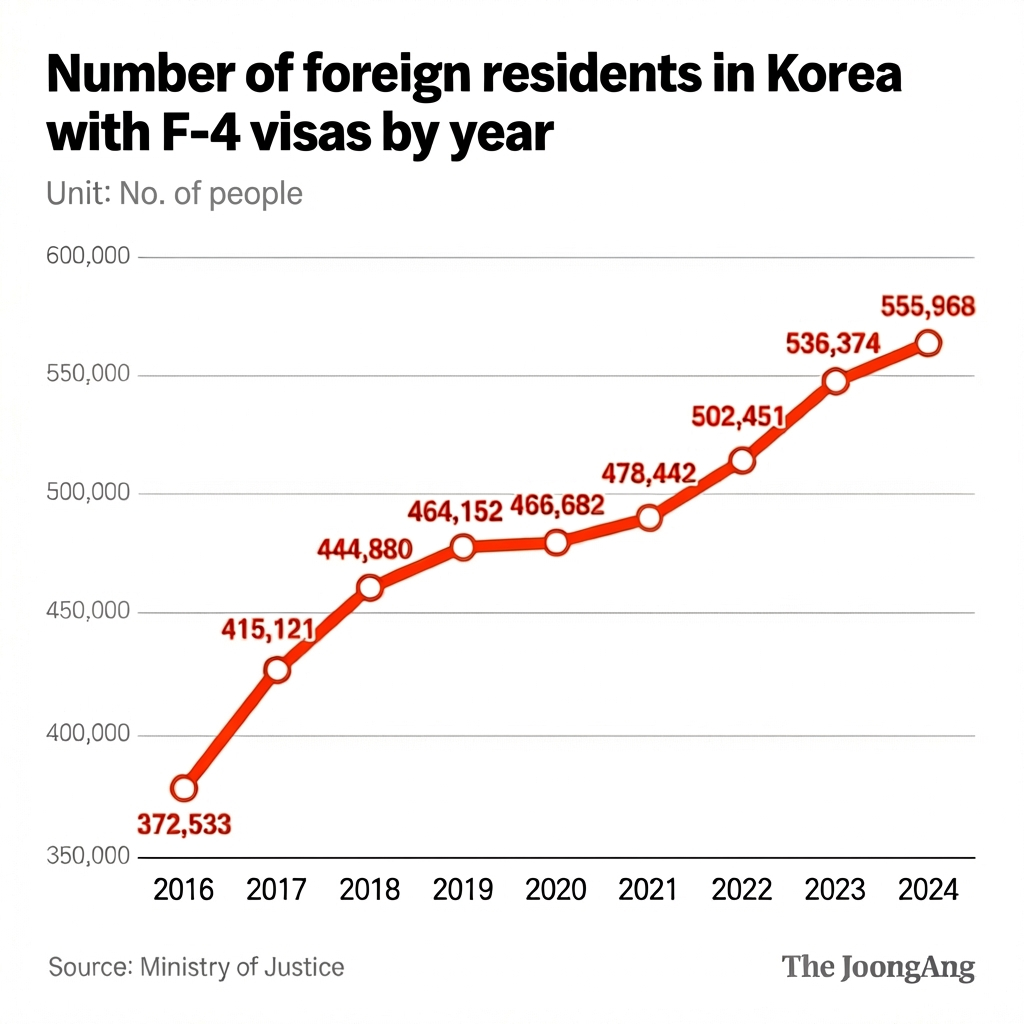
The recipients are allowed to work in a variety of fields, ranging from desk jobs to more specialized occupations, but unskilled labor such as washing dishes at a restaurant or delivering food is generally off-limits. However, an exception exists for those living in areas with declining populations.
The ease of acquisition, however, comes with a caveat: Men who do not serve in the military are ineligible, for the most part.
All able-bodied Korean men must serve in the military for 18 to 21 months as required by law. Those who renounced their citizenship, however, are exempt as citizens of another country.
That route comes with a cost for those hoping to spend an extended sojourn in Korea.
Article 5 of the Act on the Immigration and Legal Status of Overseas Koreans stipulates that the minister of justice shall not grant overseas Korean status to a Korean national with foreign nationality under certain conditions. These include cases in which a man becomes a foreign national by renouncing or losing Korean citizenship without having completed or been exempted from military service.
"Article 5 serves as the primary basis for determining overseas Korean status, and it does not set any requirement regarding the renunciation of nationality at a certain age," a Justice Ministry official told the Korea JoongAng Daily on Wednesday.
Thus, men who renounced their citizenship and do not serve in the military are ineligible for the visa unless they restore their Korean citizenship and fulfill military duties.
Military service required for restored citizens, but not for naturalized foreigners
Restoring Korean citizenship can also be an effective way to resolve all inconveniences that come with being a foreigner in Korea.
But that may not be an easy path for men, as those who do so must complete compulsory military service — required until they are 37 in the Korean traditional age system that considers people to be one year old at birth and adds one year on Jan. 1 regardless of an individual's actual birthday.
![Recruits salute during a basic training completion ceremony at a recruit training battalion in Imsil County, North Jeolla on March 18. [NEWS1]](https://koreaseafood.online/data/photo/2026/04/10/b1bd451c-e86e-4410-a3ec-5887ef6de340.jpg)
Recruits salute during a basic training completion ceremony at a recruit training battalion in Imsil County, North Jeolla on March 18. [NEWS1]
Those who restored their citizenship after the age of 37, however, are not subject to military duty.
“Under the current system, those who are 38 years old and above are exempt from the mandatory military service,” a Military Manpower Administration official told the Korea JoongAng Daily on Monday. “It could change with the new law, but that is how it is today.”
While these rules apply to overseas Koreans, those who were foreign nationals from birth and later naturalized in Korea are not subject to mandatory military service.
“Currently, foreign nationals who have naturalized can apply for a military service exemption through the Military Manpower Administration by submitting documents such as their naturalization approval or other proof of naturalization,” the Military Manpower Administration official said. “Through this process, they can receive an official exemption from military service.”
Renunciation of Korean citizenship continues
Renouncing Korean citizenship has long provided a legal way for men to avoid military service, which still continues today.
From 2021 to the end of August 2025, 18,434 men subject to military service — defined as those aged 18 or older — renounced their Korean nationality, according to the Military Manpower Administration.
Most went on to obtain citizenship in the United States, which accounted for 12,231 cases, followed by Canada with 2,282, Japan with 1,589, Australia with 821 and New Zealand with 516.
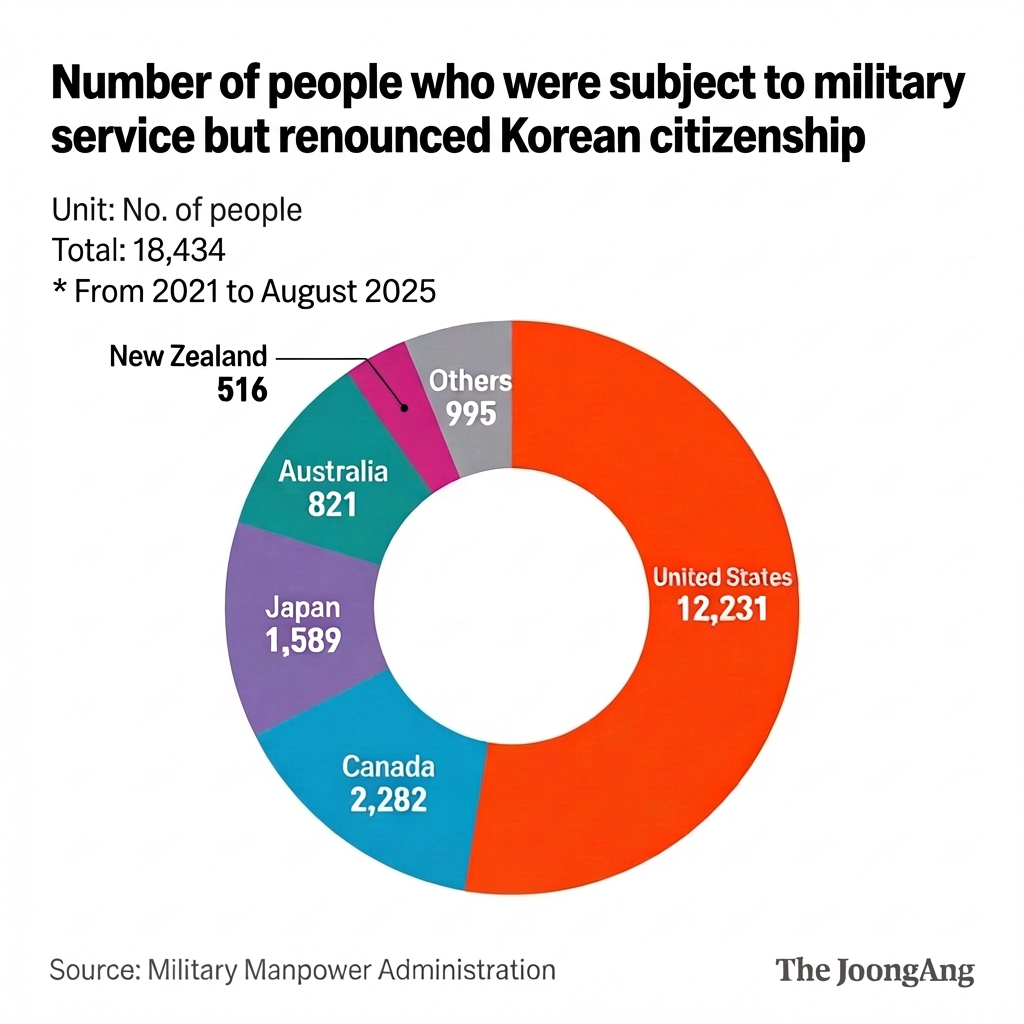
These cases are ineligible for the F-4 visa, as they fall under the category of men who become foreign nationals by renouncing or losing Korean citizenship without completing or being exempted from military service.
However, there is still a way for them to obtain the visa, as the law stipulates that the Minister of Justice may grant the F-4 visa starting Jan. 1 of the year the individual turns 41, even if they renounced Korean nationality without fulfilling or being exempted from military service.
The F-4 visa thus provides some support for holders, but for men, completion of military service can be a de facto requirement to receive the visa.
And if a man just wants to visit Korea, fear not: They can come on a tourist visa or through visa-free entry and stay for the permitted period without being subject to military conscription procedures.
BY PAIK JI-HWAN [[email protected]]


with the Korea JoongAng Daily
To write comments, please log in to one of the accounts.
Standards Board Policy (0/250자)