

With $36B sell-off in March, foreign investors wipe last year's inflow in 3 months
Published: 09 Apr. 2026, 18:38
Updated: 09 Apr. 2026, 19:08
![News of U.S. President Donald Trump’s address on the Iran war is shown in the dealing room of Hana Bank in central Seoul on April 2. [NEWS1]](https://koreaseafood.online/data/photo/2026/04/09/80d74a04-dbe2-45da-ac5d-0210e8ee17f5.jpg)
News of U.S. President Donald Trump’s address on the Iran war is shown in the dealing room of Hana Bank in central Seoul on April 2. [NEWS1]
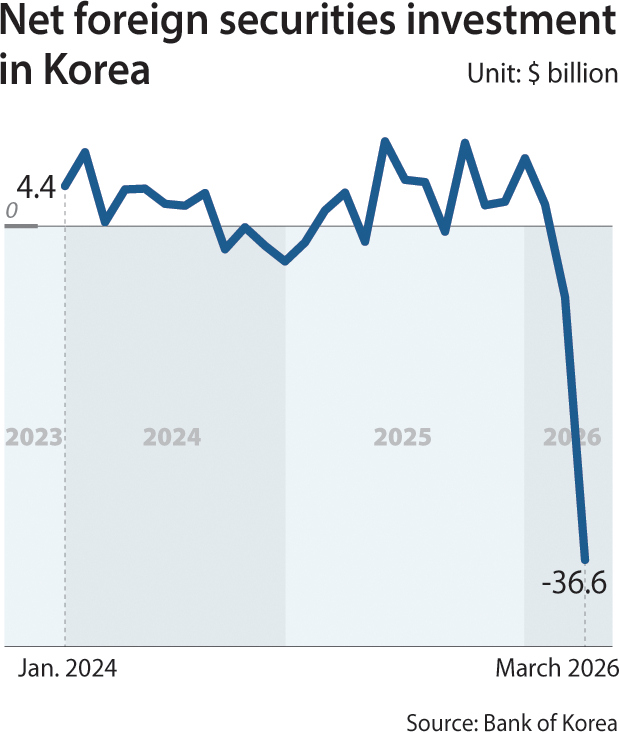
Foreign investors pulled a record $36.6 billion out of Korea’s securities markets last month, erasing last year's entire inflow in just three months while adding pressure on the Korean won and worsening volatility amid persistent instability.
The March figure is more than four times the $7.76 billion outflow in February and far exceeds the previous record of $8.97 billion set during the 2008 global financial crisis, according to a Bank of Korea report released Thursday.
Foreign portfolio investment shifted from a net inflow of $2.39 billion in January to an outflow in February, before accelerating into a sharp withdrawal in March. Cumulative net outflows for the first quarter reached $41.92 billion, effectively reversing nearly all of last year’s $42.06 billion net inflow in just three months.
In March alone, foreign investors sold $29.78 billion worth of stocks, driven by concerns about a market correction after strong gains in January and February, as well as weakened sentiment due to the military conflict in the Middle East. Stock investment has seen net outflows for three straight months this year, totaling $43.33 billion.
Bond investment also turned to the red. After six straight months of inflows, foreign investors pulled $6.77 billion from bonds in March, mainly due to maturing government bonds and a sharp drop in arbitrage opportunities.
The extra returns from short-term arbitrage — profits investors can earn even after hedging currency risks — fell sharply from 0.12 percent in February to just 0.01 percent in March.
The recent capital outflows further weakened the won against the dollar. The local currency weakened to a whopping 1,530.1 per dollar by the end of March, waning from 1,439.7 won at the end of February — a 4.3 percent decline and the steepest among major currencies in the global market.
The dollar strengthened 2.3 percent, but other major currencies weakened, including the yen by 2.2 percent, the euro by 1.8 percent and the pound by 1.3 percent.
“The rise in the exchange rate is the result of a combination of factors, including higher global oil prices and net foreign selling of domestic equities,” a Bank of Korea official said. “The pace of the increase has recently moderated as earlier expectations have been priced in.”
Despite market volatility, however, the overall conditions for securing foreign currency funding remain relatively stable. Short-term borrowing costs from abroad have changed little, while mid- to long-term costs have even declined, suggesting that Korea’s external credit conditions remain solid.
KIM WON [[email protected]]


with the Korea JoongAng Daily
To write comments, please log in to one of the accounts.
Standards Board Policy (0/250자)