

'Insufficient evidence': Frustration swells as police drop more cases, offer fewer explanations
Published: 06 Apr. 2026, 18:04
Audio report: written by reporters, read by AI
![The emblem of the National Police Agency [NEWS1]](https://koreaseafood.online/data/photo/2026/04/06/0c1f95c0-989c-4473-bd29-2deb4b425194.jpg)
The emblem of the National Police Agency [NEWS1]
Since gaining the power to close cases on their own, police are dropping a growing number of criminal complaints with little explanation, leaving victims with few avenues for redress.
One woman, who spoke to the JoongAng Ilbo on condition of anonymity, filed a complaint accusing an acquaintance of fraud after the person allegedly impersonated her to cancel an insurance policy and pocketed the refund while also selling luxury goods — including Chanel, Gucci and Louis Vuitton items — that had been entrusted to them.
The woman hired a lawyer and submitted evidence, including bank transfer records of the insurance payout and receipts for the luxury purchases. But in June of last year, police told her they had declined to forward the case to the prosecution, citing a lack of evidence.
The written notice from the police simply read, “This is to inform you that the case will not be forwarded to the prosecution due to insufficient evidence.” The woman said she was not informed whether an investigation had taken place or how the evidence was lacking.
Another person interviewed by the JoongAng Ilbo said investigators conducted a single interview with her after she filed a police complaint accusing a hospital employee of sexually assaulting her in an elevator. Investigators also closed her case without further investigation.
The notice she received, which included a grammatical error, stated only that investigators found it “difficult to conclude that the suspect’s statement is false.”
![Police sent a woman who had filed a criminal complaint of fraud against an acquaintance this one-line notice that her case had been dropped on account of "insufficient evidence." [JOONGANG ILBO]](https://koreaseafood.online/data/photo/2026/04/06/635c3c17-fc79-45fb-b923-feb9c2da71d4.jpg)
Police sent a woman who had filed a criminal complaint of fraud against an acquaintance this one-line notice that her case had been dropped on account of "insufficient evidence." [JOONGANG ILBO]
The two criminal complaints are part of a growing number of cases that have not been forwarded to the prosecution since a 2021 reform granted police the authority to close cases independently.
The number of such cases increased from 379,821 in 2021 to 594,060 last year. While objections to the closures have risen in absolute terms, their proportion relative to the total number of cases has declined.
Under the previous system, all cases were forwarded to prosecutors, who could review police findings. Now, cases are only sent to prosecutors if the complainant files an objection after their case is dropped.
“Investigators should explain whether evidence is lacking or whether the case fails to meet legal criteria,” attorney Kim Sang-gyun at the law firm Taeyul told the JoongAng Ilbo. “Without such clarification, complainants are left with a frustrating conclusion of ‘insufficient evidence.’”
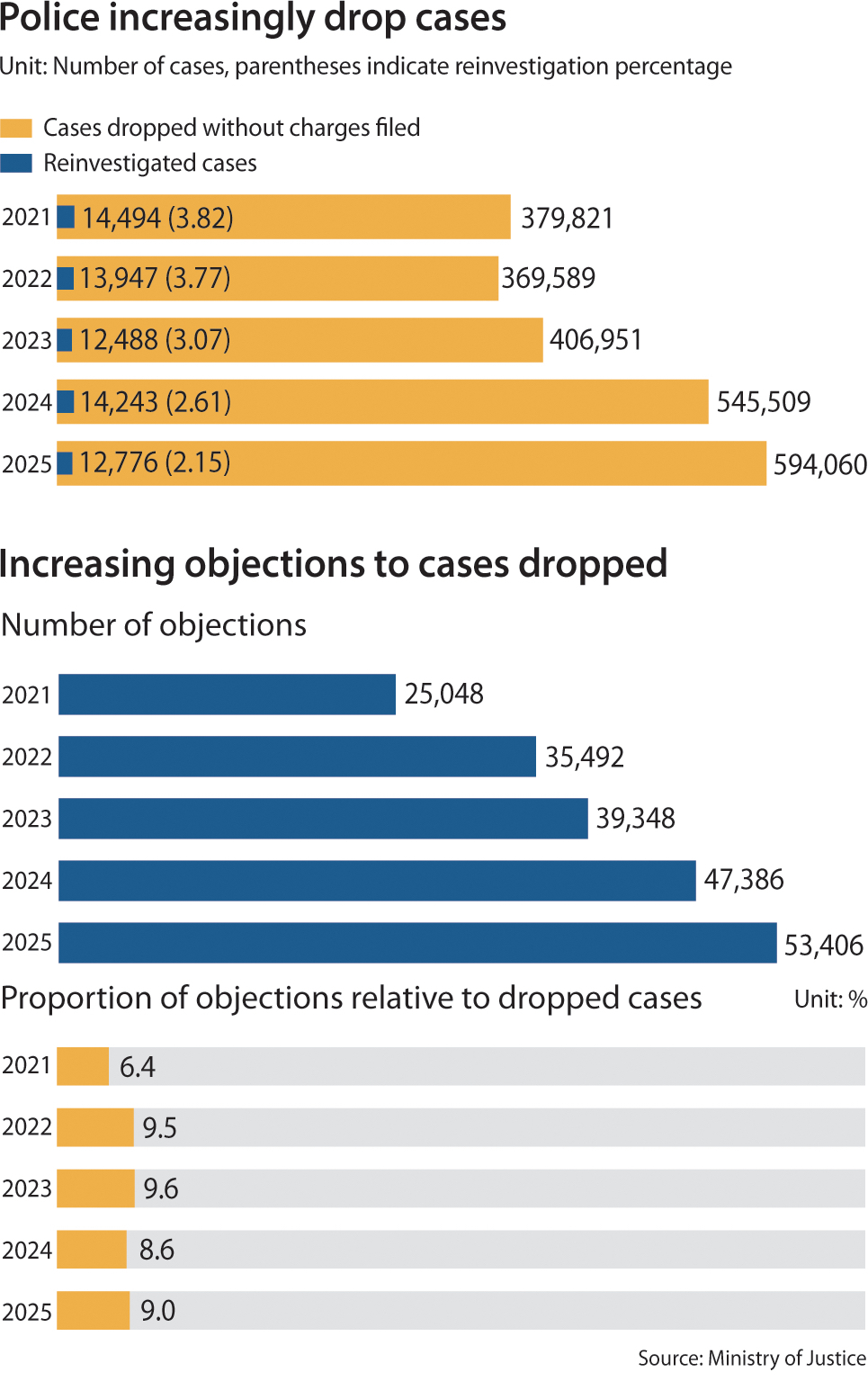
When police decline to forward a case, records are sent to prosecutors, who can request that the police investigate further within 90 days. But critics say this mechanism rarely functions effectively, as prosecutors are already overwhelmed with pending cases.
The proportion of cases in which prosecutors requested reinvestigation has declined from 3.82 percent in 2021 to 2.15 percent last year.
While prosecutors once bore responsibility for deciding how far a case progresses, many are now terminated once police decline to refer them to prosecutors. Such cases are also not assigned numbers by prosecutors, meaning they are not formally treated as criminal incidents.
“There is now a widespread perception that nonreferrals are matters that have already been closed by the police,” a senior prosecutor in the Seoul metropolitan area told the JoongAng Ilbo on condition of anonymity.
![The headquarters of the Supreme Prosecutors' Office in Seocho District, southern Seoul, as photographed on March 24. [NEWS1]](https://koreaseafood.online/data/photo/2026/04/06/4fb97e0c-43f3-462d-9ebd-de43a35be841.jpg)
The headquarters of the Supreme Prosecutors' Office in Seocho District, southern Seoul, as photographed on March 24. [NEWS1]
An advisory panel is currently reviewing whether to restore the previous system in which all cases are forwarded to prosecutors.
Park Chan-woon, a law professor at Hanyang University who recently stepped down as head of the panel, said management of investigations “would become even more difficult” if the prosecution service is abolished in line with calls from some quarters of the ruling Democratic Party.
“No investigative body can be perfect,” said Kim Ye-won, a lawyer at a disability rights center. “The previous system allowed a second review when police found no wrongdoing. If prosecutorial oversight is further reduced, it will become even harder to check police decisions.”
This article was originally written in Korean and translated by a bilingual reporter with the help of generative AI tools. It was then edited by a native English-speaking editor. All AI-assisted translations are reviewed and refined by our newsroom.
BY JEONG JIN-HO,SUK GYEONG-MIN [[email protected]]


with the Korea JoongAng Daily
To write comments, please log in to one of the accounts.
Standards Board Policy (0/250자)