

What we know so far about the 26 Korean ships stranded in the Strait of Hormuz
Published: 02 Apr. 2026, 19:31
-

- SARAH CHEA
- [email protected]
Audio report: written by reporters, read by AI
![A map showing the Strait of Hormuz is seen in an illustration [REUTERS/YONHAP]](https://koreaseafood.online/data/photo/2026/04/02/c6f2969f-caa4-4678-bbd6-28a7f5d0c6d4.jpg)
A map showing the Strait of Hormuz is seen in an illustration [REUTERS/YONHAP]
[EXPLAINER]
The outbreak of the Iran war has left the fate of 26 Korean-flagged vessels stranded in the Strait of Hormuz uncertain as cease-fire talks drag on more than a month into the conflict.
Many of the Korean ships carrying crude oil and goods such as cars have ties to the United States and are therefore subject to scrutiny by Iran. Even as the possibility of a cease-fire is raised, developments in the Strait of Hormuz appear to be unfolding on a separate track, increasing the likelihood that Iran will continue to exert control over the waterway — including by imposing transit fees.
No serious harm to the crew has been reported so far, though some are said to be suffering from trauma after witnessing airstrikes unfold at close range. But the financial toll is mounting, with each isolated vessel reportedly incurring costs of up to $1.43 million per day.
Q. How are Korean ships and crews faring in the Strait of Hormuz?
A total of 26 Korean–flagged vessels remain stranded in the Strait of Hormuz, carrying some 600 crew members, including 136 Korean nationals.
An additional 37 Koreans are aboard 11 foreign-flagged ships, bringing the total number of stranded Korean nationals in the waterway to 173.
Of the 26 ships, 16 are operated by nine major shipping companies, while eight smaller firms operate the remaining 10. Five of the ships are owned by HMM, the country’s largest shipping line.
Seven are very large crude carriers (VLCCs), along with a mix of petrochemical tankers, bulk carriers, container ships and car carriers, carrying a broad spectrum of industrial essentials, including crude oil, petrochemicals, fertilizers, steel and ammonia.
While countries such as Japan, Indonesia and Thailand have secured safe passage for their vessels through separate negotiations with Iran, Korea has refrained from pursuing bilateral talks, maintaining a cautious stance given its ties with the United States.
![Iranian Ambassador to Korea Saeed Koozechi speaks during a discussion session in Yeongdeungpo District, western Seoul, on April 1. [YONHAP]](https://koreaseafood.online/data/photo/2026/04/02/171f2144-f7af-49ff-a7cd-9d7826012b83.jpg)
Iranian Ambassador to Korea Saeed Koozechi speaks during a discussion session in Yeongdeungpo District, western Seoul, on April 1. [YONHAP]
Q. What is Iran’s stance?
Although Tehran labels Korea a “nonhostile” nation, not a single Korean‑flagged vessel has succeeded in exiting the Strait of Hormuz since the blockade.
Iran has previously warned that it barred ships from countries it considers hostile — or allied with the United States and Israel — from transiting the waterway. Yet on March 26, Iranian Ambassador to Korea Saeed Koozechi told the Korean press that Korea is “nonhostile,” suggesting that the current blockade is linked to Korea’s extensive trade ties with the United States.
Koozechi also said Iran is detaining ships belonging to Saudi Arabia’s Aramco, the world’s largest oil company, citing its collaboration with U.S. oil firms behind its growth, at an interview with Maeil Business Newspaper on Wednesday.
Korea imported a record 174.89 million barrels of crude oil from the United States last year, making it its second-largest supplier after Saudi Arabia, with imports valued at $12.88 billion, according to data from the Korea National Oil Corporation.
With crude oil supplies disrupted by the Strait of Hormuz blockade, Korea is seeking to expand imports of U.S. oil as an alternative source.
In refined fuels such as jet fuel, Korea is the United States’ top source, with a roughly 70 percent share due to the technical demands of refining fuel for aircraft operating at high altitudes and low temperatures. If Korea can’t source crude from the Middle East, where it relies on around 70 percent of its total imports, it could disrupt jet fuel supplies in the United States.
Q. What are the projected economic losses from the stranded vessels?
Exact figures are difficult to determine, but the Korea Shipowners’ Association estimates that the 26 stranded Korean vessels are collectively losing over $1.43 million per day.
Fixed capital costs alone — including charter fees and loan repayments — amount to a collective $630,000 per day, while war-risk insurance premiums run $560,000, and fuel costs are $150,000. The crew's hazard pay stands at $79,000 per day, and provisions such as food and essentials cost $11,000 per day.
“With operations halted, revenue has effectively disappeared, while war-risk insurance has surged 1,100 percent and low-sulfur fuel prices have jumped 227 percent, pushing shipping companies’ financial burdens to the brink,” said Yang Chang-ho, the standing director of the Korea Shipowners’ Association.
“The total daily losses from vessel detention amount to $1.43 million, translating to some 17.4 billion won monthly,” Yang added. “For smaller shipping companies, these costs threaten their very survival.”
![A Thai cargo ship that was hit by a missile in the Strait of Hormuz [EPA/YONHAP]](https://koreaseafood.online/data/photo/2026/04/02/d78ba611-9613-4576-87d8-9de031869ebd.jpg)
A Thai cargo ship that was hit by a missile in the Strait of Hormuz [EPA/YONHAP]
Q. Iran reportedly plans to levy transit fees — what would be the impact?
Even if Korea decides to pay the transit fees, the annual cost for its refiners alone would exceed $700 million.
Bloomberg reported on Wednesday that Iran has drafted a scheme to charge tankers roughly $1 per barrel, following the approval of related regulations by the Iranian parliament’s National Security Committee on March 30. Payments are expected to be settled in renminbi or stablecoins.
Under the plan, shipping operators must submit detailed information, including vessel ownership, cargo and destination, through brokers linked to the Islamic Revolutionary Guard Corps.
Iranian authorities will review the data to screen for connections to adversaries such as the United States or Israel, and only ships that pass this review will be permitted to transit. Iran is also reportedly considering a tiered system, ranking countries from one to five and offering more favorable conditions to allied nations.
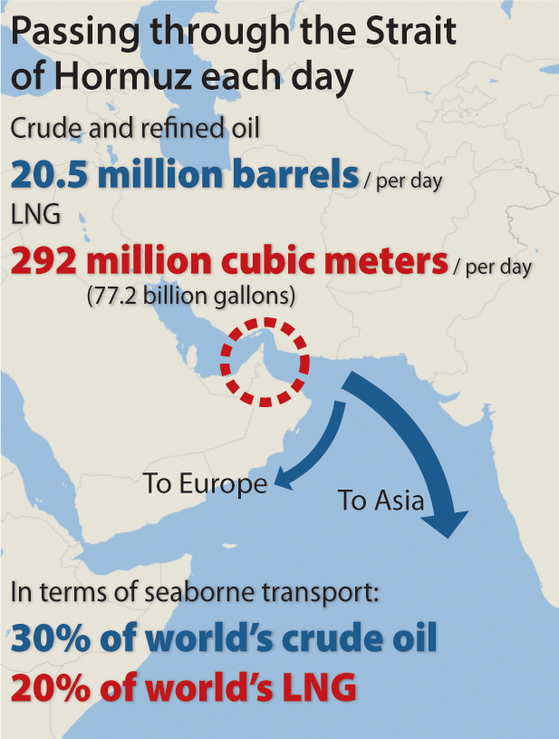
For large crude carriers with an average load of about 2 million barrels, fees could reach roughly $2 million per ship. The Strait of Hormuz channels roughly 20 percent of the world’s seaborne oil and liquefied natural gas (LNG), with about 20 million barrels of oil products passing through daily.
Korea imports roughly 700 million barrels of Middle Eastern crude annually via the strait, requiring at least 350 tankers.
Even a simple calculation suggests that Korea’s four major refiners could face annual transit costs of $700 million, with LNG shipping fees adding an estimated $200 million every year.
That said, the presidential office on Thursday afternoon dismissed as “groundless” local media reports that Korea is cautiously considering paying transit fees, saying the matter is "not under consideration."
“The government maintains that, in accordance with relevant international norms, freedom of navigation and safety for all vessels — including our own — must be ensured in the Strait of Hormuz, and that the global energy supply should be normalized as swiftly as possible,” the presidential office said.
![Tankers were anchored off the coast of Muscat, Oman, after Iran’s blockade of the Strait of Hormuz, on March 7. [REUTERS/YONHAP]](https://koreaseafood.online/data/photo/2026/04/02/cbfd3ab5-cfd1-4cd0-ac80-4e66906b2744.jpg)
Tankers were anchored off the coast of Muscat, Oman, after Iran’s blockade of the Strait of Hormuz, on March 7. [REUTERS/YONHAP]
Q. How is Korea trying to recover the 26 stranded vessels?
President Lee Jae Myung instructed the Ministries of Oceans and Fisheries and Foreign Affairs on April 1 to take all possible measures to secure the passage and to explore alternative routes, including transporting crude oil via the Red Sea.
Yet the Red Sea presents its own hazards, lying within the operational reach of Iran-aligned forces and Houthi rebels in Yemen.
Houthi Deputy Information Minister Mohammed Mansour warned that if Gulf States join U.S. or Israeli actions against Iran, the Houthis could block the Bab el-Mandeb Strait, a strategic chokepoint in the Red Sea, in an interview with Al-Monitor on Wednesday.
“Transporting crude oil through the Red Sea is virtually impossible without a diplomatic breakthrough, as the area is considered dangerous and effectively controlled by Houthi rebels,” said a source at a major shipbuilding company.
“For the past two and a half years, almost no Korean container ships have passed through. Bulk carriers and oil tankers also avoid the route unless absolutely necessary.”
BY SARAH CHEA, PARK EUN-JEE [[email protected]]


with the Korea JoongAng Daily
To write comments, please log in to one of the accounts.
Standards Board Policy (0/250자)