

Why Korea still lacks an antidiscrimination law
Published: 30 Mar. 2026, 07:00
Updated: 30 Mar. 2026, 13:00
-

- MICHAEL LEE
- [email protected]
Audio report: written by reporters, read by AI
![Participants in the 26th Seoul Queer Culture Festival carry a rainbow banner near Jonggak Station in Jongno District, central Seoul, on June 14, 2025. [NEWS1]](https://koreaseafood.online/data/photo/2026/03/30/25b86901-e40b-4e9f-9dde-1eeefc52bd96.jpg)
Participants in the 26th Seoul Queer Culture Festival carry a rainbow banner near Jonggak Station in Jongno District, central Seoul, on June 14, 2025. [NEWS1]
When 35-year-old accountant Choi Jung-hwan went out to Itaewon, a hub of gay nightlife in central Seoul, earlier this month, he thought he was just another face in the crowd.
But as Choi turned down a drunk stranger’s advances on the street, the man shouted at him, “I know where you work. I’m going to tell.”
Choi, who used a pseudonym in his interview with the Korea JoongAng Daily, recalled being filled with dread as he ran. “I didn’t know what would happen if that guy made good on his threat,” he said.
The ominous turn of Choi’s night out highlights the lack of legal safeguards against discrimination not only for LGBTQ individuals, but also for other minorities in Korea.
In most advanced economies, such protections are standard. But among members of the Organisation for Economic Cooperation and Development (OECD), only Korea and Japan lack a single overarching statute barring unequal treatment based on characteristics such as gender, disability, age, race, nationality, religion and sexual orientation in areas including employment, education and public services.
Although lawmakers from two minor liberal parties in Korea submitted separate antidiscrimination bills for consideration by the National Assembly earlier this year, both evoked a strong sense of déjà vu.
The bills are the latest in two decades of legislative proposals that have ultimately been shelved without ever being put to a vote.
In Korea, antidiscrimination bills have been repeatedly introduced for consideration by the legislature since 2007, only to falter and expire before reaching the chamber floor. The reasons lie in an interplay of political caution, social division and the way such legislation has been framed in public debate.
A familiar bill
The two antidiscrimination bills submitted by Rep. Sohn Sol of the liberal Jinbo Party and Rep. Jeong Chun-saeng of the liberal Rebuilding Korea Party both follow the broad contours of earlier proposals in that they not only enumerate protected categories but also define discriminatory conduct and establish mechanisms for redress.
At their core, however, the bills are meant to do something more fundamental: replace a patchwork of issue-specific protections with a unified framework.
“Because current laws treat both the grounds and areas of discrimination separately, it is difficult to address intersectional discrimination, where multiple factors overlap,” Rep. Sohn told the Korea JoongAng Daily.
She noted that the absence of a single comprehensive statute defining what constitutes discrimination and hate crimes has made it “difficult to respond effectively” to incidents such as rallies targeting specific nationalities.
An all-encompassing law, she said, is necessary “simply to establish clear standards for what counts as discrimination and hate in our society.”
She added that her draft bill reflects lessons from past failures to reach a full Assembly vote by clarifying definitions and emphasizing corrective measures over punitive ones.
Public opinion, divided by design

On its face, public opinion might appear to favor such a law. Polls that ask broad questions about discrimination tend to show strong support for a legal remedy.
But that apparent majority varies across surveys.
“Public opinion polling depends widely on how questions are framed,” said Kim Ji-kyung, gender equity commissioner at the National Union of Media Workers.
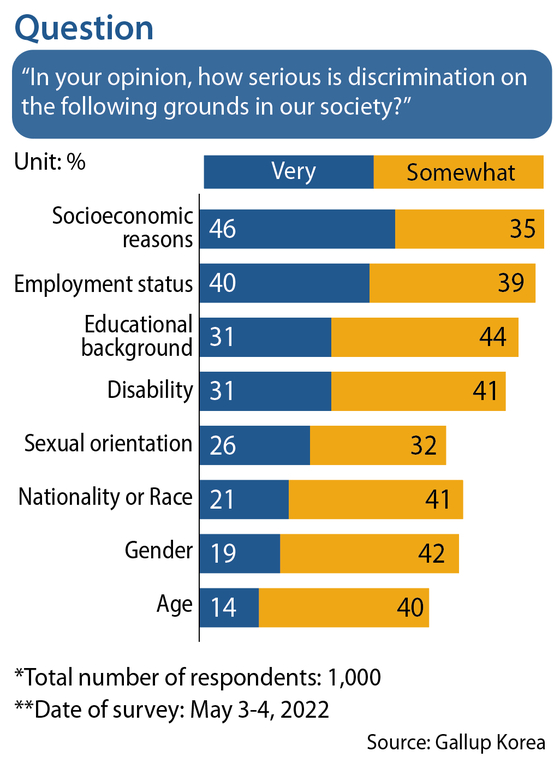
Kim noted this divergence in polling largely comes down to how questions are worded, adding that surveys commissioned by some Christian groups “are designed to draw respondents’ attention to groups that would be protected by antidiscrimination legislation.”
However, even the Gallup Korea survey also shows that Koreans do not believe discrimination is a serious problem for all groups. While 46 percent of respondents said that they believe socioeconomic discrimination is “very” serious, only 26 percent said the same of discrimination based on sexual orientation.
The politics of ‘social consensus’
If there is a single phrase that has come to define the impasse over antidiscrimination legislation, it is “social consensus.”
Politicians, including former President Moon Jae-in and high-profile lawmakers, have repeatedly argued that such bills should not be passed without broad public agreement.
However, Kim says she believes the so-called need for social consensus is actually “an excuse,” arguing that the real obstacle is a “lack of will” to expend political capital on the issue.
Part of that calculation is due to the closely contested nature of Korean elections, which leads politicians to tread carefully around issues that certain segments of the population feel strongly about.
“Given that elections are often decided by very small margins, even relatively small voting blocs can exert outsized influence,” Kim said. “Churches, in particular, function as highly mobilized communities. Lawmakers receive coordinated text messages and other forms of pressure, and some have spoken in interviews about the psychological burden this creates.”
According to Lee Jong-geol, the general director of the Korean gay human rights group Chingusai, sustained opposition to antidiscrimination legislation dates back to around 2007, when conservative Protestant groups picked up on the inclusion of “sexual orientation” as a protected category.
“Since then, the pattern of opposition has been consistent. Although the proposed law is meant to establish equality for everyone, these groups have repeatedly demanded that lawmakers remove LGBTQ people from all iterations of the bill,” he said.
Sohn described similar dynamics from inside the legislative process.
“The biggest reason for the lack of progress in the National Assembly is the harassment from some conservative Protestant groups whenever the law is brought up,” she said. “No matter how well-crafted the bill may be, the moment discussion begins, lawmakers are flooded with phone calls and text messages, and some are even named and shamed from church pulpits. Under those conditions, who would want to engage in debate?”
She further suggested that religious opposition to the law may be less monolithic than it appears. “There are Christians who have stood alongside me at press conferences and urged members of their community to support antidiscrimination legislation,” she noted.
Still, Sohn acknowledged that anxiety over potential blowback — particularly in the run-up to elections — has stalled past legislative efforts.
“The continuous cycle of local elections, general elections and presidential elections constantly generates concerns that voting outcomes might be influenced by backlash from certain regions or groups.”
However, Sohn argued that parties and lawmakers should be willing to break this pattern of postponement.
“This is not a law to be passed ‘when there is time.’ It is a fundamental issue of rights that must be addressed now.”
![People hold up placards with slogans opposing the passage of a comprehensive antidiscrimination legislation at a conservative rally in Gwangju on Nov. 29, 2025. [YONHAP]](https://koreaseafood.online/data/photo/2026/03/30/59dca66e-5551-4b40-ad5f-debe37ef576f.jpg)
People hold up placards with slogans opposing the passage of a comprehensive antidiscrimination legislation at a conservative rally in Gwangju on Nov. 29, 2025. [YONHAP]
Debate shaped by coverage
The way antidiscrimination legislation is presented in public discourse has also shaped its trajectory.
“When past bills were covered by the media, they were usually not presented as a broad framework of protections,” Kim observed. “Instead, they were often reduced to a narrower debate centered on a handful of contentious issues, such as sexual orientation.”
She added that some groups circulated misinformation and “unfounded interpretations” of past bills to whip up opposition.
Meanwhile, more recent proposals suffer from a lack of attention, in part because past bills have repeatedly failed.
“The media does not treat pending antidiscrimination legislation as a noteworthy topic because reporters think they have a sense of how these efforts are going to end,” Kim said. “These bills struggle to garner just enough cosponsors for submission. Without sustained media attention, the issue struggles to gain traction in public debate.”
To overcome pervasive apathy, Kim noted that some advocacy groups are now considering alternative means of forcing passage of antidiscrimination legislation, or at least securing piecemeal protections.
One is through the courts, the route activists in Taiwan used to successfully pursue the legalization of same-sex marriage in 2019.
Similar efforts in Korea resulted in a 2021 court decision that the discharge of a transgender soldier was unlawful, a 2022 ruling by the Supreme Court overturning the conviction of a conscripted soldier for consensual same-sex relations, and a 2024 Supreme Court ruling recognizing same-sex couples’ eligibility for spousal health insurance benefits.
![Participants in the 26th Seoul Queer Culture Festival hold up rainbow flags as they march up a road near Myeongdong Cathedral in Jung District, central Seoul, on June 14, 2025. [NEWS1]](https://koreaseafood.online/data/photo/2026/03/30/4e190dc1-d6ea-42e9-bc98-fdfa884dad57.jpg)
Participants in the 26th Seoul Queer Culture Festival hold up rainbow flags as they march up a road near Myeongdong Cathedral in Jung District, central Seoul, on June 14, 2025. [NEWS1]
An enduring cycle
For those directly affected, the consequences of the lack of antidiscrimination legislation in Korea are not abstract.
“LGBTQ people suffer in fear in everyday life, especially in the workplace,” Lee said, noting that being outed “usually entails seriously negative consequences” for a person’s personal and professional relationships.
That fear can have broader implications. Lee noted that during the Covid-19 cluster outbreak in Itaewon in May 2020, many people who went to clubs in the area were reluctant to get tested because they feared exposure of their identity. “This shows how discrimination can directly undermine public safety,” he said.
At its core, he added, the bill is about more than any single provision. “The antidiscrimination bill is, in many ways, symbolic. It represents a broader principle — whether the state is willing to pass a law that guarantees equality for all.”
He further argued that protections, or the lack thereof, cut both ways.
“Calls to remove LGBTQ people from the bill so that it might be passed do not resolve social conflict — they deepen it,” he said. “Such proposals effectively legitimize discrimination.”
BY MICHAEL LEE [[email protected]]


with the Korea JoongAng Daily
To write comments, please log in to one of the accounts.
Standards Board Policy (0/250자)