

Passengers rush to buy plane tickets before April’s steep fuel surcharges kick in
Published: 27 Mar. 2026, 18:40
-

- SARAH CHEA
- [email protected]
Audio report: written by reporters, read by AI
![Korean Air and Emirates planes are seen at Incheon International Airport on March 16. [YONHAP]](https://koreaseafood.online/data/photo/2026/03/27/3ff32ac1-f4d2-4971-a104-112762e68bb0.jpg)
Korean Air and Emirates planes are seen at Incheon International Airport on March 16. [YONHAP]
With the protracted Iran war disrupting jet fuel supply, fuel surcharges at Korean airlines are set to triple, which could add as much as 400,000 won ($270) to the cost of a round-trip ticket.
Some flights have already been canceled, and airlines are announcing across-the-board reductions in operations.
Oil prices, closely intertwined with currency movements and acutely sensitive to geopolitical shocks, are expected to dampen demand for long-haul routes, thereby compounding financial pressures on airlines over the longer term.
Heavier tickets, bigger bills
Korean Air recently spiked its fuel surcharges on tickets issued from April, with one-way fees for its longest-haul routes — those exceeding 6,500 miles, including Incheon to New York and Toronto — climbing more than three-fold from 99,900 won in March to 303,000 won.
That means each passenger will have to pay an additional 400,000 won for a round-trip ticket. For a family of four, that translates into an additional burden of up to 1.6 million won for the trip.
On most European routes, including London, Paris and Frankfurt, surcharges will jump from 79,500 won to 276,000 won, while even fees for short routes, under 499 miles, such as Fukuoka in Japan and Qingdao in China, will rise from 13,500 won to 42,000 won.
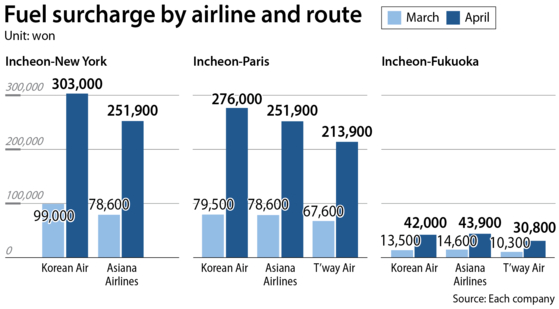
Asiana Airlines also hiked its surcharge for a ticket to New York from 78,600 won to 251,900 won, while its Fukuoka route saw fees jump from 14,600 won to 43,900 won.
“After the fuel surcharge announcement, ticket inquiries are on the rise, but mainly on short-haul routes rather than long-haul ones,” said a source at one of Korea’s major airlines.
“A fuel surcharge doesn’t fully offset all of the rising oil prices,” they continued. “If this trend continues, surcharges will climb even higher in May, and if it drags on, it becomes truly perilous.”
Set every month, fuel surcharges are additional fees imposed by airlines to offset losses stemming from rising oil prices, which account for roughly 30 percent of total airfare prices.
These surcharges are calculated based on the average price of Singapore jet fuel, which uses a 33-tier pricing system. That price has surged to Level 18 between Feb. 16 and March 15 from Level 6 in the previous month — an increase of 12 levels in just a month, marking the steepest monthly jump since the current pricing mechanism was introduced in 2016. Even during the sharp run-up in oil prices following the Russia-Ukraine war in 2022, the index only climbed by eight levels over three months.
![Exchange rate information for currencies such as the U.S. dollar and Japanese yen is displayed at a currency exchange counter at the Incheon International Airport on March 25. [NEWS1]](https://koreaseafood.online/data/photo/2026/03/27/47f886b2-af1d-48b2-9524-38d503a36344.jpg)
Exchange rate information for currencies such as the U.S. dollar and Japanese yen is displayed at a currency exchange counter at the Incheon International Airport on March 25. [NEWS1]
Korean Air uses around 30 million barrels of jet fuel every year and each $1 increase in the price of oil translates into roughly 45 billion won in additional annual costs.
Fuel surcharges on Air Premia’s New York routes, priced in U.S. dollars, will jump from $57 this month to $194 next month. On T’way Air’s Paris flights, surcharges will rise from 67,600 won to 213,900 won. Air Busan and Jin Air have also increased fuel surcharges on their Incheon–Fukuoka routes by more than three-fold.
The surge in fuel surcharges among Korean carriers is far steeper than that at foreign airlines, largely due to Korea’s heavy reliance on Middle Eastern crude.
Airlines such as Thai Airways and United Airlines have responded not with separate surcharges but by raising base fares by roughly 5 to 20 percent. Carriers without fuel surcharges, like Air France and KLM, have increased long-haul ticket prices by about 50 euros ($58).
“Once oil prices rise, they rarely come down quickly, and it takes even longer for those increases to be reflected in airfares, which inevitably forces fuel surcharges to climb gradually,” said Professor Lee Hwi-young at the Department of Airline Service Management at Inha Technical College.
“Oil prices are closely linked to exchange rates, and a stronger won tends to dampen travelers’ willingness to spend,” Lee added. “While demand for long-haul routes is plunging, the absolute volume of short-haul travel isn’t increasing, which will hit airlines’ profitability over the long term.”
![Planes from several of Korea's airlines are seen at Incheon International Airport. [YONHAP]](https://koreaseafood.online/data/photo/2026/03/27/a96e08c0-cbc9-40b7-80f2-cb55af4a392e.jpg)
Planes from several of Korea's airlines are seen at Incheon International Airport. [YONHAP]
Flights canceled, airlines squeezed
Airlines struggling to stay afloat — mostly budget carriers that offer tickets at lower prices — have already begun to suspend or reduce flights.
Eastar Jet said it will fully suspend around 50 flights on the Incheon–Phu Quoc route from May 5 through the end of the month. Air Premia has also canceled several North American routes, including 26 Incheon–Los Angeles flights, six Incheon–Honolulu flights, eight Incheon–San Francisco flights, and two New York departures. These long-haul routes had been marquee offerings for the airline, highlighting the severity of the cuts.
Aero K will suspend four routes from Cheongju to Ibaraki, Narita, Clark, and Ulaanbaatar between April and June, while Air Busan will halt three routes from Busan to Da Nang, Cebu and Guam in April.
Jeju Air, the country’s largest low-cost carrier (LCC), is currently reviewing whether additional Southeast Asian routes should be canceled. T’way Air, in addition to cutting routes, is raising excess baggage fees in an attempt to offset losses.
![A Korean Air plane takes off from Incheon International Airport on March 15 [YONHAP]](https://koreaseafood.online/data/photo/2026/03/27/93681ff6-dc9c-4b4c-bb85-8bca18e783a5.jpg)
A Korean Air plane takes off from Incheon International Airport on March 15 [YONHAP]
The core challenge rests with Korea's two leading carriers, Korean Air and Asiana Airlines, which, as they undergo integration, remain bound by a regulatory mandate forbidding any reduction in seat capacity, compelling them to shoulder the full financial impact even as market conditions deteriorate. The Fair Trade Commission (FTC) imposed a stringent condition for them not to shrink seat supply to less than 90 percent of 2019 levels when approving their merger.
“In these extraordinary circumstances, such as the current war, the FTC could temporarily relax these restrictions,” said Prof. Lee.
On March 25, Asiana declared an emergency management system to “review the cost structure across all divisions and strengthen an operational focus centered on profitability.”
This came after T’way Air, Korea’s second-largest LCC, became the first in the industry to declare an emergency management plan on March 16, citing the ongoing war and rising fuel costs.
BY SARAH CHEA [[email protected]]


with the Korea JoongAng Daily
To write comments, please log in to one of the accounts.
Standards Board Policy (0/250자)