

SeMA director Choi Eun-ju balances autonomy, uniqueness with eight branches
Published: 26 Mar. 2026, 07:00
Updated: 31 Mar. 2026, 17:47
-
- LEE JIAN
- [email protected]
Audio report: written by reporters, read by AI
[INTERVIEW]
![Seoul Museum of Art Director Choi Eun-ju poses in front of the newly-opened Seo-Seoul Museum of Art in Geumcheon District, southern Seoul, on March 13. [PARK SANG-MOON]](https://koreaseafood.online/data/photo/2026/03/31/c874f922-9fe7-4819-9318-ccf31cb319c5.jpg)
Running one museum is demanding. So imagine what it's like for Choi Eun-ju, the director of the Seoul Museum of Art (SeMA), who runs eight.
With the opening of the Seo-Seoul Museum of Art in Geumcheon District, southern Seoul, earlier this month, the Seoul Metropolitan Government has completed its yearslong project to build an eight-branch network of museums across the capital.
The first SeMA was founded in 1988 and moved to its current location next to the Deoksu Palace in Jung District, central Seoul, in 2002, occupying a former Supreme Court building dating back to 1928.
The six others are the Seoul Museum of Art, also in Jung District; Buk SeMA in Nowon District, northern Seoul; Nam SeMA in Gwanak District, eastern Seoul; AA (Art Archives) SeMA in Jongno District, central Seoul; Photo SeMA in Dobong District, northern Seoul; Nanji Residency SeMA in Mapo District, western Seoul; and Paik Ground SeMA in Jongno District.
In 2026, SeMA plans to stage 39 exhibitions across the eight venues, alongside 634 educational programs with a total curatorial and research staff of 50. The institution as a whole employs about 250 people and is supported by an annual operating budget of approximately 30 to 40 billion won ($20 to 27 million).
In charge of all of this is Choi.
"Many people, especially from abroad, ask if I am the only director of all SeMA facilities," she said. "And then they ask, ‘How is that possible?’"
Whether the question is driven by curiosity or concern, Choi is unfazed.
“Of course, there have been many twists and turns, and a number of policy decisions along the way. But yes, it is possible, and it’s being received very positively. I believe we have completed a system that other museums don’t have," she told the Korea JoongAng Daily in an interview at the Seo-Seoul Museum of Art on March 13.
Choi studied Western painting at Seoul National University and later earned advanced degrees in art theory and education. She has held senior roles at the National Museum of Modern and Contemporary Art, as well as director positions at the Gyeonggi Museum of Modern Art and the Daegu Art Museum.
Since her SeMA appointment in March 2023, she has overseen the opening of three new branches, including the Art Archives Seoul Museum of Art and the Photography Seoul Museum of Art.
“And now, we’ve opened this museum in Seo-Seoul. It is the first public art museum to open in the southwest region of Seoul. I feel truly proud,” she said.
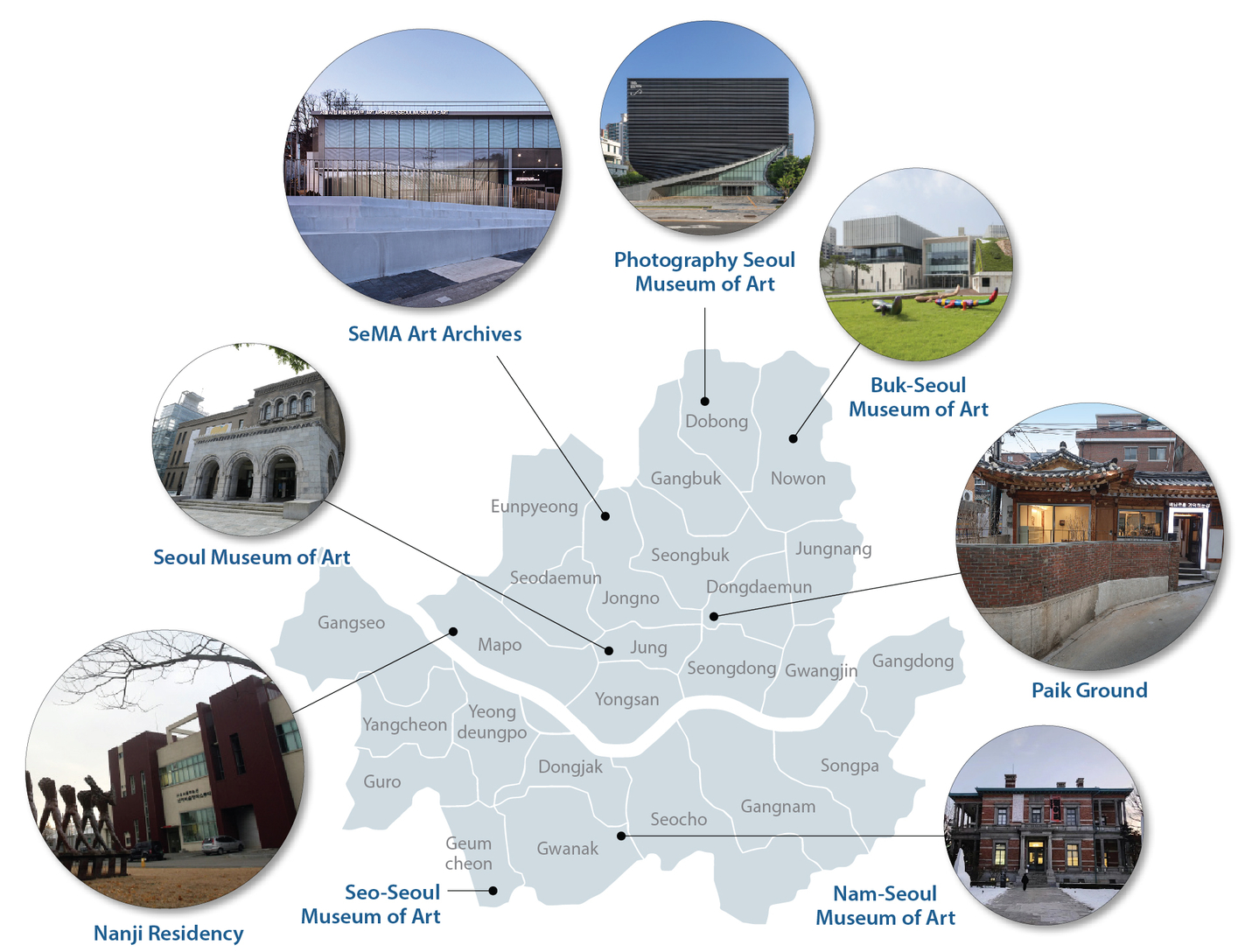
But the goal wasn’t only expansion in a geographical sense. Choi wanted to build a system that offers the public not just widespread access but also a greater variety of contemporary art.
“We wanted the museums linked but not overlapping,” she said. “If location were the only difference, exhibitions across the main building and branches could easily become similar over time. Contemporary art tends to follow certain directions and trends, so exhibitions can start to look alike.”
So instead, each branch has a distinct area or discipline of focus. Photo SeMA, for instance, curates shows on photography and video. Nam-Seoul SeMA concentrates on modern sculpture. Art Archives SeMA operates as a research- and materials-based institution. The newly opened Seo-Seoul Museum is dedicated to new media and interdisciplinary practices, the first public institution to center its program on these fields.
Another benefit of a network structure is the ability to collaborate across branches, said Choi. A recent exhibition at Photo SeMA, for instance, drew a large portion of its exhibit from the main SeMA museum’s collection to explore how fine art artists in the 1960s and 1970s used photography as an experimental medium, reframing familiar works through the lens of a completely different discipline.
“Each branch operates with its own autonomy and specialization, while still being unified under the umbrella of SeMA as a single institution,” Choi said. “This kind of museum structure is unique in Korea and rare even on a global scale.”
Maintaining that balance requires a “rigorous and at times, tedious” but necessary process, said Choi. One of the first changes she made since she stepped in as SeMA director was introducing a new exhibition planning system to replace what was a more informal, top-down approach.
Today, curators present proposals several times a year, often in day-long meetings. “The risk of a purely democratic process,” she said, “is that you end up with exhibitions that are not bad, but not particularly distinctive either.”
Her role, she explained, is to push ideas further, sometimes combining, expanding and refining them until they become something sharper.
A large consideration when planning these exhibitions is the younger generation, but getting them through the door is no longer the issue.
“Gen Zs come to galleries as if they were dropping by their own homes. The same goes for museums,” Choi said. “There’s been a generational shift. We used to work hard to bring people in, but that era is over. Now the question is: What kinds of experiences can museums offer to those who come of their own accord?”
![The exterior of the newly-opened Seo-Seoul Museum of Art in Geumcheon District, southern Seoul [SEO-SEOUL MUSEUM OF ART]](https://koreaseafood.online/data/photo/2026/03/31/9ad4bd7a-073f-4eef-a1c0-f8655dd80e4d.jpg)
This has led to changes in exhibition design itself. Increasingly, works invite physical engagement, interaction and participation. Performances, installations and educational programs blur the boundary between viewer and participant.
Yet even as attendance rises, challenges remain. Costs have surged dramatically and many museums are struggling with funding. Last year, for instance, the Van Gogh Museum in Amsterdam said it was considering closure after the Dutch government declined to provide 2.5 million euros ($2.9 million) annually for essential upgrades and sustainability measures. In the United States, roughly one-third of all museums have lost government grants or contracts since U.S. President Donald Trump took office, according to a survey released last year by the American Alliance of Museums.
SeMA, though not suffering from a decrease in government funding over the past years, still struggles to make ends meet. “Ten years ago, a domestic exhibition could be organized with around 100 million won. Now it’s 300 to 500 million,” Choi said, citing the introduction of artist fees, as well as increased transportation and labor costs. “International exhibitions can reach up to 2 or 3 billion won.”
“That said, the Seoul Museum of Art is supported by a very dedicated patrons’ group,” added Choi. SeMA also relies in part on sponsorships, including in-kind support. The 2023 Seoul Mediacity Biennale, for instance, involved around 20 sponsors.
Another ongoing tension — both in Korea and globally — is the question of censorship, and SeMA isn’t immune to that either.
In June 2025, controversy arose after the museum excluded a critic’s text containing commentary on the Dec. 3 martial law situation from an exhibition catalogue. The decision sparked accusations of censorship, with critics arguing that a public institution had restricted artistic expression that diverged from government or municipal positions. The issue quickly escalated into collective statements and public forums within the art community. The museum released an official statement denying censorship, saying it was a misunderstanding.
“Does artistic freedom automatically equate to censorship when conflicts arise?” Choi said. “That’s something that requires careful thought.”
She emphasized that such disputes often stem from differing interpretations of rights and responsibilities. While creators hold copyright, institutions also retain production and editorial rights — frameworks that are typically defined through prior agreements.
“These kinds of tensions can always occur,” she said. “And they will continue to be debated.”
BY LEE JIAN [[email protected]]
Seoul Museum of Art Director Choi Eun-ju poses in front of the newly-opened Seo-Seoul Museum of Art in Geumcheon District, southern Seoul, on March 13. [PARK SANG-MOON]
Running one museum is demanding. So imagine what it's like for Choi Eun-ju, the director of the Seoul Museum of Art (SeMA), who runs eight.
With the opening of the Seo-Seoul Museum of Art in Geumcheon District, southern Seoul, earlier this month, the Seoul Metropolitan Government has completed its yearslong project to build an eight-branch network of museums across the capital.
The first SeMA was founded in 1988 and moved to its current location next to the Deoksu Palace in Jung District, central Seoul, in 2002, occupying a former Supreme Court building dating back to 1928.
The six others are the Seoul Museum of Art, also in Jung District; Buk SeMA in Nowon District, northern Seoul; Nam SeMA in Gwanak District, eastern Seoul; AA (Art Archives) SeMA in Jongno District, central Seoul; Photo SeMA in Dobong District, northern Seoul; Nanji Residency SeMA in Mapo District, western Seoul; and Paik Ground SeMA in Jongno District.
In 2026, SeMA plans to stage 39 exhibitions across the eight venues, alongside 634 educational programs with a total curatorial and research staff of 50. The institution as a whole employs about 250 people and is supported by an annual operating budget of approximately 30 to 40 billion won ($20 to 27 million).
In charge of all of this is Choi.
"Many people, especially from abroad, ask if I am the only director of all SeMA facilities," she said. "And then they ask, ‘How is that possible?’"
Whether the question is driven by curiosity or concern, Choi is unfazed.
“Of course, there have been many twists and turns, and a number of policy decisions along the way. But yes, it is possible, and it’s being received very positively. I believe we have completed a system that other museums don’t have," she told the Korea JoongAng Daily in an interview at the Seo-Seoul Museum of Art on March 13.
Choi studied Western painting at Seoul National University and later earned advanced degrees in art theory and education. She has held senior roles at the National Museum of Modern and Contemporary Art, as well as director positions at the Gyeonggi Museum of Modern Art and the Daegu Art Museum.
Since her SeMA appointment in March 2023, she has overseen the opening of three new branches, including the Art Archives Seoul Museum of Art and the Photography Seoul Museum of Art.
“And now, we’ve opened this museum in Seo-Seoul. It is the first public art museum to open in the southwest region of Seoul. I feel truly proud,” she said.
But the goal wasn’t only expansion in a geographical sense. Choi wanted to build a system that offers the public not just widespread access but also a greater variety of contemporary art.
“We wanted the museums linked but not overlapping,” she said. “If location were the only difference, exhibitions across the main building and branches could easily become similar over time. Contemporary art tends to follow certain directions and trends, so exhibitions can start to look alike.”
So instead, each branch has a distinct area or discipline of focus. Photo SeMA, for instance, curates shows on photography and video. Nam-Seoul SeMA concentrates on modern sculpture. Art Archives SeMA operates as a research- and materials-based institution. The newly opened Seo-Seoul Museum is dedicated to new media and interdisciplinary practices, the first public institution to center its program on these fields.
Another benefit of a network structure is the ability to collaborate across branches, said Choi. A recent exhibition at Photo SeMA, for instance, drew a large portion of its exhibit from the main SeMA museum’s collection to explore how fine art artists in the 1960s and 1970s used photography as an experimental medium, reframing familiar works through the lens of a completely different discipline.
“Each branch operates with its own autonomy and specialization, while still being unified under the umbrella of SeMA as a single institution,” Choi said. “This kind of museum structure is unique in Korea and rare even on a global scale.”
Maintaining that balance requires a “rigorous and at times, tedious” but necessary process, said Choi. One of the first changes she made since she stepped in as SeMA director was introducing a new exhibition planning system to replace what was a more informal, top-down approach.
Today, curators present proposals several times a year, often in day-long meetings. “The risk of a purely democratic process,” she said, “is that you end up with exhibitions that are not bad, but not particularly distinctive either.”
Her role, she explained, is to push ideas further, sometimes combining, expanding and refining them until they become something sharper.
A large consideration when planning these exhibitions is the younger generation, but getting them through the door is no longer the issue.
“Gen Zs come to galleries as if they were dropping by their own homes. The same goes for museums,” Choi said. “There’s been a generational shift. We used to work hard to bring people in, but that era is over. Now the question is: What kinds of experiences can museums offer to those who come of their own accord?”
The exterior of the newly-opened Seo-Seoul Museum of Art in Geumcheon District, southern Seoul [SEO-SEOUL MUSEUM OF ART]
This has led to changes in exhibition design itself. Increasingly, works invite physical engagement, interaction and participation. Performances, installations and educational programs blur the boundary between viewer and participant.
Yet even as attendance rises, challenges remain. Costs have surged dramatically and many museums are struggling with funding. Last year, for instance, the Van Gogh Museum in Amsterdam said it was considering closure after the Dutch government declined to provide 2.5 million euros ($2.9 million) annually for essential upgrades and sustainability measures. In the United States, roughly one-third of all museums have lost government grants or contracts since U.S. President Donald Trump took office, according to a survey released last year by the American Alliance of Museums.
SeMA, though not suffering from a decrease in government funding over the past years, still struggles to make ends meet. “Ten years ago, a domestic exhibition could be organized with around 100 million won. Now it’s 300 to 500 million,” Choi said, citing the introduction of artist fees, as well as increased transportation and labor costs. “International exhibitions can reach up to 2 or 3 billion won.”
“That said, the Seoul Museum of Art is supported by a very dedicated patrons’ group,” added Choi. SeMA also relies in part on sponsorships, including in-kind support. The 2023 Seoul Mediacity Biennale, for instance, involved around 20 sponsors.
Another ongoing tension — both in Korea and globally — is the question of censorship, and SeMA isn’t immune to that either.
In June 2025, controversy arose after the museum excluded a critic’s text containing commentary on the Dec. 3 martial law situation from an exhibition catalogue. The decision sparked accusations of censorship, with critics arguing that a public institution had restricted artistic expression that diverged from government or municipal positions. The issue quickly escalated into collective statements and public forums within the art community. The museum released an official statement denying censorship, saying it was a misunderstanding.
“Does artistic freedom automatically equate to censorship when conflicts arise?” Choi said. “That’s something that requires careful thought.”
She emphasized that such disputes often stem from differing interpretations of rights and responsibilities. While creators hold copyright, institutions also retain production and editorial rights — frameworks that are typically defined through prior agreements.
“These kinds of tensions can always occur,” she said. “And they will continue to be debated.”
BY LEE JIAN [[email protected]]


with the Korea JoongAng Daily
To write comments, please log in to one of the accounts.
Standards Board Policy (0/250자)