

Rollout of KF-21 Boramae fighter jet marks long-awaited milestone for Korean defense industry
Published: 25 Mar. 2026, 14:42
Updated: 25 Mar. 2026, 17:03
-

- CHO YONG-JUN
- [email protected]
![President Lee Jae Myung speaks in front of the KF-21 at the launch ceremony of the fighter jet on March 25 at the Korea Aerospace Industries headquarters in Sacheon, South Gyeongsang. [NEWS1]](https://koreaseafood.online/data/photo/2026/03/25/c79807a7-b15b-4069-b7fe-f09ffa3850e4.jpg)
President Lee Jae Myung speaks in front of the KF-21 at the launch ceremony of the fighter jet on March 25 at the Korea Aerospace Industries headquarters in Sacheon, South Gyeongsang. [NEWS1]
The first production unit of the KF-21 Boramae rolled out of the factory on Wednesday, more than two decades after Korea first decided to make a fighter jet built with homegrown technologies.
"Our fighter jet, which will protect our skies with our own strength, is finally ready for deployment," President Lee Jae Myung said during the KF-21's official launch ceremony at the Korea Aerospace Industries (KAI) headquarters in Sacheon, South Gyeongsang, on Wednesday.
Lee said the KF-21 finally gives Korea weapons that "protect peace with our own technology and will" on land, sea and now the skies.
![The KF-21 fighter jet at the launching ceremony on March 25 at the Korea Aerospace Industries headquarters in Sacheon, South Gyeongsang. [JOINT PRESS CORPS]](https://koreaseafood.online/data/photo/2026/03/25/78d83b45-5d26-454f-a91f-b6efff22ce71.jpg)
The KF-21 fighter jet at the launching ceremony on March 25 at the Korea Aerospace Industries headquarters in Sacheon, South Gyeongsang. [JOINT PRESS CORPS]
The mass production of the supersonic fighter developed by the Korea Aerospace Industries (KAI) not only marks a triumph for the Korean defense and aviation industry but also introduces a new, formidable and price-competitive export item.
With the president attending the ceremony, the KF-21’s official debut represented a moment of massive domestic pride. But for everyone outside Korea, the true significance of the new fighter jet comes down to its place in the global market, filling the missing middle gap.
"The success of the KF-21 means more than just a strengthening of our national defense; it signifies that Korea has secured a new driving force to compete proudly with the world's leading defense powerhouses," the president said, adding that the KF-21's "outstanding performance, low maintenance costs and scalability of the platform" resulted in "immense interest" from other countries.
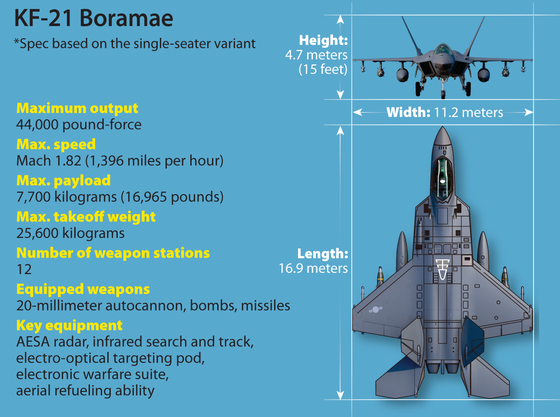
The aircraft, developed as a 4.5-generation fighter, positions itself as the “medium” fighter platform — less powerful but notably cheaper than the fifth-generation stealth fighters like the American F-35, while vastly outperforming the light and trainer jets like the FA-50. The aircraft's airframe is also explicitly designed to be fully stealth-compatible with future upgrades.
![The KF-21 fighter jet at the launching ceremony on March 25 at the Korea Aerospace Industries headquarters in Sacheon, South Gyeongsang. [NEWS1]](https://koreaseafood.online/data/photo/2026/03/25/5ee04c2d-8295-4375-9410-07fbbdab2289.jpg)
The KF-21 fighter jet at the launching ceremony on March 25 at the Korea Aerospace Industries headquarters in Sacheon, South Gyeongsang. [NEWS1]
The journey of the KF-21 development was arduous, if not risky. The concept of building a jet fighter with indigenous technologies was first officially proposed in 2001 by then-President Kim Dae-jung, to replace the F-5 fighter jets developed in the United States in the 1950s.
Korea had just finished developing the T-50 Golden Eagle, a supersonic trainer jet, but developing a fully-fledged fighter jet was another story. Early on, the Korea Development Institute reported that developing a fighter jet was infeasible, as it was much cheaper to purchase jet fighters from overseas manufacturers.
Korea’s solution was to bring in a joint development partner, Indonesia, to help fund the program. Jakarta initially agreed to fund 20 percent of the fighter jet development process — then code-named KF-X — in exchange for prototype models, technology transfers and production rights in Indonesia.
This partnership also turned out to be anything but smooth. Jakarta and Seoul squabbled, fueled by the Southeast Asian nation’s decision to push back the payment and instead sign deals to purchase France’s Rafale and Turkey’s yet-to-be-developed Kaan fighter jets.
![The KF-21 on a test flight in 2025 [REPULIC OF KOREA KOREAN AIR FORCE]](https://koreaseafood.online/data/photo/2026/03/25/c6df1596-d28e-4644-9373-d453342b6a1b.jpg)
The KF-21 on a test flight in 2025 [REPULIC OF KOREA KOREAN AIR FORCE]
KAI and the Agency for Defense Development soldiered on regardless, and Indonesia is expected to sign a deal to import 16 KF-21 fighter jets, down from 48, during the Indonesian president’s visit to Korea in late March.
The domestic significance of the KF-21 is that its development enabled the Korean defense industry to master technologies that the United States and other nations have traditionally been reluctant to share.
Notably, the KF-21 is fitted with a Hanwha Systems-developed active electronically scanned array (AESA) radar, a technology Washington previously denied transferring to Seoul. The AESA radar allows the aircraft to detect and track multiple targets simultaneously.
The early batches of the KF-21 are expected to have a localization rate of up to 65 percent — higher than the sub-50 percent recorded in the first production of the TA-50. Seoul hopes to increase the rate to 80 percent, with the engine being the only major part based on U.S. technology.
With the mass production of the 40 KF-21 Batch-I fighter jets officially commencing, Korea and KAI are now in full force to hit the export market. KAI had already previously exported the T-50 Golden Eagle and the FA-50 Fighting Eagle to Poland, Indonesia, Malaysia, the Philippines and Thailand. The KF-21 serves as a tempting option for nations that cannot purchase fifth-generation fighters from the United States for geopolitical reasons, while for nations already utilizing KAI’s FA-50, it offers an upgrade path that minimizes the hassle of switching.
The United Arab Emirates signed a letter of intent regarding the KF-21 last April, with the Gulf state's deputy defense minister even sitting in the back seat of a KF-21 prototype during his visit to Sacheon. Abu Dhabi's interest is echoed by neighboring Saudi Arabia, which has recently shown tremendous interest in co-developing future iterations of the jet to build its own domestic aerospace ecosystem.
Beyond the Middle East, nations like Peru and Poland are also closely monitoring the KF-21 as a highly capable and one that doesn't require Washington's strict approval.
The KF-21 will be fitted with integrated air-to-ground attacking capabilities for batches beginning in early 2027 — effectively, a Block-II upgrade — followed by the planned Batch-III.
The Batch-III, also known as the KF-21EX, is still in the early stages of development but is expected to be equipped with fully-fledged stealth capabilities, making the jet fighter comparable to the fifth-generation fighters of other nations.
"We will not rest here and continue to invest and support to ensure the continuous growth of our industry," President Lee said.
![The KF-21 during its development phase [KOREA AEROSPACE INDUSTRIES]](https://koreaseafood.online/data/photo/2026/03/25/f1a52625-089a-4c9a-b0ba-1c6e7077553d.jpg)
The KF-21 during its development phase [KOREA AEROSPACE INDUSTRIES]
BY CHO YONG-JUN [[email protected]]


with the Korea JoongAng Daily
To write comments, please log in to one of the accounts.
Standards Board Policy (0/250자)