

‘Roller Kospi’: Iran war sends Korea’s market on a meme-fueled ride
-

- SARAH CHEA
- [email protected]
![A meme featuring Samsung Electronics Executive Chairman Lee Jae-yong, front, and SK Chairman Chey Tae-won speeding away in a car, with the "I’ll be back — just wait a little" serving as a tongue-in-cheek signal for investors to offload falling stocks. [SCREEN CAPTURE]](https://koreaseafood.online/data/photo/2026/03/18/48455477-d391-4b9b-af98-5ae173b18da1.jpg)
A meme featuring Samsung Electronics Executive Chairman Lee Jae-yong, front, and SK Chairman Chey Tae-won speeding away in a car, with the "I’ll be back — just wait a little" serving as a tongue-in-cheek signal for investors to offload falling stocks. [SCREEN CAPTURE]
As Korea’s stock market fluctuates amid the Iran war — rollercoastering wildly in an unusually volatile pattern — the turmoil has become fodder for memes circulating across online communities.
From memes comparing the plunging Kospi with the shape of the Strait of Hormuz to posts lampooning the country’s corporate titans, the online satire captures the anxiety of retail investors who piled into the market, some even with borrowed money.
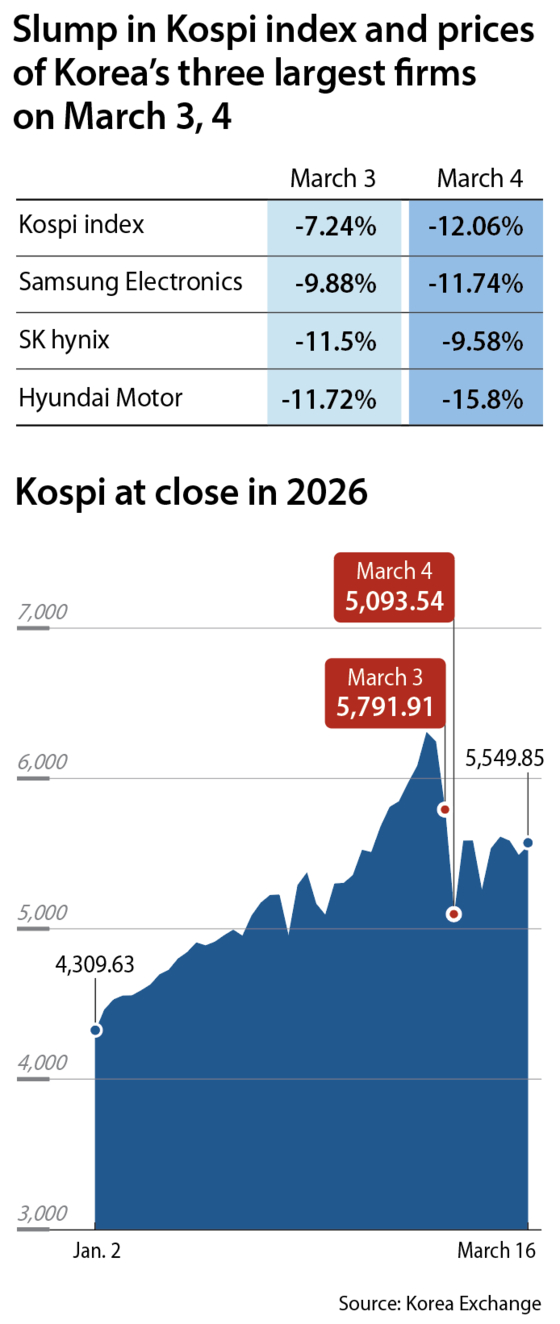
The benchmark bourse, which enjoyed a heyday as it surged to a record high of around 6,300 in late February, had suffered a sharp dip due to the war and hovered around 5,500 as of Tuesday. On March 3 and 4, right after the start of the war, the Kospi lost about 1 quadrillion won ($670 billion) in value, dragging the index down into the 5,000 range.
The nosedive stood in stark contrast to other global markets. The NYSE Composite Index fell only 0.35 percent on March 2 and 1.77 percent on March 3, immediately after the outbreak of war, before rebounding 0.38 percent on March 4. The Nasdaq Composite showed similar resilience, rising 0.36 percent on March 2 and then dipping only 1.02 percent on March 3.
Japan’s Nikkei 225 also experienced an initial drop of 2.27 percent on the day following the conflict, but recovered 0.94 percent the next day.
![On Reddit, a viral meme compares the plunging Kospi chart to the narrow shape of the Strait of Hormuz, with users joking that “the Korean market is trading on the ‘Escape From the Strait of Hormuz’ chart." [SCREEN CAPTURE]](https://koreaseafood.online/data/photo/2026/03/18/f0e1df2c-10d0-40ec-b701-8326538f2272.jpg)
On Reddit, a viral meme compares the plunging Kospi chart to the narrow shape of the Strait of Hormuz, with users joking that “the Korean market is trading on the ‘Escape From the Strait of Hormuz’ chart." [SCREEN CAPTURE]
Memes chronicle Korea’s market madness
On Reddit, one viral meme based on a bar chart of the Kospi compares the steep plunge to the shape of the strategic Hormuz waterway, with users joking that “the Korean market is trading on the ‘Escape From the Strait of Hormuz’ chart.”
The chart tracks the dramatic trajectory of the index, which touched an intraday record of 6,347.41 on Feb. 27 before tumbling in the wake of the Iran war, sliding to 5,093.54 by March 4 after two days of steep losses.
Another widely shared “tycoon meme,” riffing on Korea’s most prominent corporate leaders, depicts Samsung Electronics Executive Chairman Lee Jae-yong and Chey Tae-won of SK Group and Hyundai Motor Group chief Euisun Chung speeding away in a car as war looms in the background, with captions like “I’ll be back — just wait a little,” while another depicts Lee positioned at the door of a helicopter with a parachute on his back as the tail rotor explodes, accompanied by the text “No time to explain, get out now,” a tongue-in-cheek signal for investors to dump their falling stocks.
In contrast, a similar meme features Hanwha Chairman Kim Seung-youn beckoning from a driver's seat with the line “No time to explain — get in” as shares of the conglomerate's defense subsidiaries surged amid the war.
One particularly popular clip shows a man sprinting after a bus he has just missed, only for the vehicle to explode moments later, symbolizing investors chasing a surging market, only to narrowly miss the sudden downturn. The video uses a scene from SBS’s "Stairway to Heaven" (2003-04) when the main character, played by Kwon Sang-woo, runs after a bus carrying his presumed-dead first love, portrayed by Choi Ji-woo.
Other widely circulated clips include footage of the late actor Lee Soon-jae from the documentary program "Human Theater" (2000-) in which he remarks, “It may be awkward for the person involved, but to a third party, it’s objectively amusing,” expressing the schadenfreude of some who felt they missed the Kospi's surge, only to dodge the perceived massive losses by retail investors who appear to be losing money at nearly every turn.
The ‘Roller Kospi’
Korea’s stock market — riding an unprecedented wave before the war — has since plunged with dizzying speed, transforming into what traders now call the world’s most extreme roller coaster, or the “Roller Kospi.”
The bourse, which closed at 2,698.97 on June 2 of last year, the last trading session before President Lee Jae Myung took office, surged to blow past the 5,000 mark for the first time in intraday trading on Jan. 22, improbably realizing his campaign promise of a "Kospi 5000 era" in just six months.
The rally continued unabated as the index crossed 6,000 on Feb. 25 and climbed to an all-time intraday high of 6,347.41 two days later.
But the reversal was swift. In the first two trading days after the outbreak of war — March 3 and 4 — the benchmark tumbled sharply, closing at 5,093.54 on March 4 before stabilizing around the 5,500 level. Over those two days, roughly 1.07 quadrillion won in market capitalization evaporated across the combined Kospi and Kosdaq markets.
![A post says Korea's stock market lost about 1 quadrillion won ($670 billion) in market value just in two days on March 3 and 4, right after the start of the Iran war. [SCREEN CAPTURE]](https://koreaseafood.online/data/photo/2026/03/18/2273a1fd-684e-4f97-a0a0-6a48d3a3221e.jpg)
A post says Korea's stock market lost about 1 quadrillion won ($670 billion) in market value just in two days on March 3 and 4, right after the start of the Iran war. [SCREEN CAPTURE]
Shares of Samsung Electronics — the country’s largest company by market cap — soared by nearly 300 percent from 56,800 won on June 2 to a record of 218,000 won on Feb. 26, only to plunge more than 20 percent over the two days, wiping about 262 trillion won from the company’s market value.
SK hynix fell more than 20 percent over the two days, erasing roughly 141.8 trillion won in market cap, while Hyundai Motor lost about 35.4 trillion won in value over the same period.
The combined losses for the three largest firms accounted for 41.1 percent of the total decline in market value across the entire Korean stock market.
The most severe damage came on March 4, when the Kospi plunged 12.06 percent to close at 5,093.54 — the largest one-day drop in both points and percentage terms in Korea’s history, even beating the fallout from the September 11 attacks, when the index fell 12.02 percent on Sept. 12, 2001.
So far this year, eight sidecars — five-minute halts to program trading — have been activated during trading, including five on the sell side and three on the buy side. Marketwide circuit breakers, which stop trading of all stocks for 20 minutes, have been activated twice.
The number of activations of the volatility interruption system, which pauses trading for a specific security for roughly two minutes, reached 3,314 from March 3 to 6, averaging 828.5 per day, an incredible increase from the daily averages of just 134.3 logged in January and 183.4 in February.
![A meme of Hanwha Group Chairman Kim Seung-youn with the phrase “No time to explain — get in” as shares of Hanwha’s defense-related subsidiaries surged amid the war. [SCREEN CAPTURE]](https://koreaseafood.online/data/photo/2026/03/18/9ac54fba-a012-4ef6-9c41-de9d397d9c73.jpg)
A meme of Hanwha Group Chairman Kim Seung-youn with the phrase “No time to explain — get in” as shares of Hanwha’s defense-related subsidiaries surged amid the war. [SCREEN CAPTURE]
Investing, or a speculative frenzy?
The violent swings, experts say, are being driven largely by retail investors — often referred to in Korea as “ants” — even as institutions and foreign investors rush to offload Korean shares.
The average daily trading value on the Kospi has exceeded 40 trillion won in March, while the turnover, a measure of how frequently shares change hands, has also climbed above 2 percent, a sign that short-term trading is dominating the market.
Retail investors snapped up a net 18.33 trillion won worth of shares on Kospi solely this month through Monday, while foreign investors sold a net 14.17 trillion won and institutional investors unloaded about 5.04 trillion won.
Samsung Electronics has taken a particularly sharp hit, with foreign investors dumping roughly a net 22.28 trillion won worth of shares from February through Monday. The retreat has pushed the company's foreign ownership ratio down to 49.68 percent as of Monday, below 50 percent for the first time in about eight months.
Retail investors, by contrast, purchased about 15.33 trillion won worth of Samsung shares over the same period.
Hana Securities said the recent sell-off by foreign investors appeared “unusually sensitive compared to historical benchmarks,” adding that global investors may have been using the highly liquid Kospi market as “a convenient hedging vehicle” in the midst of extreme risk aversion triggered by the Middle East conflict.
“From the standpoint of emotional synchronization, the current situation can be explained by the strong herd mentality often observed among Koreans, particularly during periods of economic uncertainty,” said psychology professor Lim Myung-ho of Dankook University.
“FOMO — the fear of missing out — has become pervasive, and people feel they cannot be the only ones left behind while others are making money, and that collective impulse is fueling this unusual phenomenon.”
BY SARAH CHEA [[email protected]]


with the Korea JoongAng Daily
To write comments, please log in to one of the accounts.
Standards Board Policy (0/250자)